By: Elizabeth Nunn, Katie Alves, Lucy Karyagina, and Paola Madrigal
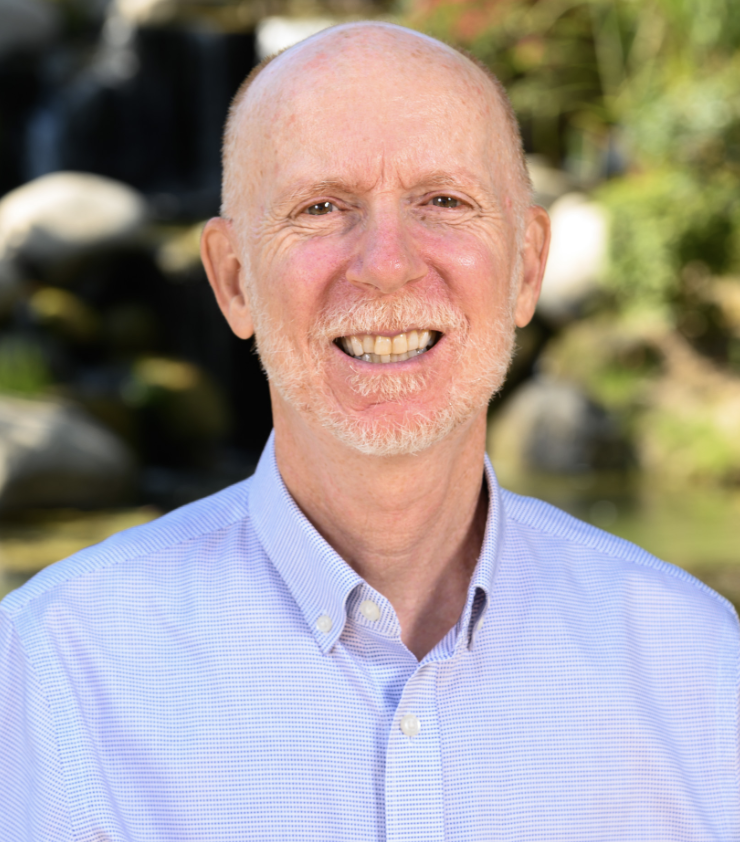
Frank Russell, courtesy of CSUF
Our group was given the privilege of speaking with Dr. Frank Russell surrounding his published research work “Twitter and News Gatekeeping: Interactivity, reciprocity, and promotion in news organizations’ tweets.” Frank Russell is a journalism associate professor in the Department of Communications at California State University, Fullerton. He earned his Ph.D. in journalism while at the University of Missouri, along with a Center for the Digital Globe graduate certificate. His previous jobs have included editor, reporter, and more while working for the San Jose Mercury News, The Seattle Times, Puget Sound Business Journal, and the Los Angeles Daily News. Russell now teaches classes on News Literacy, Digital News Reporting and Writing, Editing and Design, and Principles and History of American Mass Communications. We sat down with him to ask about his process while completing this Twitter-focused research on journalism, what he would do differently, and his overall thoughts.
Read more: Interview with Dr. Frank Russell on Twitter and News GatekeepingWe are most interested in Professor Rusell’s study titled “Twitter and News Gatekeeping: Interactivity, reciprocity, and promotion in news organizations’ tweets” precisely because it is in the same realm as what our group is interested in doing for our own research.
Q: What was your inspiration for this study?
There were a few things that inspired Professor Russell to create this study. But the main reason is that Professor Russell had the question of how were the biggest companies in media using Twitter. As a journalist himself, understanding the use of a platform and if it will grow into something more is something important to him and other journalists. Back in 2013, Professor Russell and his colleagues found themselves starting this study during a political crisis. They were interested in seeing where it takes them during such a distressful time and how it will benefit them.
Q: What were some of the biggest challenges and limitations you faced when conducting your research?
Jokingly, Professor Russell shared with us his lack of being a “Super Computer” as his biggest challenge. Completing a study like this, where he is trying to understand the uses of social media and what can come from it, can be very extensive. And with a lack of resources, that can heighten the issues significantly. We can understand how much of an effect that would have on a study, considering it revolves around how Twitter is used in journalism. Not having enough resources to access Twitter can slow the process down. Everyone could benefit from having their own “Super Computer.”
Q: When conducting this research study, did you prefer a quantitative or qualitative analysis method?
Professor Russell does both quantitative and qualitative when doing his research. The quantitative work he does is typically content analysis, which is what he did for this research study. He also uses discourse analysis, which he defined as “looking at what people say or write and trying to figure out things about a phenomenon based on what people [who] are part of it say or write.” When conducting his research, Professor Russell looked into the relationship between journalism as a social institution and Silicon Valley platforms as a social institution.
Q: How did you prepare for the study? Did you take any steps beforehand, gather any sources, etc.?
When preparing for this study, Professor Russell hired two master’s students to work as coders, whom he also acknowledged in the research. He also took the time to do an extensive literature review beforehand. In preparation for the study, he decided to go about it based on what he had learned in research method classes he had previously done. He even took a class in quantitative content analysis, where he ended up doing a different study related to Twitter as well.
Q: After you concluded your research, did you see any flaws with the reciprocal journalism model?
Professor Russell shared with our group that he didn’t see any flaws with the reciprocal journalism model. He then went on to say that the reciprocal journalism model had not been adopted at the organizational level while adding that there was evidence showing that individual journalists using Twitter were using this reciprocal model. Russell defined the idea to us as “journalists and audience members… interact with each other with reciprocity, or with respecting each other as equals, whereas organizations were taking kind of a broadcast mode.” He further explained that these organizations using Twitter were mainly trying to get clicks and interactions as opposed to using it as a unique platform for storytelling. Russell left us with one last thought: because of how much Twitter has changed since his study was completed, he is unsure if the platform as a whole, will be available for individual journalists anymore.
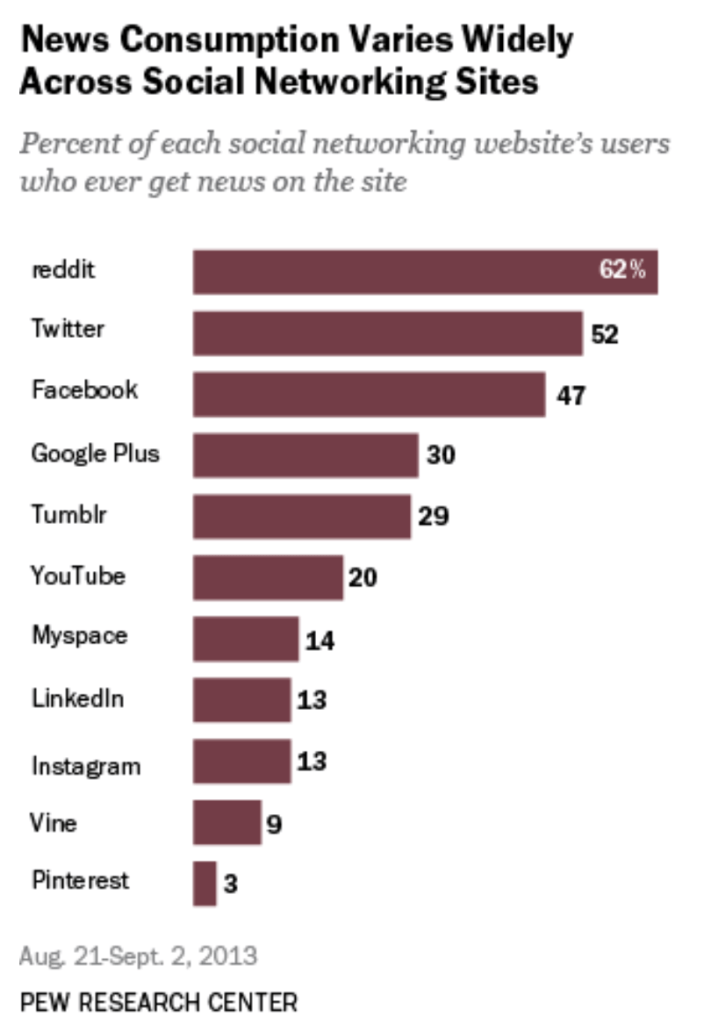
Holcomb, Jesse, Jeffrey Gottfried, and Amy Mitchell. 2013. “News Use Across Social Media
Platforms.” Pew Research Journalism Project, November 14. http://www.journalism.
org/2013/11/14/news-use-across-social-media-platforms/.
Professor Rusell refers back to this image and research because, as one may notice, Twitter is the second most used social media network. This information proves that the reason why most news organizations were using Twitter is because they just wanted to get clicks and interactions. It is also important to note that about half of Twitter users view the platform as a news source, which makes them less likely to turn to traditional media for news.
Q: Would you have done anything differently if you did it all over again?
Professor Russell explains that if given the opportunity to do it all over again, he would not do anything differently. This is because he was able to answer his own questions effectively in the way he conducted the study. It is also important to note that this type of research study, using Twitter could not be done again due to new Twitter guidelines with Elon Musk’s takeover. He also expressed that this research study, in particular, was the easiest to get published, so there would be no need to change anything.
To summarize, after talking to Professor Russell about his past studies and the journey he took to complete them, we felt as though we had a much better understanding of the kind of process it takes to create a research project and how much time and effort is genuinely involved. It was wonderful getting to speak to someone such as Russell, who has completed many different projects during his career, and we are grateful that he was willing to open up to us about it. He helped guide us into a direction we should go for our own research project and left us with some insight to think about. While his research was a unique project that could not be replicated anymore, it inspired us to make our own research project surrounding social media in a new way, different than what it used to be. Our interview with Russell will continue to inspire us to learn more about the research process.

 The Society for Communications Research