By Aidan McElhany, Jake Cipres, Ashley Abercrombie, and Fernando Calvillo Alcantar
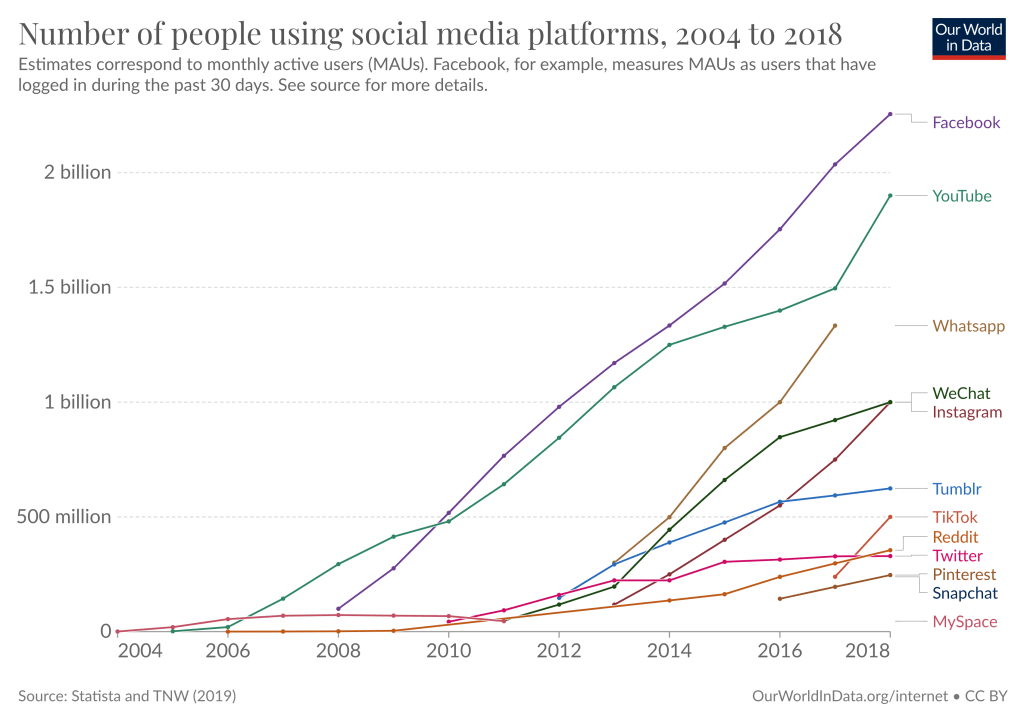
With the rising popularity of social media platforms such as TikTok, Instagram, and YouTube, many have expressed their concerns about how the excessive use of these platforms will affect our mental health and other aspects of our well-being. In particular, the short-form content present on TikTok and YouTube Shorts has been criticized for its potential negative effects on users’ attention spans. Our research study aims to find a correlation between the use of social media platforms and its influence on the attention spans of media users. The study will examine two variables in regard to social media usage. The first is which social media platforms are most widely used. The second is how much time media users spend on each platform on a daily, weekly, and monthly basis. Additionally, the study will examine signs of a shorter attention span, such as restlessness, inability to focus for long periods of time, etc. The data will be gathered through a convenience sample survey consisting of students at California State University, Fullerton.
In order to ensure that our study yields the most reliable and valid results possible, our team reached out to Dr. Assaf, a communications instructor at CSUF. We interviewed her about her past research regarding media effects and mass communications in order to gain more insight into how to design and conduct a successful research study. The goal of this interview was to understand what steps should be taken prior to the study to ensure that any confounding variables are eliminated. Additionally, our team wanted to understand the best way to compile and analyze the data. The interview is discussed further in the following sections.
Professor Assaf was extremely open and helpful during the interview process. Our group prepared questions beforehand and went in with an open mind ready to gather information. We began our interview with Professor Assaf by asking if she had any preliminary information our group should know before beginning our research. She explained that it is important to choose a research topic that interests us. Our group all agreed on the topic of “how social media affects attention span,” so it was reassuring to hear that personal interest is important when choosing a research topic.

Next, we asked Professor Assaf to go into detail about a research study she has conducted. She spoke about her study on language in newspaper headlines, which combines the areas of communications and mental health. She wanted to dive deeper into both areas combined since there was not a lot of current research out there. To wrap up the interview, we asked questions about survey elements such as sample size and question types. We wanted to know a solid number of survey responses to aim for as well as her advice on how to format our survey to entice people to respond. Now we know to aim for about 100 responses, but depending on how long the survey is out, 30-40 people would be sufficient. Professor Assaf recommended putting the easier, demographic-based questions at the beginning before getting into the “hard-hitting” questions.
Before we got deeper into the conversation, we asked if there was any sort of advice that she could give us. She responded with, “you always want to find a research question that is interesting to you.” Our group went over a couple of different topics, and when we finally came up with “how social media affects attention span,” we all kind of felt like there was a kind of a click when it was brought up. The next tip she gave us was to “fill the void”. She explained how there are tons of studies on the same topic out there, it’s about looking at it from a different perspective and attempting to add on. She says that replications can be beneficial in certain circumstances, but in research we are always trying to find ways to add on to what we already know.
Professor Assaf quickly went over some of her studies that she has authored or been involved in. It helped us get an insider perspective for us not doing something like this before. In our group meeting before the Zoom, we were hoping to get 100 people for our survey thinking that was a solid number. The professor talked about how it would be fantastic if we could get 100 people, but it might actually be harder than we think. She said to aim for something closer to 30-50 and the more that we get the better.
Professor Assaf’s advice to bear in mind throughout the project included ensuring that our research is adding on to an existing research topic. This will give us more stuff to inquire about and explore in our research. She gave our team some useful advice on developing a structure for our survey questions. She recommended that we begin with some demographic and psychographic questions to gain useful and personal information about our target audience. She explained that we should then move into asking some of the hard-hitting questions that will help us to answer our research question. These should include questions that can bring numerical value to our study such as yes or no answer questions, as well as questions involving scales.
Finally, Professor Assaf recommended that we end our survey with a few open-ended questions to gain a better understanding of what our target audience thinks about the topic at hand. Furthermore, professor Assaf encouraged us to find prior research that is similar to our topic so that we can take inspiration from it and see what we could do differently. Moving forward, our team will apply Professor Assaf’s advice and aim to do our best with this ongoing research project.
Included below is a video recording of our Zoom meeting with Professor Assaf.

 The Society for Communications Research