By: Kyle McCaghren, Logan Blevins, Victoria Bridenbecker

We had the pleasure of sitting down with Dr. Zac Johnson to discuss his study from 2021 about the effect of student-to-student confirmation on the overall mental health and well-being of college students. Dr. Johnson is an associate professor at California State University, Fullerton, in the Department of Human Communications Studies. His research is featured in Communication Education, Communication Quarterly, Communication Research Reports, and other publications.
Read more: Interview with Dr. Zac Johnson on the effect of student-to-student confirmation on student’s mental health and well-being.Q1: In regards to student-to-student confirmation, what caused you to take an interest in that topic and take a dive into it?
Dr. Johnson described student-to-student confirmation as his niche area of study that he was exposed to when seeking to find a direction to take his study in when transitioning out of graduate school and into his career as a researcher.
When going through existing literature and studies, he came to the realization that, as a collective, there were a multitude of studies on teacher-to-student relations. Yet, the understanding of student-to-student interaction and confirmation was borderline nonexistent. Dr. Johnson took an interest in exploring what had yet to be studied about the college student and wanted to assist in pioneering an increase in the focus on this topic.
With this study and various others Dr. Johnson has participated in throughout the years, the focus is on positive forms of communication and communication ideas. He described how a majority of communications research in his field has the tendency to focus on the negative aspects of communication, such as misbehavior and complaining. He attributes this focus on the negatives to the belief that it creates a sense of relatability and normality for the audience; people can look at these negative forms of communication and justify that they are normal because they complain, too. Dr. Johnson guides his research away from this norm to focus on aspects of communication, such as confirmation, that reveal more positive behaviors and their potential benefits.
Q2: In your study, you have a decent selection of references to other studies throughout; what was the process like in finding previous literature for this topic?
Dr. Johnson described how, in this niche field of study that he is in, communications-based research is almost impossible to find. In the case of this study, he had to take a dive into studies from psychology, sociology, and educational psychology in order to find some references and information about the topic.
In the field of communications, the focus has always been on learning outcomes and the things that directly impact those outcomes. Studying student interaction and anything related to the mental health and well-being of the student just has not been done yet. Dr. Johnson said that this actually has been to the detriment of the field in general as it is a significant piece of the puzzle being left out; he continues these studies to fill that gap and pioneer its importance.
Q3: During the sampling process for this study, 412 university students were surveyed. Were you hands-on in the process of gathering those surveys, and what was the process like?
Dr. Johnson described how he has a commitment to going out and gathering his data and surveys. He will go out physically on campuses to individually survey students on his own and take over the whole data-gathering process. Data to Dr. Johnson is an extremely important part of his studies, and he feels the personal responsibility to gather and collect it for his studies. The process can be very challenging at times, but committing to the data-gathering process ensures that things are done correctly.
Q4: When it comes to the results of your studies, do you sometimes find it challenging to translate those results into a meaningful discussion?
When it comes to the discussions, Dr. Johnson described how it definitely can be difficult, but it all comes down to the strength of your results. In cases where your results are significant and strong, it can be easier to draw the conclusions you come to in the end. In the case of this study, he describes how the results were pretty much what was expected, and so there were pretty decent grounds for discussion.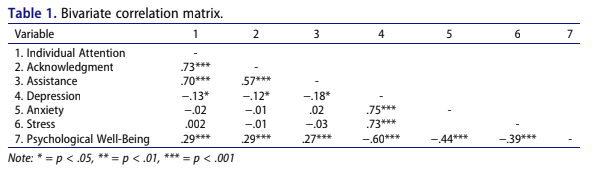
There are, of course, cases where you may go into a study, and the results you find are meager at best. In those cases, it can be hard to find much significance that you can translate to a results-based discussion, and Dr. Johnson shared that he has had studies like this in the past.
Q5: In your discussion, you describe the practical implications of your results as well as the limitations. Do you view it as a researcher’s duty to offer these kinds of insights in their studies?
Dr. Johnson explained how, in some lines of research, this is not necessary, and sometimes just the results are enough. However, with his focus on instructional communications research, it absolutely should be a duty to offer those practical implications.
“It should be the point of instructional-based research. If you’re not sort of concluding why you should care about this, what can you take away from this practically to impact your students’ experiences, to impact your experiences, to be a better teacher, then what are you doing?”

 The Society for Communications Research