By: Andrew Pucci, Anthony Jasso, Sara Virgen

Professor Robert Meeds, PhD
Our Group had the opportunity to conduct an in-depth interview with Professor Robert Meeds in regards to his study, “Cognitive & Attitudinal Effects of Technical Advertising.” This study aims to understand the idea how individuals with varying levels of knowledge in specific product domains respond to print advertisements containing technical information. The focus lies on understanding consumer-level differences in processing persuasive messages, which directly influence advertising copywriting strategies. We discussed Robert Meeds’s breakdown of the study, how the study came about to begin with, and his overall thoughts and process within the study.
Dr. Robert Meeds is currently a professor at Cal State Fullerton within the realm of Communications. This study was conducted in the early 2000s and at this time Meeds was part of the Communications Graduate program at the University of Kansas State. Robert Meeds was the sole author of this study and the idea came about during his time completing his Ph.D. when taking Advertising and Psycholinguistics Courses.
At the beginning of our interview, when mentioning the motivation behind this specific study, Meeds explains that the inspiration for this directly came from his PhD Adviser who was a field psychiatrist. She made sure that Meeds understood that there were not many individuals in this field and this was ultimately what kept him going and created many more research studies shortly after. For this study alone since it was conducted in 2004, the main focus behind the study was print ads since they were in high popularity and were the only way to promote business or products. Meeds’ foundation helped future companies in creating, implementing, and perfecting certain print ads to have a lasting effect on consumers thinking related to products. He then quickly pivoted to the present sense of advertising by mentioning even twenty years later when print ads have ultimately disappeared, the mobile realm of the world ultimately works the same way, just more advanced.

Figure 1 : Layouts of Stimulus Ads – INTERNATIONAL JOURNAL OF ADVERTISING, 2004, 23(3)
In order to understand the Cognitive & Attitudinal effects of Technical Advertising Meeds first had to develop the population in which he wanted to observe. Again since he was in his PhD program he explains his audience was strictly an undergraduate student population. He was able to get even “splits” in the population meaning he had an even amount of gender both male and female which strengthened his study. To categorize participants based on their knowledge levels, Meeds employed a multifaceted approach. Initially, he distributed questionnaires that assessed objective knowledge through multiple-choice questions about the technical features of various products. Based on participants’ responses, he segmented the population into groups with high and low consumer knowledge, laying the foundation for subsequent analyses. Meeds also considered subjective consumer knowledge, defined as “individuals’ perceptions of their understanding in a particular area.” This subjective assessment provided further insight into participants’ cognitive processes and attitudes towards technical advertising. By methodically dividing the population based on both objective and subjective measures of knowledge, Meeds set the stage for a comprehensive exploration of how varying levels of consumer expertise influence responses to print advertisements.
Break Down Analysis of the Study with Robert Meeds
During the middle point of our interview, we switched the focus and really wanted to deep dive into Robert Meeds’s mind on the breakdown of the study from his perspective and certain types of manipulation that catered to his overall research. Professor Meeds highlighted the different factors at play in the study design. Among these were between-subject factors, with gender being identified as a “fixed factor.” Gender was utilized to ensure equal representation across the participant groups. Meeds emphasized the significance of demographic controls in the research. Factors such as age, income, employment status, race, and education were recorded during the initial questionnaire stage. These controls were crucial in accounting for any external variables that could impact how participants responded. Meeds also talked in depth about the manipulated factors, specifically self-assessed knowledge and objective knowledge. These factors were considered within-subject variables, meaning they were adjusted for each participant individually. Participants were grouped based on their knowledge levels, distinguishing between high and low levels for both self-assessed and objective knowledge. Then Meeds examined the within-subject factors, focusing on the manipulation of technical language in advertisements. He detailed how participants were exposed to various ad versions, each containing technical or non-technical language – a process overseen by him to maintain consistency throughout the study. Through meticulous manipulation of these factors, Meeds explored the intricate connections between consumer knowledge, technical language, and advertising effectiveness. By utilizing a mixed methodology approach he was able to capture similar trends within participant groups while also pinpointing subtle variations in individual responses.
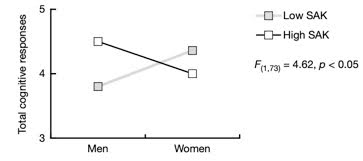
FIGURE 2 TOTAL COGNITIVE RESPONSES AND SELF-ASSESSED KNOWLEDGE BY GENDER INTERACTION

FIGURE 3 PERCEIVED PRODUCT DURABILITY AND TECHNICAL LANGUAGE BY OBJECTIVE KNOWLEDGE BY GENDER INTERACTION
During the interview there is one point that really intrigue us, Professor Meeds impressed us with his explanation of how he expertly used regression analysis to filter out any potential misleading factors. He stressed the essential nature of factoring in variables like age, education level, and income when analyzing data. By incorporating these details into the model, Meeds made sure that the impact of gender and consumer knowledge stayed unaffected by other demographic traits. Meeds said this helped him highlight the importance of the interplay between gender and self-assessed understanding in influencing the total cognitive responses produced by the participants.
Study Effectiveness Today/What Would Meeds Change
At the end of our interview, we asked a series of questions regarding the future of this study or what changes Meeds himself would make to somewhat “modernize” his research. He mentioned that during this time his research study was actually ranked number two within the field of cognitive research studies which was a huge accomplishment early in his career. He believes the only thing he might have changed were the actual brands he showed individuals since they were made up by him, he explained that it would have felt more real on the participants’ end to have real brands but it would also be difficult eliminating brand loyalty. In regards to modernizing the study and the overall effect today, Meeds goes into depth by explaining even if he updated the study with maybe mobile ads done on cellphones or updated brands like he mentioned the results would still end up almost the same in his eyes. He continued by saying that this study today if done and revised by someone else actually would not be beneficial he has learned over the years that a study like this which is strictly psychological and less emotional doesn’t really get much recognition anymore.

 The Society for Communications Research