By Brianna Faucher, Alyssa Sanchez, Alyssa Silfa, Benji Hernandez, and Makayla Orona

About Dr. Sha
Dr. Bey-Ling Sha received her undergraduate degree at Purdue University majoring in communications where she specialized in public relations. She then earned her masters at the University of Maryland majoring in journalism where she mostly worked in public relations followed by earning her doctorate’s degree at the University of Maryland majoring in mass communications with an emphasis in national public relations. After finishing her studies, Dr. Sha worked at the US federal government in public relations for the census bureau for roughly five years. During her last three years at the bureau, Dr.Sha taught public relations at the University of Maryland where she later went to California State University, San Diego. There, she worked for 15 years as an assistant professor for public relations in conjunction to directing the school of journalism and media studies. Her last year at San Diego State she became the Associate Dean of the College of Professional Studies and Fine Arts. Since July 2019, she has been thriving as the Dean of Communications at California State University, Fullerton.
Read More: Interview with Dr. Bey-Ling Sha on “Is it still a women’s issue? A study of work-life balance among men and women in public relations”Q1: What first got you inspired to participate in the research of this study of “work-life balance” within the Public Relations field?
Her research primarily focuses on identity and how it interacts with public relations. She divided her research into three categories: “identity as a means of segmenting in relations with a basis in racial and ethnic identities”, “public relations people”, and “how public relations practitioners play a really important role in articulating the identity of organizations themselves”. The research for this article pertains to her focus on people within the public relations field.
Q2: What was your role in the making of this research article?
Dr. Sha goes on to say how the research article encompassed a compilation of a lot of other research. The article was published in 2008 which made it challenging for Dr. Sha to remember the details but nonetheless confirmed that she made sure that the work the other authors had been citing of hers was in the correct format and context. She emphasized that her role in the making of this study was not as significant as some of the other authors.
Q3: When it comes to gender roles, how does this transpire in the workplace especially in regards to women and minority men?
There are so many things yet to be researched but we do know in PR for gender it is unfair. Women are inherently face more difficulties. For instance, when asking for a raise compared men, women are much more likely to receive pushback or less of an increase. Dr. Sha goes on to state:
“Women could never catch up, women are working more technician roles than janitorial. No matter how much experience you have, it could be the same experience or same amount of education women still earn less than men”,
but still receive unfair treatment in the workplace with respectable positions. The gender pay gap is one of the most persistent trends found in the workplace and continues to manifest.
Q4: Reading the study, the focus groups were conducted based on gender and geographic locations. What would you have done differently in the sampling process to be more intentional with adding participants of different domestic statuses and ethnic backgrounds? I imagine it plays a big role in work life balance if the participant is single, married, married with kids, or a single parent, and their ethnic background, so how would you diversify the focus groups, taking these things into consideration?
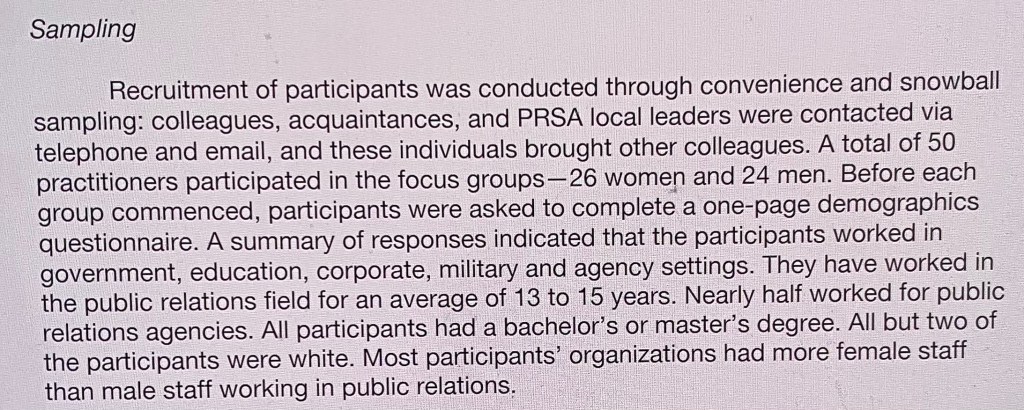
In a modern study, Dr. Sha brings to mind that we would need to consider factors outside of biological gender, for example, trans-gendered, intersex, and non gender conforming individuals. Essentially, she implies that since the study was conducted, a more nuanced definition of gender has come about that must be applied to present-day gender studies. To put this to action, Dr. Sha would ask participants to identify their gender and look at gender as the basis, but also look at gender by different classifications, such a race, or ethnic backgrounds. The downside to conducting a study with an extended amount of intersectionality is that there is much more data to be collected by each of the intersecting demographics. This would require a larger respondent pool making the data more difficult to analyze, therefore making it difficult to develop an accurate conclusion. Dr. Sha also shares the downside of using focus groups in this kind of study as people may feel less comfortable sharing parts of their identity with the group. However, since we have more resources, such as zoom, we can conduct focus groups easier and among people of different geographical locations at lower costs than before.
Q5: Is there another research method that you believe could have aided the study more?
When asked if there is another research method that Dr. Sha believes could have aided the study more, she mentioned that based on the previous questions and answers it depends because research, especially now that we are in the digital world, has inspired the idea of survey research on phones and computers making it easier and cheaper. When conducting research, Dr.Sha and the team had to mail, and buy postage, which overall was time consuming. Dr. Sha suggests that doing a digital survey like SurveyMonkey that are convenient and give better access to data, would have been beneficial. Today, surveys that are electronically mailed to participants are much more efficient in saving time and energy.
Q6: It seems as though women face low-self esteem in the workplace. What have you noticed to be the trend and how does it impact minority men as well?
Demand characteristics happen when you say something you think you and others will want to hear. This can be an issue whenever you conduct a focus group.
People assume women have no confidence. Confident women get judged in a different way from confident men. It’s usually looked down upon when women openly display their confidence and typically gets judged a being full of herself whereas a man may be cheered on for his ability to believe in himself.
Q7: To wrap up this interview, in the discussion/conclusion section of the study it stated that “the findings of the study suggest several opportunities for future research.” Would you want to pick up this study again in the future?
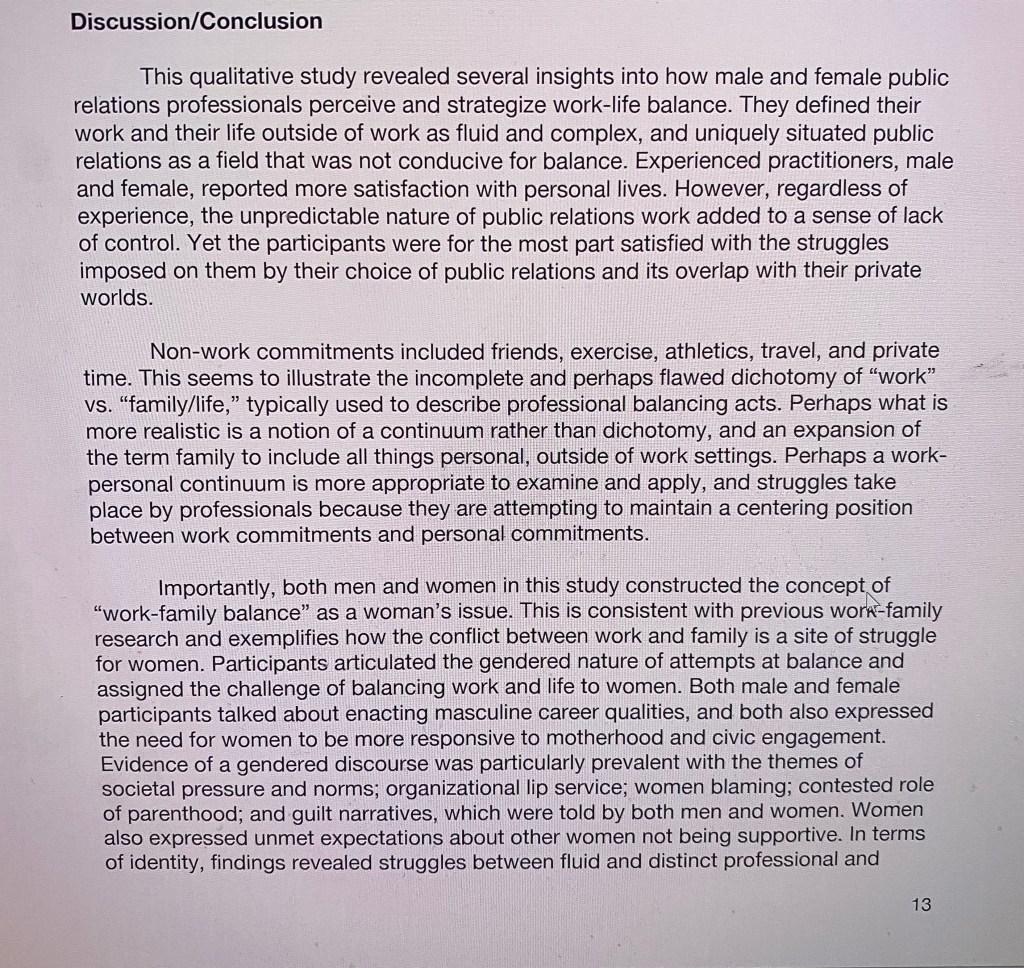
Enthusiastically, Dr. Sha said she would love to pick up this study as the research for this article was conducted 15+ years ago. Although open to the opportunity, juggling Dean of Communications at CSUF and other admirable matters there does not allocated enough time for her to collect data on this topic. She presented a question back to the audience stating who else has done the research on the particular topic and to research them on their recent data. With confidence, Dr. Sha, talked about how she is sure that others have picked up this area of study but would love to compare the results from when this study was conducted to now. It is vital for there to be current data on the balance of work-life and how it affects men and women in Public Relations.

 The Society for Communications Research