
11/06/2024
By: Ann Sadek, Nicole Strang, Lauren Rosbottom, & Abigail Chertock
Dr. Zac D. Johnson is an associate professor at California State University, Fullerton. His work is in the Department of Human Communication Studies. After years of experience, he’s in his first semester as the department chair. Dr. Johnson’s primary research pertains to the way students communicate inside and outside of the classroom environment and subsequent effects that follow. His work is featured in many places, including Communication Research Reports, Communication Education, Communication Quarterly, and more. We were pleased to have the opportunity to sit down and discuss his published research, From student-to-student confirmation to students’ self-determination: an integrated peer-centered model of self-determination theory in the classroom.
Dr. Johnson explained that he enjoys studying student-to-student confirmation, which refers to how students interact with each other in educational environments. He further explained that he and his wife (who is also his research partner) were eager to learn more about the tertiary stuff that comes with the college experience. Although they’ve gathered plenty of data on learning and motivation, they wanted to know how confirmation can impact it. It’s important to note that confirmation is not a straightforward process; it involves multiple layers of interaction. Dr. Johnson explains “I’d like for us to create unique and organic ways for students to connect with each other, to find those spaces to confirm one another, because when we do it really artificially like saying ok everybody pair up and say something nice about each other, everybody just goes *shrugs* “cool shirt” and that’s it; but if we can create cultures, experiences, and spaces in a class and in a degree program and all this stuff for students, for that to just become the norm, then that becomes the norm and it self-perpetuates”. Thus, he was eager to further his research on the importance of peer interactions in shaping students’ mental health to uncover the complexities of these relationships. Dr. Johnson further explained that his wife is interested in studying mental health and that this research was their first step.
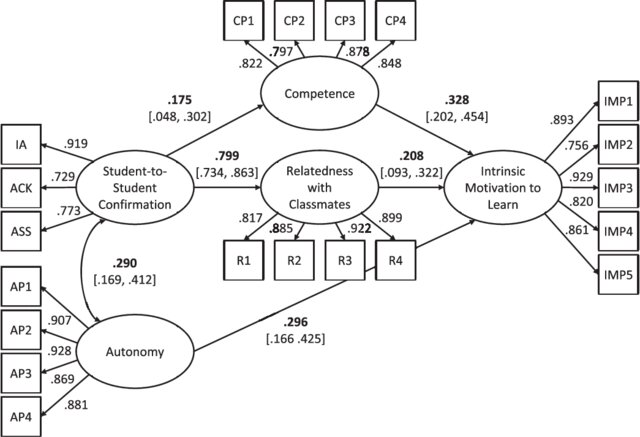
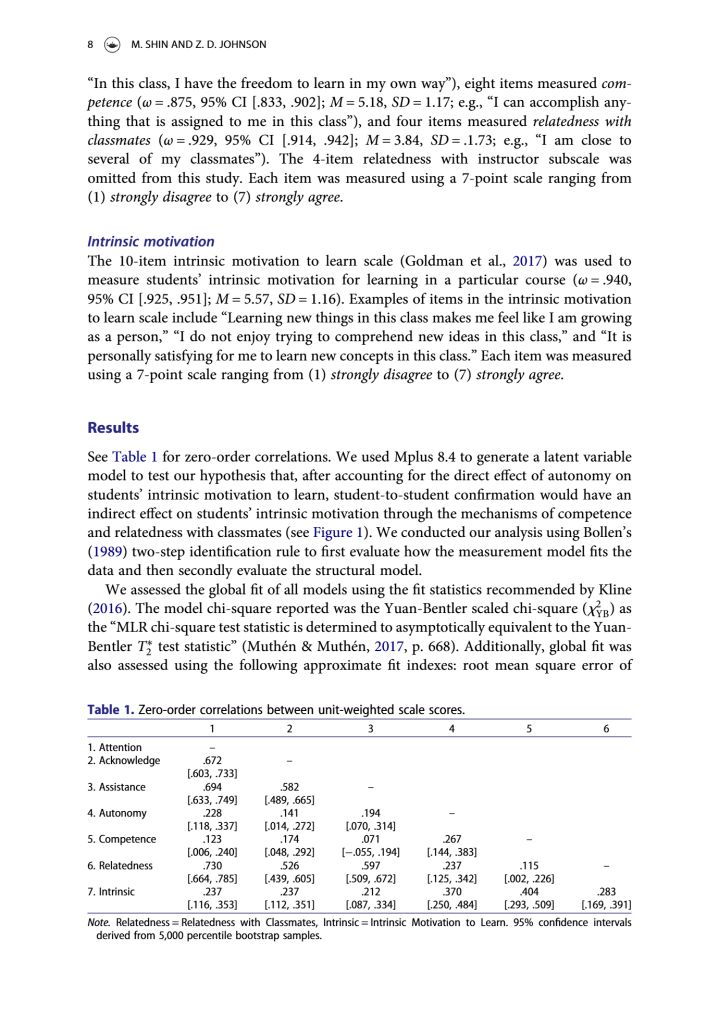
One aspect of the study that we discussed with Dr. Johnson was his decision to collect the data for this research in a quantitative approach. One of the main points that were important to having collected the data in this way was to be able to take the quantitative data that is collected and apply that knowledge to other research samples. This was used for a confirmation study because the components to confirmation can be applied across different subjects. Dr. Johnson also explained how if dealing with qualitative data it cannot be as easily compared to other studies as it may have a different approach.
Another important aspect of creating this study that we wanted to discover more about was the process of making the statements that were used for the Likert scale questions. During this discussion, we learned about the process in making these statements. We learned that one of the most important parts of creating a statement for these scales is that they are valid. We learned that they did an exploratory process to ensure that all the concepts worked together for the study. Dr. Johnson explained that after they determined the ideas they would be using then they could continue making the statements. The starting number of statements that they created was around eighty statements. Those statements were then narrowed down to about 25 statements to be used in the study.
When researching, one of the biggest factors one must consider is, how will this research impact the subject we are studying? We asked Dr. Johnson “In what ways do you think your findings could inform or expand existing instructional communication models? ,he took a deep breath to first think about the answer. Dr. Johnson replied, “I’d love to drive towards some more theories; one of the common critiques of instructional communication is a-theoretical which means that’s absent of theory. Typically what we see in instructional communication is like looking at this one teacher behavior (this one thing a teacher does) and how does that impact all these outcomes”. By remaining hopeful, Johnson would like to see real change in how these topics are studied within learning spaces.
In such an unpredictable world, things will rarely go 100% according to plan. While most of the interview was dedicated to analyzing and better understanding the study, we wanted to get some information on the things that didn’t go smoothly. We asked Dr. Johnson how he handled any unexpected findings or trends that didn’t align with his hypothesis. He responded by saying that while it’s upsetting to have unforeseen data, you have to accept that it’s still the truth. He also added that. “Maybe it’s not the truth you expected to see, but you know, it is the truth for that sample” (Johnson). He reminded us that it’s always possible for there to be an outside factor affecting the results; for example, his experience as someone who went to college in 2011 is different from someone who went to college in 2021. He concluded his thoughts by sharing that when analyzing data, positive or negative, the best thing to do is sit and think. In doing so, one can properly consider what their next steps should be.
Student-to-student confirmation, ordinary general interaction, and the research that goes along with those subjects have been greatly affected by the COVID-19 pandemic. Even though Johnson did his research a few years before the pandemic, we were curious about his thoughts as to how the entire process affected the research today and how we go from here to get the right data. In his answer, Dr. Johnson said “it has made it more challenging because the nature of education has shifted”. What he is trying to convey is that online classes becoming the norm has created a culture shift in how students learn, as well as how they communicate in an educational environment. Seeing the effects of the pandemic on students, whether good or bad, is undeniably different compared to the way it was previously before COVID. Even though there is not a proposed solution quite yet on how Dr. Johnson will collect updated research, he is optimistic on coming up with ideas.
The landscape of research Dr. Johnson studies is ever changing in times where technology is becoming a consistent tool for interaction. By sitting down and discussing, we can get to the nitty gritty details of student-to-student confirmation and figure out aspects of student behavior that are influenced directly by social understanding/interaction.

 The Society for Communications Research