Dr. Cynthia King decided to do this experiment because she had a background in studying media, particularly from her media violence fellowship that she received during her enrollment at the University of Alabama. With this fellowship, she was able to learn from Dr. Zillman and Dr. Bryant. While studying under Dr. Zillman, she was able to learn the proper techniques needed in order to create specific research. On the other hand, she learned how to develop concepts that she was passionate about and dig into the relation between those concepts while studying under Dr. Bryant. She chose to incorporate humor into her study because she was enrolled in a course that focused on humor and found out that humor at times can come along with a bit of hostility. This made her want to dig deeper and discover if humor would trivialize the violence. Dr. Cynthia King knew that she wanted to do an experiment because she wanted to look at the effects and know that experiments are the only way to prove causality truly.
Gathering data for this experiment was reasonably easy because she got college students to participate by asking professors to assign extra credit to those who took part in the study. Since this was done at the University of Alabama, a very large college town, gathering people was easier than at Cal State Fullerton. She mentioned that it was standard for many undergraduate Communication students to participate in a study or two due to the proximity and extra credit opportunities that came with these studies. She also got others to join by going to places around the college town and asking for volunteers since this experiment occurred before COVID-19.
When designing this experiment, she knew that the movie she chose to show to the participants would be crucial in the outcome of her study. She needed to find a balance between her two options of hero and villain and the control group option for her experiment. She chose the film “Hitman” because she wanted a movie that was not very well known, and that was something that people would not remember specifics from if they had already seen it. In addition, she also knew that she wanted both the hero and villain to take part in the humor aspect to truly be able to engage the impact these characters had on the audience. To her, this was the most challenging part of the experiment because of the little nuances, such as music, that can play an impactful part in how the audience perceives a film. This experiment was conducted before many video editing software programs, so all of the editing had to be done in a linear fashion, and she could not go back and fix anything once it was completed. Below are the excerpts of the villain and hero dialogue she used within the experiment.
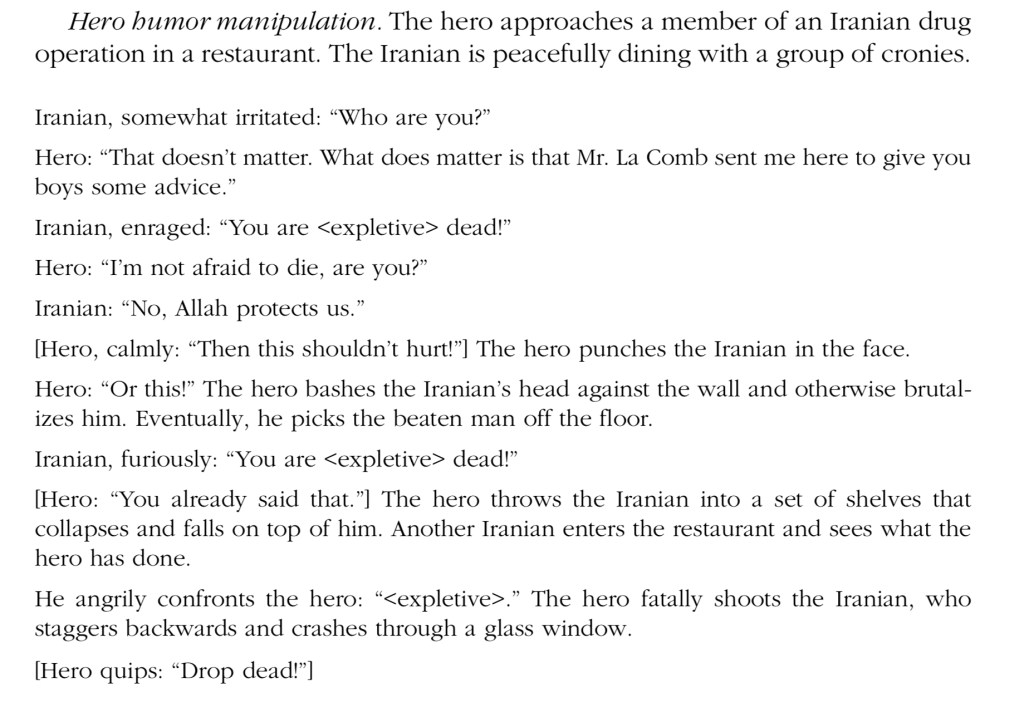
Excerpt courtesy of King, C. (2000). Effects of Humorous Heros and Villians in Violent Action Films
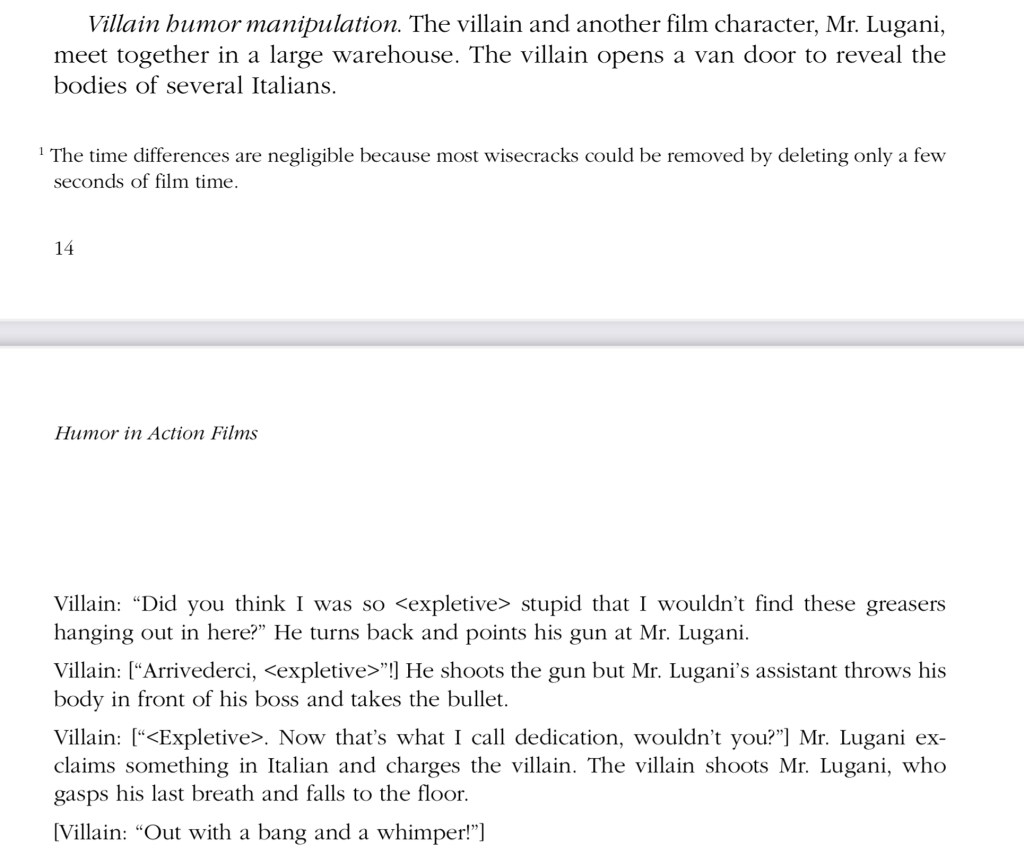
Excerpt courtesy of King, C. (2000). Effects of Humorous Heroes and Villains in Violent Action Films
Once the data was collected, she focused on gender as the primary independent variable. When designing this study, asking for the participant’s gender on the questionnaire was just one small factor that she would include amongst many other questions, as this is something many experiments add to gather the demographic data of those they are studying. However, when analyzing the data from this study, she discovered that gender was a huge variable in her research. She found that Male and Female participants had very different reactions to how jokes were presented by both the heroes and the villains in the film, as seen in the graph below.
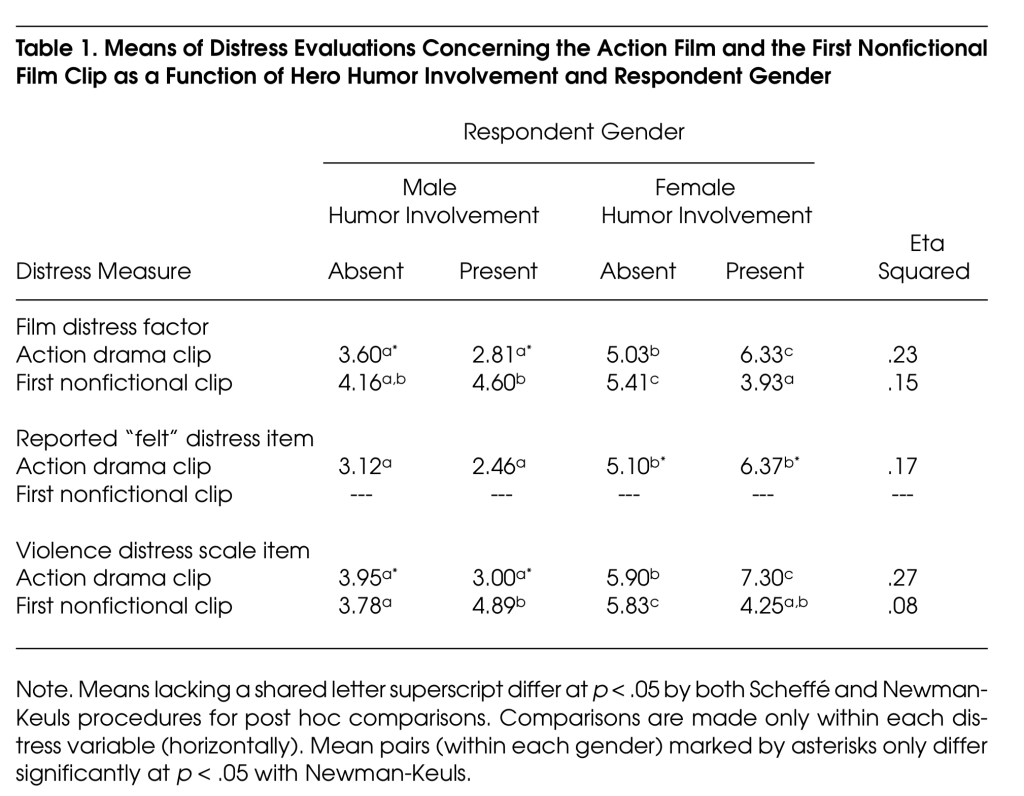
Chart Courtesy of King, C. (2000). Effects of Humorous Heroes and Villains in Violent Action Films
When asked for advice she would give to anyone just starting in the field of research, Dr. King emphasizes the importance of extensive reading to gain ideas and background knowledge. She advises new researchers to dive into previous studies to understand what has already been done and always ask questions to deepen their understanding. She mentioned that you never know when you can expand upon things already done before you. One of her key pieces of advice is to keep the research process simple and manageable. As she puts it, “The best project is a done project.”
Throughout her career, Dr. King has conducted various impactful studies. One notable project involved mood management and the influence of advertisements on brand perception. She also explored how news articles affect the challenges companies face and how writing press releases can influence public perceptions. Her work on social media analytics shows modern content analysis techniques that reflect the evolving media landscape.
Dr. King’s research shows how the media can shape societal trends and perceptions. She has investigated media violence, problematic song lyrics, and the importance of understanding media. Her findings highlight the need to be careful when consuming media. She has also used this ideal when raising her two teenage sons, especially in this ever-evolving media landscape. Advocacy in entertainment from the late 1980s and 90s remains relevant today, but on different platforms.
As time has progressed since her experiment, how society affects media have changed. Dr. King explains how the rise of social media has played a significant role in how media is created and shared. She emphasized how access to people’s lives and the ways they think weren’t as readily available as they are now with social media. Social media allows for things to be shared instantaneously, and with this ability, Dr. King believes that a new nature of principles is taught. She goes back and forth between promoting what social media has been able to teach us while also analyzing its effects on society and the ability to be fed information without adequately researching.
Dr. King believes that the connection between mass media and its ability to influence social-cultural aspects of society lies within reinforcement. Depictions of ideas and trends in society are highlighted through media, therefore reinforcing these ideas. Dr. King explains how when people create media based on ideas in their personal lives or seen through society, the media is able to not only reinforce the thoughts of the individuals, but the thoughts of society as a whole. In Dr. King’s research on humor and violence, she notated the ways that people perceived the images they were watching, and then further analyzed how these images were reinforced in media and society. She emphasizes that media literacy is necessary when navigating an ever-changing media environment. Dr. King heavily stresses the ways in which media and society are tied together at all times.
Throughout this conversation with Dr. King, we found her insight into the field of research to be insightful to our project, which we are conducting. As we are just starting in the field, hearing from an accomplished researcher allowed us to refine our question and hypothesis for the study that we are conducting in this course. As we are similarly studying the effects of how film impacts an audience, we learned the importance of having a strong understanding of causation through experiments, which allows for causation to be fully understood. Though we are just doing a survey, I think furthering our research in future experiments would be a great way to fully encapsulate the understanding of how media can impact an audience.
Link to Interview:
Sources:
King, Cynthia. (2000). Effects of humorous heroes and villains in violent action films. Journal of Communication. 50. 5 – 24. 10.1111/j.1460-2466.2000.tb02831.x.

 The Society for Communications Research