Q1: You have multiple research studies that feature Twitter. What has drawn you to conduct studies on Twitter compared to other social media platforms like Facebook or Instagram?
Professor Russell explained that before becoming X, Twitter, unlike other social media platforms, made data free to researchers, allowing him to explore many research questions cheaply. The available data is what he used to carry out not only this research but also many others throughout the years, such as his 2015 study “Journalists, gatekeeping, and social interaction on Twitter: Differences by beat and media type for newspapers and online news” and his 2019 study “Twitter and news gatekeeping: Interactivity, reciprocity, and promotion in news organizations’ tweets.” After Elon Musk bought Twitter on October 27, 2022, Twitter or X data was no longer free. Professor Russell shared his disappointment with this change, as it is no longer feasible for him to conduct research involving Twitter because paying for access to the data would be too costly.
Q2: What was the process like for choosing gatekeeping theory as the guide for your research?
In journalism, gatekeeping theory refers to how newspapers control information by selecting and filtering information presented to the public, shaping public discourse. Professor Russell considers gatekeeping theory one of the main theories of journalism studies. He refers to it as a “middle-level theory.” Compared to other theories like field theory or institutional theory, which are more all-encompassing. In his research, Professor Russell used gatekeeping as the basic framework to examine how nonprofit newsrooms and regional newspapers use Twitter to select, shape, and share news content, comprehending how that selection affects the newsroom’s presence on Twitter. Using gatekeeping theory, he also studied how Twitter affects journalism at different levels, individual journalists, and news companies. After establishing gatekeeping as his research’s leading theory of focus, Professor Russell conducted a case study to help answer his hypotheses.
Q3: How did you pick this as the best quantitative research design for this study?
Professor Russell answered that his research questions drive whether he uses a quantitative or qualitative research design. For his BREAKING study and other studies involving Twitter, he clarified that the research questions of other studies he had found often led him to create his own new questions. Professor Russell shared that back in the day, a tiny group of journalists conducted research regarding Twitter and journalism. He noticed that they tended to focus on individual journalists’ use of Twitter. He wanted to do research at the organizational level; for his BREAKING study to answer his research question, he simply needed to conduct a content analysis of the 17,000 Tweets in his sample size by searching for specific text within the Tweets. Professor Russell explained that if he ever had a research question that involved needing to be conducted in an experiment, he wouldn’t have done the study because he doesn’t enjoy performing it. He feels that his background in quantitative content analysis and qualitative discourse analysis helps him better answer research questions that those methods can solve.
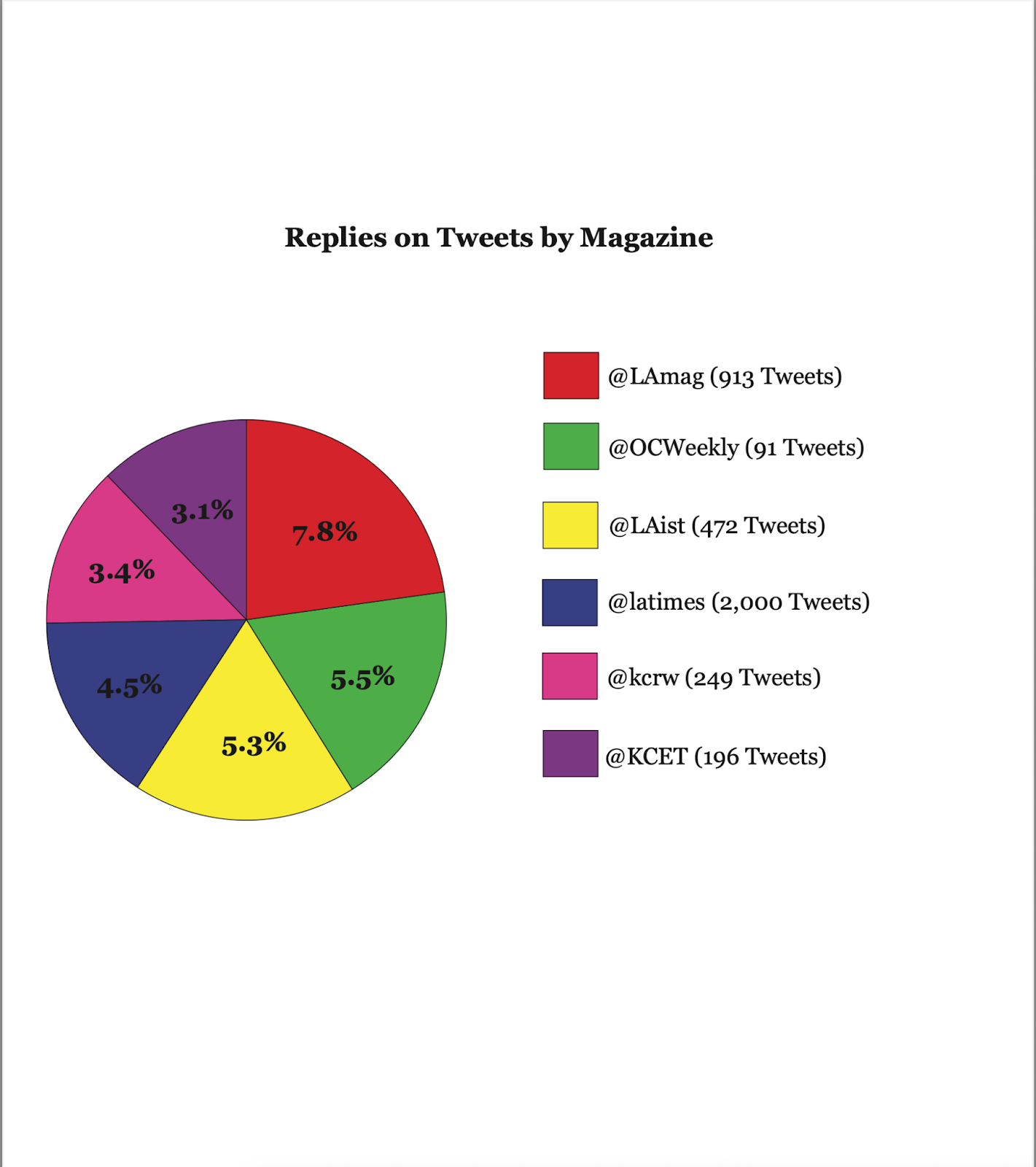
Example of his qualitative research: Out of 913 tweets chosen by @LAmag 7.8% had replies.

Example of his qualitative research: Of the tweets selected from the magazines, 16.1% were about crime.
Q5: Were there any outlets you considered that you ultimately decided not to include in your research?
Professor Russell shares that when conducting their research, they go through a process of peer review not knowing who the peer reviewers are, and when he reviews other studies, he doesn’t know who the others are although often times, because the field is small, he is able to guess who the authors are. He goes on to explain that the reviews are good, but they often insist on having a reason as to why researchers choose what they choose to study. Giving a helpful tip to base your research on other research, part of their data was based on Pew Research’s How the Public Uses News Media, as well as data that they found regarding audience size.
Q6: Were there any outlets or voices that might have been underrepresented in your study?
With there being a multitude of research about community journalism, Professor Russell wanted to look into a market where there would be resources available for him to use social media, which is why he decided to focus on Southern California, then from there looking more in depth into Los Angeles focusing on the largest news outlets. He explains he chose these more prominent organizations because they had more resources to participate on Twitter than opposed to smaller, more local organizations.
Q8: Do you think newsrooms will place a greater emphasis on having a strong social media presence in the future if this trend continues?
Although Professor Russell admits he isn’t 100% certain, he draws back to his own experience while working at the Centers of Mercury News from 2009 to 2011 he had done a lot of research on how journalists and news organizations use Twitter and that in the past 10 years routines have stabilized so he doesnt really see it accelerating but states he has been surprised in the past. Yet, he warns to be cautious not to draw conclusions based on the experience of one person only. He wondered if AI makes it easier to do social media posing to himself a new research question.
Conclusion:
Professor Russell’s interview was very informative and insightful. While we are not in the journalism industry, his research techniques are applicable to any communication research being conducted. His thought process will be a guide to how we dive into our own research regarding politics and social media.
Full interview:

 The Society for Communications Research