In today’s media-heavy world, we’re constantly surrounded by images and narratives that shape our perceptions. Both in on-screen portrayal and in occupational positions, the public—media-consumers, specifically—have been exposed to inaccuracy of women’s behavior, exposure, and intentions. Lederle explains why such stereotypes exist and how it is harmful and degrading to the world, especially other women who should be nothing other than inspired to achieve greatness.
The media continues to perpetuate outdated stereotypes of women, often depicting them as homemakers, mothers, dependent on men, or objects of male desire. These narrow portrayals shape societal expectations and limit women’s perceived potential. However, after further observation, conducting more studies, and speaking with all types of women from around the world, Lederle believes that more women are learning to break free of these stereotypes and redefine their roles, especially in the workplace. Progress is evident, but not inevitable.
In her study, she dives into the persistence of women’s stereotypes. When the media is not displaying women in inaccurate stereotypical roles, they will depict stereotypical behavior. This might include beauty standards or what women are “supposed to value.” Essentially, media tends to reiterate that a woman is supposed to either focus on taking care of others or her own looks. This is a completely untrue testament to what women truly value.
Even so, women are now challenging these stereotypes and actively redefining their roles. By entering leadership positions in fields such as politics, trades, and STEM, women are defying the previous notions of such fields being successful because it was male-dominated. Also, through political exposure and arts, they are creating change by sharing more authentic stories of womanhood. Lederle also makes it clear that the majority of women—primarily in the U.S., but also around the world—are shifting away from that imposed “either/or” mindset. Many women can be successful having both a career and a family.
While progress is happening, Lederle believes that the media still needs to do better at portraying the full range of women’s experiences. Women can be strong, independent, and complex, and the media should portray that. Lederle hypothesizes that audiences have power, and by supporting content that breaks stereotypes, we influence what stories get told. Ultimately, amplifying women’s voices will help inspire broader change.
The article concludes with a hopeful claim for the future—that the old, narrow roles and gradually being dismantled and change is on the rise. However, Lederle and others will continue to study the progress of women’s exposure in the media. To further progress, she announces a call to action—for everyone has a role to play in challenging stereotypes and pushing for accurate representation, as well as spreading the word and inspiring others.
Throughout our interview we were able to learn a lot about how Lederle has first hand experience with stereotypes and discrimination from her workplace as a partner and team leader for Inspective AI, and how she could connect it to her study.
Being a woman in a leadership role typically meant that she was underestimated in almost every room and scenario. For example, there were times where she would walk into a meeting as the boss and be addressed as if she were an intern or assistant, simply because she is a woman. Even though they may have had female bosses in the past, men often overlook the woman in authority by nature, assuming that it wouldn’t be a woman in that role.
Sometimes, in fact, most of the time, this bias isn’t even a conscious one, rather something that has been developed due to exposure of the way women are portrayed in the media. In the interview Lederle explained how women are delegated to princesses and mothers and homemakers in fiction, portrayed as being nurturing, caring, and kind, versus getting to be leaders who make decisions, not compromises.
That isn’t to say that the effects that these portrayals have are excusable by any means, but it explains how these perceptions take root and become so pervasive in our society. As such, Lederle tries to be a catalyst for change within the workplace, an example for her younger coworkers. She leads by example, she explained in the interview, hoping to show others just how powerful women can be.
In fact, one of the reasons that she wanted to do the interview with us was because as a woman in a male dominated field, she finds it to be her duty to educate younger women on how best to handle discrimination, and make sure you don’t fall into the roles that many would unfairly place on women due to their exposure in media.
However, Lederle doesn’t think all hope is lost, which is why she’s so firm in her belief that women should help uplift other women, especially in the workplace. Though it isn’t perfect, and most likely never will be, the portrayal of women has become more well rounded in recent years, leaning more towards showing women as capable of heroism and independence.
In shows and movies, women are now more frequently put into positions of power such as the president, coaches in sports, or CEOs of successful companies. Even though these are portrayals in fiction, they will help normalize those kinds of roles for real life women who are seeking to break barriers and rise to the tops of social and cultural ladders.
Conclusion
Tiffany Lederle is an expert in her own right on how women are viewed and treated in the workforce, especially when they are in leadership positions. She knows firsthand how the portrayals of women in media affect the roles that real life women are offered, or allowed to succeed in, and despite improvements in recent years, hopes that eventually more women are inspired by positive representation in the future to chase and achieve their dreams. To view an excerpt from our interview, see below:
Excerpt from Interview:
(Excerpt from “Breaking the Mold: Women Defying Media Stereotypes” by Tiffany Lederle)
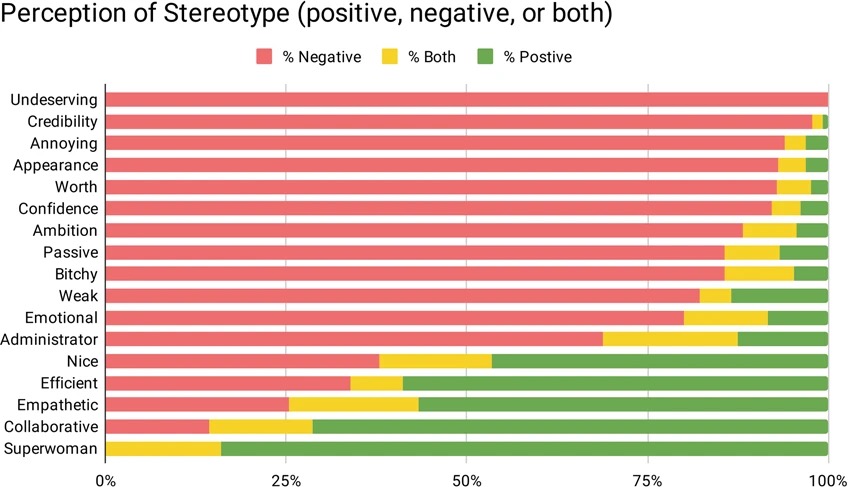
(Excerpt from McKinnon, Merryn, and Christine O’Connell. “Perceptions of Stereotypes Applied to Women Who Publicly Communicate Their STEM Work.” Humanities and Social Sciences Communications, vol. 7, no. 1, 25 Nov. 2020, http://www.nature.com/articles/s41599-020-00654-0, https://doi.org/10.1057/s41599-020-00654-0)

 The Society for Communications Research