by Jackie Logwood, Stephen Lopez, Dustin Malek & Tony Rodriguez
Amy Schmitz Weiss is a research professor at the School of Journalism and Media Studies, at San Diego State University. Her 2020 paper titled Journalists and Their Perceptions of Location: Making Meaning in the Community is an attempt to better understand the role location plays in journalism. It’s one of many papers and research projects Dr. Schmitz Weiss has conducted over several years.
“The article is one of several that I’ve done that look at the idea and the framework called spatial journalism. That is an area that I’ve been developing for several years now that looks at…how journalists do their work from a lens of location,” says Dr. Schmitz Weiss.
Read more: Interview with Dr. Amy Schmitz Weiss on her research paper, Journalists and Their Perceptions of Location: Making Meaning in the CommunityThe role of location and journalism is long-standing and, in many ways, obvious. After all, newspapers are often location-based. The New York Times, The Chicago Tribune. The Fayetteville Observer. For centuries newspapers have been serving specific communities, covering local elections, high school sports teams, community events, and the like. Location and journalism are not a new concept but that doesn’t mean there isn’t room for improvement. Nearly every person in the developed world carries a GPS device in their pocket and uses apps like Yelp that can direct you to the best pizza or hamburger in any given city. How the technologies of today improve journalistic practices that have been around for centuries is at the heart of Dr. Schmitz Weiss’s research.
For this study, Dr. Schmitz Weiss interviewed twenty-one journalists from three different media organizations that use software to geotag the location of the stories they report on. The interviews represent a form of qualitative research known as grounded theory. Grounded theory collects data, in this case, answers to interview questions, forms concepts from that data, and groups those concepts into categories. Through these twenty-one interviews, Dr Schmitz Weiss identified recurring themes and insights. Those were grouped into six categories which eventually consolidated into three. This is the final phase of grounded theory research which is where the data is analyzed and interpreted to identify relationships and connections between the categories.
“Basically the grounded theory approach entails diving in and reviewing all the material that you have. In this case, all the transcripts, the 21 reviews going through and at first identifying what the explicit information that’s there, what people say in the actual wording, and doing a first read of that, and then going back through that a few more times, two times, three times, four times to re-review what’s coming up that’s implicit, that could be garnered out of the deeper meaning of what people are saying, and then identifying how they may translate with the specific themes or concepts, and then grouping them accordingly,” says Dr. Schmitz Weiss.
The three categories that the research led to are as follows. Location as a meaning maker, location as an organizer, and location as a communicative challenge. This article offers a cursory overview of each category. It is in no way meant to represent the extensive research Dr. Schmitz Weiss has done on the topic of spatial journalism but rather to display the outcomes the research uncovered using grounded theory research.
Location as a meaning maker is the idea that we as people ascribe meaning to a place. The example Dr. Schmitz Weiss used in our conversation was a person’s favorite coffee shop. To one person it might simply be another coffee shop, to someone else that might be where you wrote your first screenplay or worked your way through college. Readers will engage in a story about a place they care about. Understanding which places people in the community have an outsized connection to provides a helpful context for journalists and can potentially drive readership.
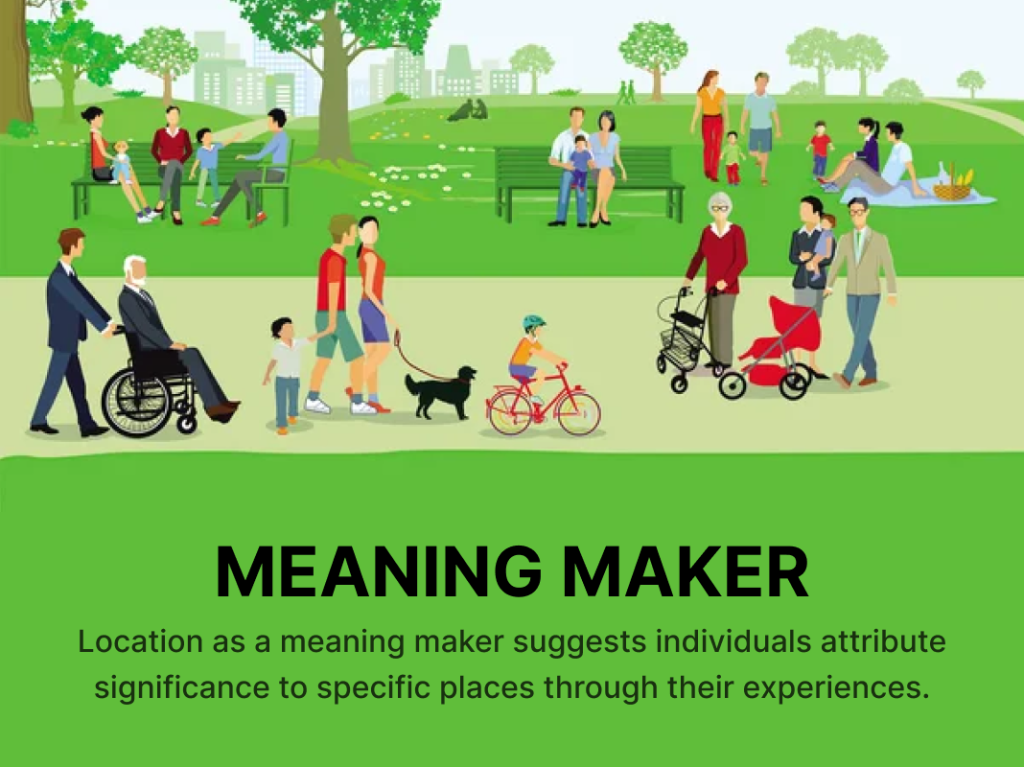
“Spatial ideology takes the idea of what we put in our mind as what’s close and has meaning to us and puts it within the context of space and place is how we associate information and how we make decisions from that information of how important it’s to us or why we would want to know more about it,” says Dr. Schmitz Weiss.
Location as an organizer is helped by the technology that some news organizations use allowing them to geotag the stories they cover. This technology gives newsrooms a visual representation of where news is happening. In the past, a newsroom might have had a sense of where news was happening but they wouldn’t have hard data, now they do. Although this does bring about certain challenges. As one of the publishers, Dr. Schmitz Weiss interviewed explained in the research paper.
“Not everything that you cover should be eligible for this sort of thing. Like, if you’re down at City Hall and you’re writing a story that ultimately takes place at City Hall, people don’t need to see that on a map, because it’s a City Hall story, right? It’s not a geographically linked thing.…. We needed the editor to sort of go through and figure out what was appropriate to tag and what was not,” said the editor.

There’s also the issue of privacy. The Austin Monitor has an interactive map on their website where Austinites can see stories based on location. Usually, they geotag stories based on an address. If a liquor store gets robbed, that’s easy, put in the address and move on. But sometimes a story has multiple locations in those cases they have to make tough decisions. The new technology brings up old ethical issues journalists have always faced. Using an exact address could potentially out a source leaving them open to retribution. Or it could be used to identify a victim of a crime. In cases like that, these organizations have to be broad, opting for cross streets or general areas rather than exact locations. While challenges exist, there are numerous benefits. It allows stories to be categorized in new and unique ways and it lets organizations know which parts of the community are underserved.
The last category Dr. Schmitz Weiss found was location as a communicative challenge. Essentially the challenge is convincing news organizations that spatial journalism is a value add that will help drive readership.
“The research shows that when something has space place with meaning to them, they are more interested, they’ll consume it more,” says Dr. Schmitz Weiss.
While this type of grounded theory qualitative research is thorough and can be eye-opening it does have its drawbacks in comparison to quantitative research.
“If you have a thousand people representative of a population for a quantitative study, you might be able to say because of X, Y happened based on statistics…. with qualitative you’re not going to have a large enough sample to say, because of X, Y happened with twenty people,” says Dr. Schmitz Weiss.
Still, qualitative research has many advantages. Dr. Schmitz Weiss continues.
“…with that said, qualitative research can still show the validity in the layers of nuance and deep meaning that comes out of those 20 people that shows specific patterns, similarities or differences.”
 The Society for Communications Research