By: Alexa Olmos, Dulce Garcilazo, Haley Lopez, Mia Mendoza

Gayle Jansen Brisbane is a former broadcast sports journalist and current associate professor at CSUF, teaching TV news and sports journalism. Brisbane, Ph.D., studies women’s progress in sports media and how religion, politics, and media intersect today. She holds degrees from CU Boulder, Chatham University, and Pepperdine. The research study titled “Side-by-Side Sports Reporters: A Between-Subjects Experiment of the Effect of Gender in Reporting on the NFL,” written by Brisbane, analyzes gender representation in sports journalism, more specifically in the NFL, as well as highlights the importance of ongoing studies to understand biases in sports media.
Key Findings:
Brisbane studies indicated that audience perceptions of gender in sports media reporting have evolved. She highlights previous research that emphasizes biases favoring male reporters. However, her study found that such biases have decreased. This suggests that there is a shift towards more diverse and equitable views regarding gender in the sports industry.
MORE
Q1: How did you go about the variables like attractiveness or experience in selecting the journalists for the videos?
To fairly examine perceptions of credibility and knowledge, Dr. Brisbane was careful to control key variables. She selected two professional sportscasters, one male and one female, who were similar in age, attractiveness, and experience in the sports business. She even pretested their attractiveness by having a small group of people rate them to ensure one wasn’t significantly more attractive than the other. By holding these factors constant, the only major difference between the two presenters was gender. This approach allowed participants to focus solely on the sportscasters’ credibility and knowledge rather than other factors.
Q2: The study focuses on fact-based vs. Opinion-based reporting– why was this distinction essential?
One of the most important choices in Dr. Brisbane’s study design was the decision to compare fact-based reporting versus opinion-based reporting, specifically in the context of NFL coverage. The NFL, a hyper-masculine sport with no female players, has often drawn criticism regarding how women in the media are treated when covering it. Female sportscasters are frequently dismissed with comments questioning how they could possibly understand the game if they haven’t played it.
With this in mind, the study tested whether audiences would perceive female reporters as equally credible when presenting objective facts versus offering a personal opinion. Participants watched one of two versions of the same script: one version simply outlined recent NFL rule changes, while the other included a measured opinion about why those changes might not be a good idea. Both male and female reporters delivered the exact same words in the same setting to ensure gender was the only variable.
Following this format, the researchers had to ask themselves a critical question: if a woman presents facts, she might be seen as neutral or acceptable, but does that same credibility still hold if she offers her own opinion or takes on the game? Would viewers accept her expertise when expressing an opinion, or would misogyny and stereotypes surface? By repeating and refining the recordings to be exactly the same, Dr Brisbane ensured the experiment tested audience perception with complete consistency, making the gender-based insights even more compelling.
Q3: What challenges did you face during your study, and how did you overcome them?
While designing a study that isolates gender bias in sports journalism, Dr. Brisbane faced several challenges, particularly when it came to gathering participants. She wanted to move beyond the limited approach many academic studies take, which often rely solely on college students. This method typically skews younger and more females, which could distort results for a topic like NFL reporting that traditionally draws an older male audience.
Initially, the study had a limited number of participants. To address this, Dr. Brisbane and her co-author invested in Amazon Mechanical Turk, a platform that allowed them to collect data from a wider, more representative demographic across the United States. This approach brought in a diverse mix of participants by age and gender, with a particularly valuable number of older male respondents—the exact audience they aimed to understand.
Financial limitations could have held the project back, but with funding support from her co-author, Dr. Brisbane was able to scale the study in a meaningful way. The result was a participant pool that better reflected the actual audience consuming televised NFL coverage, strengthening the relevance and impact of the study’s findings.
Q4: Were you surprised that your findings differed from those of prior studies?
Dr. Brisbane explained that she wasn’t entirely surprised by the results as being a part of the sports media industry for 20 years, she was hopeful there would be more of an acceptance of women in sports. She had hoped that her findings would prove no difference, showing how strongly women had made progress. For Dr. Brisbane, it meant that women in sports media have made credible strides and moved beyond the topic of bias/discrimination in the industry.
Q5: How do these findings compare to older studies that showed clear gender bias?
Dr. Brisbane notes that many older studies it was often focused on women’s physical attraction rather than their professional efforts. Through Brisbane’s own study, she focuses on her connections in the business to get an assessment from current sportscasters. Brisbane believed that previous studies focused too heavily on a woman’s looks, so in her own study, Brisbane branched out and got findings from women in sports media showing their professional credibility rather than looks.
Q6: What do your findings suggest about the sports journalism industry, specifically female sportscasters?
Dr. Brisbane shared that her findings highlight the growing recognition that women belong in sports media and that their opinions are valued for their credibility and knowledge. She explained that when women approach sports journalism in a professional way, they are just as capable as their male counterparts. Today, women are increasingly seen as valuable contributors in the field, offering meaningful insights into the games themselves. Dr. Brisbane believes her findings and this ongoing evolution will open doors for even more women to make their mark in the industry.
She also expressed that it’s encouraging to see women in sports media being more accepted, hoping this trend continues. However, she acknowledged that challenges remain, including sexism and unequal treatment. While there’s still work to be done, Dr. Brisbane believes it’s important to recognize the progress made. Although achieving complete gender equality has yet to be achieved, the gap is narrowing. Her findings ultimately point to a positive shift in the industry that supports female sportscasters’ continuous empowerment.
Case-Study Participants Information
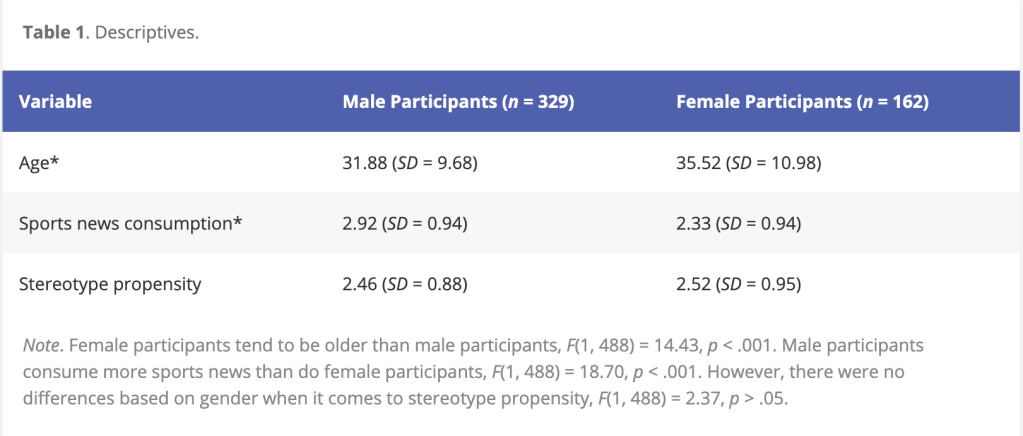
Brisbane, G. J., Ferrucci, P., & Tandoc, E. (2021). Side-by-Side Sports Reporters: A Between-Subjects Experiment of the Effect of Gender in Reporting on the NFL. Communication & Sport, 11(1), 115-134. https://doi.org/10.1177/2167479521995462 (Original work published 2023)
Case-Study Sampling Method
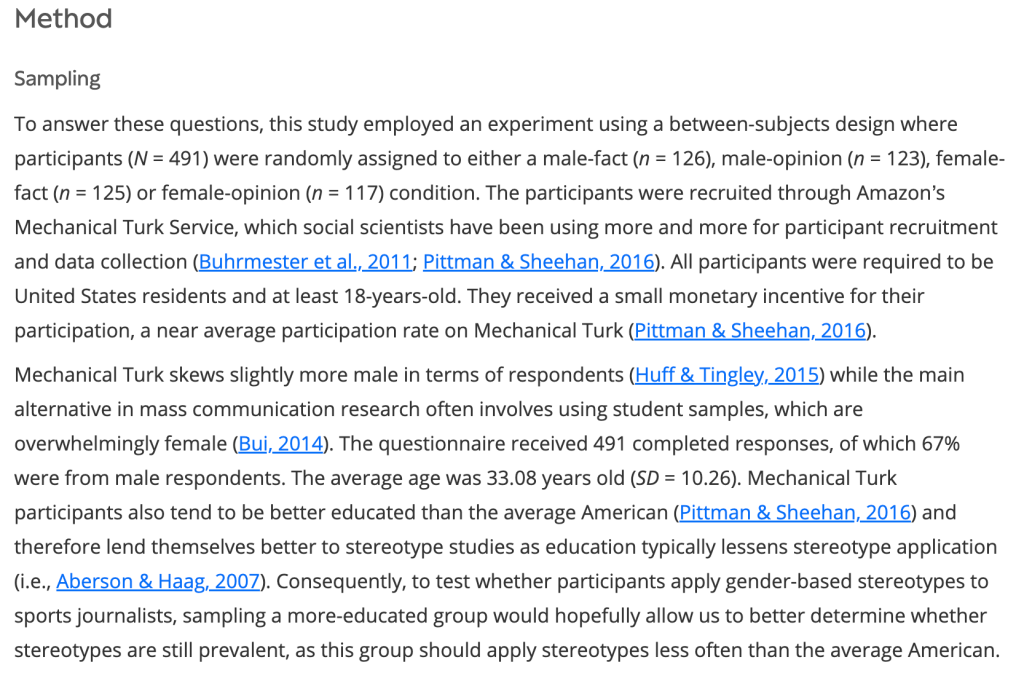
Brisbane, G. J., Ferrucci, P., & Tandoc, E. (2021). Side-by-Side Sports Reporters: A Between-Subjects Experiment of the Effect of Gender in Reporting on the NFL. Communication & Sport, 11(1), 115-134. https://doi.org/10.1177/2167479521995462 (Original work published 2023)
Clipped Interview
 The Society for Communications Research