By Denise Luis Cruz, Lauren Lujan, Eito Sugai, and Grace Tran
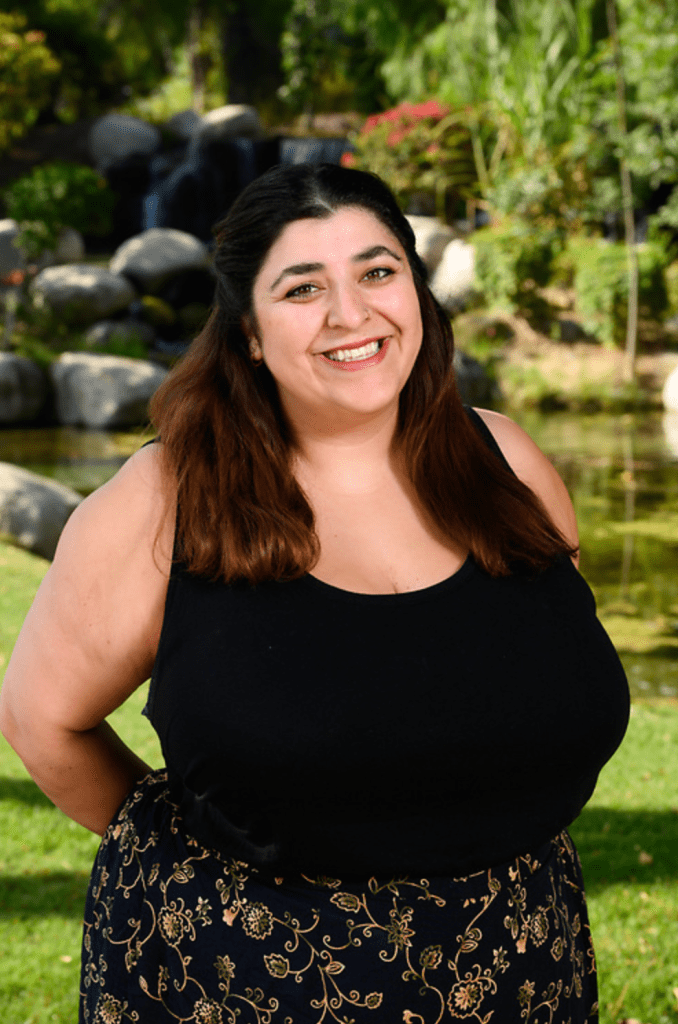
We had the privilege of interviewing Dr. Farnosh Mazandarani, a social scientist and methodologist. She holds a PhD in Communication and Media Studies from the University of North Carolina at Chapel Hill. She began her studies at California State University, Fullerton, where she obtained her M.A. in Mass Communication and B.A., double majoring in Entertainment Studies and Radio-Television Film. Dr. Mazandarani is a part-time lecturer who teaches Mass Media Ethics and Entertainment and Society in the Department of Communication. Her experience includes working for Disney ABC Television Group as a commercial clearance coordinator. She was also a production assistant for Nickelodeon Animation Studios’ hit show The Fairly Oddparents. Professor Mazandarani’s research specifically focuses on pornographic media content and its influence on relationship assessments.
During our interview with Professor Mazandarani on her thesis, “Millennial Perceptions of Pornographic Media, Realism, and Influence on Relationship Assessments,” we were given important insight on how to shape our study. A profound layer of her work lies in her analysis of how perceptions formed in media conception translate beyond the realm of pornography and into broad but impactful aspects of life during our interview. She emphasized that media, especially highly visual and emotionally charged content like pornography, has a strong influence on how people subconsciously form beliefs, often reinforcing stereotypes and shaping how we see ourselves and others in real life.
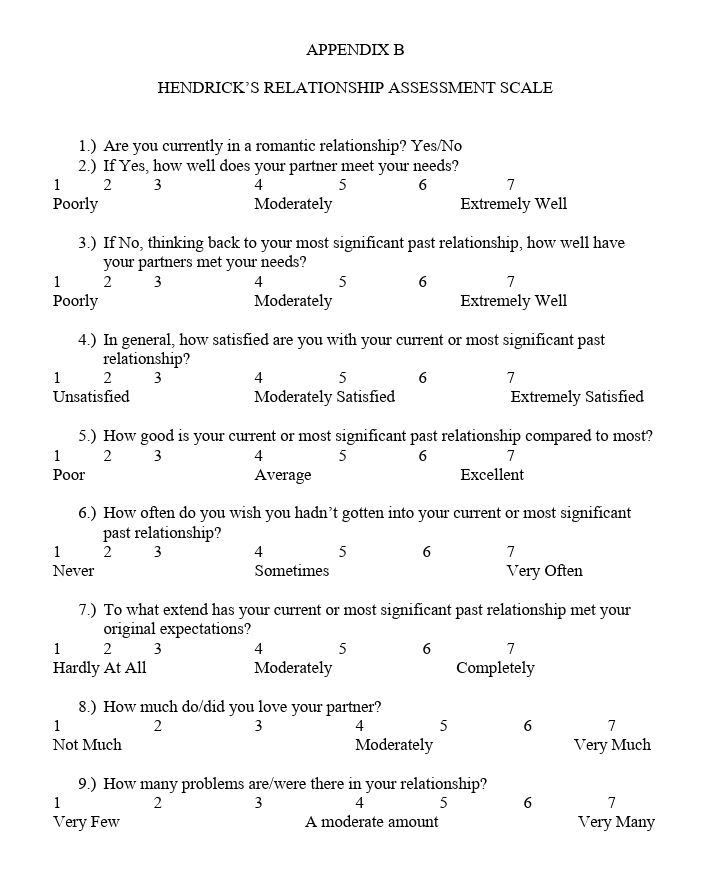
An example of one of the assessment scales used in the study.
This helped us recognize that how people interpret media realism doesn’t just impact their romantic or sexual relationships. It shapes how they internalize and navigate systems of race and power, and they are more broadly identified. Professor Mazandarni explained to us how, in everyday life, we can see examples of this and how individuals form expectations about people based on ethnic backgrounds, from what they consume in movies, news, coverage, and other media outlets. Professor Mazandarni discusses how the adult entertainment industry perpetuates racial stereotypes and capitalizes on racial fantasies and fetishes. After the murder of George Floyd, porn sites were flooded with offensive racist content, following the Black Lives Matter Movement. During our interview, she mentioned that pornography websites often have a massive number of racist titles, ultimately profiting from racism.
Research suggests that the perception of realism in the categories can subconsciously validate the belief that these portrayals represent how people form these beliefs and how they think certain people should behave. Her insight and work show that media literacy must include understanding how media reinforces systematic racism. Mazandari also pointed out that pornography consumption has increased over the years. She referenced that back in 2018, Hawaii residents woke up to an emergency alert on their cellular phone to seek immediate shelter due to an incoming missile. After a second message was sent declaring it was a false missile alert, there was an increase in traffic from users in Hawaii watching pornography.
Professor Mazandarani didn’t shy away from letting us know the reality of conducting research. Things are rarely going to go the way you planned, and most times, you’re going to have to switch your plans midway. She talked to us about how staying flexible is a key way to not block ourselves into a corner and make it harder on ourselves. Professor Mazandarani mentioned to us that her 2016 research was basically a 3 in 1 study. Because she was just starting off as a researcher, her determination to prove everything all at once complicated her overall operation for her study and took a lot longer than anticipated. She also talked about how, because of how her study was formatted, she felt like she wasn’t able to go in depth with each topic that she touched base upon and that she “doesn’t think this study is all that good” compared to the recent studies she has conducted and published. Professor Mazandarani mentioned that if she had the chance to redo the study over again, she would focus on one topic rather than having everything thrown together.
Limitations were another topic that she talked to us about, and how some research has a limit to which you can go before you start to face backlash or lack of information. With Professor Mazandarani’s topic being sexual, an already taboo topic, pre-existing research was scarce, and there were a lot more rules put into place to make sure that research couldn’t go past a certain point. She understands that there are safe measures to protect the public, but at the same time, it’s only hindering researchers like herself from fully understanding human nature and putting that research to good use in other channels like media and relationship evolutions.
The way she formatted her study was intentional, and the Likert Scale surveys and purposefully worded questions were all calculated to the smallest detail to make sure that the results she was collecting would benefit her, either by proving her point or showing her in another direction. She noted that finding the “perfect” way to collect data is never easy and that we should spend a good amount of time focusing on what kind of data we want to collect, how, and why. Many iterations of her study were revised and changed to make the operation as streamlined as possible. We, as students with ample information provided to us by the Pollack Library and other applications online, should take advantage of everything that we can get our hands on. She helped us understand that in any research study, everything is connected, no matter the topic. We were also reminded how important it was to identify our independent and dependent variables early on because that is always so crucial for guiding the direction of any research study. By understanding how these variables interact, it became easier to figure out what kind of data we needed and how to build our study step by step. It made research feel less overwhelming and more like a process you can follow and make sense of.
After interviewing Professor Mazandarani, our team has a clear understanding of what we are going to do moving forward. We have a solid idea of what we want to do for our research project. She informed us that flexibility is key when conducting research, and it is crucial to have a plan if things don’t turn out how we want them to. Ultimately, it is valuable to take advantage of our campus resources, such as the Pollack Library.
A glimpse into our interview with Professor Mazandarani: https://youtu.be/U9InUeqOWoI?feature=shared
Citations:
Mazandarani, Farnosh. Farnosh Mazandarni Headshot. 2025. https://www.farnosh.com/frontpage/whothehellami
Mazandarani, Farnosh. Real or Ideal: Millennial Perceptions of Pornographic Media Realism and Influence on Relationship Assessments, ProQuest, 2016.
 The Society for Communications Research