By: Jessica Marquez, Audrey Sanchez, Isaias Galvan, and Jacob Medina
Introduction:
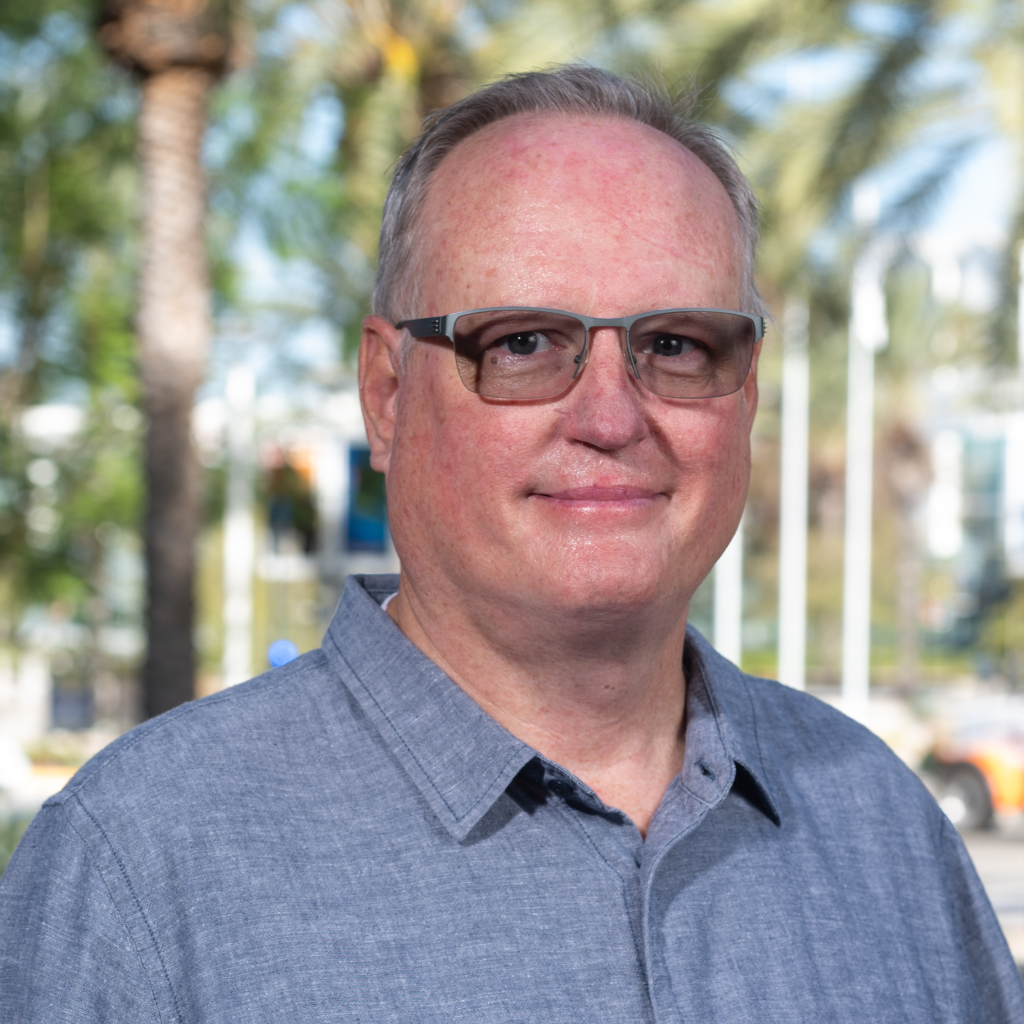
Dr. Ed Fink is a Faculty Emeritus and Professor of Cinema and Television Arts at California State University, Fullerton. With an impressive academic background, Dr. Fink holds a Ph.D. in Mass Communications and an M.A. in Telecommunications from Indiana University, as well as a B.A. in Theatre and Drama from Valparaiso University. Since joining Cal State Fullerton in 1990, Dr. Fink has played a huge role in the growth of the College of Communications, advancing to Full Professor in 2006 and later serving in multiple leadership roles, including Director of the Faculty Development Center, Associate Dean, and Dean of the College of Communications. One of his most notable achievements was authoring the proposals that created the B.A. degree and department of Radio-TV-Film in 2001, now known as Cinema and Television Arts. Dr. Fink is recognized for his dedication to teaching, advising, and scholarship, authoring four textbooks and publishing articles in respected journals. His expertise has been showcased at numerous professional conferences, and he continues to serve as a division officer for the Broadcast Education Association. Beyond academia, Dr. Fink is known for his successful fundraising efforts, commitment to service, and contributions to both the university and professional community.
Q1. What inspired you to conduct this research study?
When talking to Dr. Fink told us that this study was conducted for his doctorate dissertation back in the 1990s when he was attending Indiana University. The study was originally 300 pages and had been cut down multiple times to the copy that we see today. As a graduate student, Fink was studying mass communication and taking many classes focusing on research methods, where he had to conduct a lot of survey research and design. What inspired him was one of his professors named Egon Guba. He had written a book called Naturalistic Inquiry, which was a study on teacher satisfaction. After his study, Egon realized that they had missed a couple of variables, which led him to question the whole science paradigm. His professor’s questioning of the paradigm sparked an interest in Fink to also ask the idea of mass communication. Unlike physics, chemistry, or civil engineering, mass communications doesn’t just use one method of research but can use all of them depending on the research question you have. With these questions that Dr.Fink was having about mass communication research, he realized he wanted to make this his dissertation topic. By doing so, he was hoping to find clarity on what researchers do in the field of mass communication. From there, he conducted a literary review and found that there were three traditions, social science, interpretive, and critical studies, that all the journal articles he read fell under. Fink then went on to formally conduct his study, trying to prove his thesis that “all or at least most of the research of mass communication falls into these three broad, broadly defined research traditions”.
Q2. What were some of the challenges you faced while conducting this research/collecting the data?
Dr. Fink stated that there were quite a few challenges when conducting his research. The first was intercoder reliability, which meant that he had trouble defining all these terms, along with not quite knowing how to operationalize them once they were defined. He also had issues later down the line with the wording he used in his study, which led to people going over his dissertation to question the findings he collected. The second issue he ran into was with the reliability of his coding. The graduate students that he had hired as coders were not coming up with the same answer for the ten articles they were given, falling short of the 70% reliability standard. To fix the problem, Fink went back and fine-tuned his definitions, along with giving the graduate students ten additional articles to code. This second round got his reliability scores up to where they needed to be. The third problem was time; Fink was a new professor at Cal State Fullerton when doing this research. Meaning that he had to find time in between teaching and treading to collect the data that he needed, often using times like spring break to get most of the intercoder reliability ready.
Q3. If you could do this study again, what would you do differently?
If Dr. Fink had the opportunity to conduct his study again, he mentioned that there are several things he would do differently. One of the main changes he would implement is the use of mixed methods. He explained that mixed methods research has become increasingly popular among researchers today. This approach combines both qualitative and quantitative methods, allowing for a more comprehensive understanding of the research topic. Dr. Fink also discussed using a mixed method design that would include surveying participants, conducting focus groups, and incorporating experiments. He believes this approach would allow for a deeper exploration of the research question and would help capture different perspectives within the data. Dr. Fink also noted that researchers today often work across multiple traditions, leading to less coherence within a single method and more crossover between research approaches. If conducting the study today, he would create new coding instruments that account for this blending of methods, allowing for a more flexible and accurate analysis.
Lastly, Dr. Fink expressed the importance of being open-minded and considering the possibility that mixed methods might even be viewed as a fourth tradition in research. He explained that recent readings and studies he has explored highlight the growing use of mixed methods, suggesting that researchers should recognize this evolving trend and incorporate it into their work. Overall, Dr. Fink emphasized that mixed methods would play a key role if he were to conduct the study again.
Q4. How did you determine how long you would collect the data?
While working alongside his mentor, Dr. Fink aimed to determine how many studies he would need for his research to be considered credible. He was also trying to complete his work within a shorter time frame, ideally avoiding a two- to three-year process. After factoring in the time it typically took him to thoroughly analyze each article, as well as his financial situation, Dr. Fink ultimately decided to work with a sample of 253 studies. Out of those 253, eight were identified as outliers. Upon closer examination, Dr. Fink noticed that these eight studies posed research questions that didn’t align with the conditions of his research. The questions were either too vague or misaligned with the goals and methods of his study, making it difficult to draw meaningful conclusions. Many of the questions appeared to be rooted more in mass communication perspectives, but they lacked clear indicators that would classify them as falling under social science, interpretive, or critical approaches. As a result, Dr. Fink chose not to include these outliers in his final analysis. He did not view them as mixed-method studies either, as they didn’t meet the criteria or demonstrate a clear combination of methodologies.
Q5. What methods did you use to collect and analyze the data? (qualitative or quantitative or a combination of both for this study?
Dr. Fink said that he used a quantitative method for performing this study. While defending his dissertation, it was brought to his attention that it might be problematic to use one of the three paradigms to research them. He argued that the social science paradigm–numbers and data–was the most reliable and formal method for proving whether or not the proposed paradigms were the most commonly used in mass communication studies. Taking his research question into account, “Does it seem that the three research traditions guide the studies that are published in the field of mass communications?” he found that a formal content analysis was the most appropriate method.
Q6. Did the study’s results come out how you expected, or were you surprised by your findings?
Dr. Fink explained that the results of his study came out as he expected. He mentioned that the process involved reading many internal articles to help define the three research paradigms and their operational variables. Out of 253 articles, Dr. Fink found that eight studies fit within these paradigms, which made sense to him. He explained that when a research paper is submitted, it goes through a peer-review process where editors select reviewers who specialize in that specific area. These reviewers come from one of the three traditions or paradigms identified in the study: critical studies, historical, and social science research. For example, Dr. Fink noted that critical studies tend to make value judgments, historical articles often use interpretive methods, and mass media effect studies rely heavily on quantitative measurement and social science techniques. That being said, it did not surprise him that reviewers were often aligned with these paradigms.
However, Dr. Fink was surprised by some findings, particularly with the idea of generalizability within the social science paradigm. He expected to see more instances where researchers stated their study could be generalized to a larger population. He found that most studies limited their claims, likely because their sample sizes were small or specific, such as college students aged 18-25. Dr. Fink also anticipated more generalizability within critical studies, especially regarding calls for social change, but found this to be less common than expected.

 The Society for Communications Research