Gallery

Why Are Young Adults Using CDs In A Digital Era?

By: Kaylah Preechakul, Kate Villacin, Genelle Gogue, Isabel Araiza
Dr. Waleed Rashidi

Dr.Waleed Rashidi is a professor at California State University, Fullerton in the Department of Communications. He received his B.S. in Communications-Journalism from Cal Poly Pomona, his M.A. in Communications from CSUF, and ended with his Ed.D from the University of La Verne. Rashidi is well-versed in all things entertainment & tourism and public relations. He previously served as the editor in chief of Mean Street Magazine and hosted several radio shows. Rashidi now passes on his experience and wisdom to all curious CSUF students who are so grateful to learn alongside an expert.

Waleed Rashidi conducted a study researching how young adults still use compact discs and what they are doing with them. Specifically, he wanted to know how they were purchasing CDs and why. This topic piqued his interest because while CDs may have been the medium that introduced this demographic to music, most younger generations use streaming as their primary listening platform. However, over the last couple of years, there has been a unique demographic of younger people purchasing CDs. Rashidi was interested to find out this information in an era where the consumption of music is primarily streaming, especially for the younger demographic. With this study, he aimed to catch this transitional moment in media and research the gap on the fading format.

Read More: Why Are Young Adults Using CDs In A Digital Era?

Conducting a research study during COVID-19

His target audience is Generation Z and younger millennial age groups. To begin his research process, he narrowed the target age group to 18-26 year-olds. His sampling frame consisted of college students at CSUF. He put together a survey on Qualtrics, including both qualitative and quantitative data. He then sent an email blast to the student population. The survey was open for any student of any major to take, so the data was not gathered from just Communication majors. To encourage students to take the survey, as an incentive, he gave out gift cards with a small sum of money to students who completed the survey. He concluded that 50 responses would be enough to generalize the data to the population. In total, he received 57 responses: 52 complete responses and five partial responses.

Rashidi strategically chose to incorporate a blend of qualitative and quantitative methodologies in his research, recognizing the important benefits of both for more accurate data in this study. While the emphasis leaned more toward qualitative techniques, a conscious effort was made to strike a balance. The survey predominantly featured open-ended questions for students to answer with no bias surrounding others, structured around “why, where, and how,” aiming to elicit in-depth responses.

The utilization of Qualtrics as a survey tool greatly facilitated the collection of such qualitative data. In ensuring the reliability and validity of his study, Rashidi took deliberate steps, such as engaging a substantial sample population. The concept of data saturation, where the sample size is adequate, representative, and comprehensive enough for broader generalizations, was a vital consideration. Notably, the surveyed students’ average age stood at 21.5 years, contributing to the demographic understanding. Despite the challenging backdrop of the COVID-19 pandemic, Rashidi managed to collect a total of 57 responses, including two partial responses. Despite the limitations imposed by the circumstances of quarantine and COVID-19, this sample size was deemed sufficiently representative for the experiment.

In terms of the survey information provided, Rashidi made his survey questions based on the main focal points of his study. Rashidi also provided requirements before students could answer his survey. As stated, they have to be 18-26 years old and had to have purchased a new CD in the last year. This ensures that he reaches his target audience. The media and technology is evolving day by day, Rashidi wants to make his questions specific to discover how the younger generation is listening to music.

This nostalgic way of listening is still being used. To find out why, Rashidi’s survey consisted of these questions. When was the last time you purchased a NEW CD? Rashidi found that many of his participants purchased CD’s in May 2019-2020. Why did you purchase a new CD? Where have you bought your recent purchase? (What was your source?) Where did you play your new CDs? What devices did you use? (computer, DVD player, boombox, home stereo) Why do you currently play CDs? He decided to make this an open ended question which gave room for additional information. How many CDs do you own? How many new and used CDs have you purchased? Will you continue to purchase new CDs in the future? Why are you expecting to purchase new CDs? What genres of music do you listen to on CDs? Rashidi provided options of pop, rock, country, and more. Which of these audio playbacks do you use? (Many of his participants responded with options like vinyl, cassettes, downloads, and streaming. These questions were responded to by 57 students and Rashidi was able to make his analysis and see what mark CD’s have made on the younger generation.

Rashidi’s role in the research landscape is focused on observing the evolving trends in how the younger generation engages with media. His aspiration is to witness and contribute to the continued evolution of these trends over the coming years. Essentially, Rashidi’s work embodies a dedication to observing the dynamic shifts in media consumption patterns among younger demographics and generations. His eagerness for ongoing exploration and analysis in this field reveals a commitment to understanding the evolving landscape of media usage, reflecting a desire for continued investigation and interpretation in this domain.
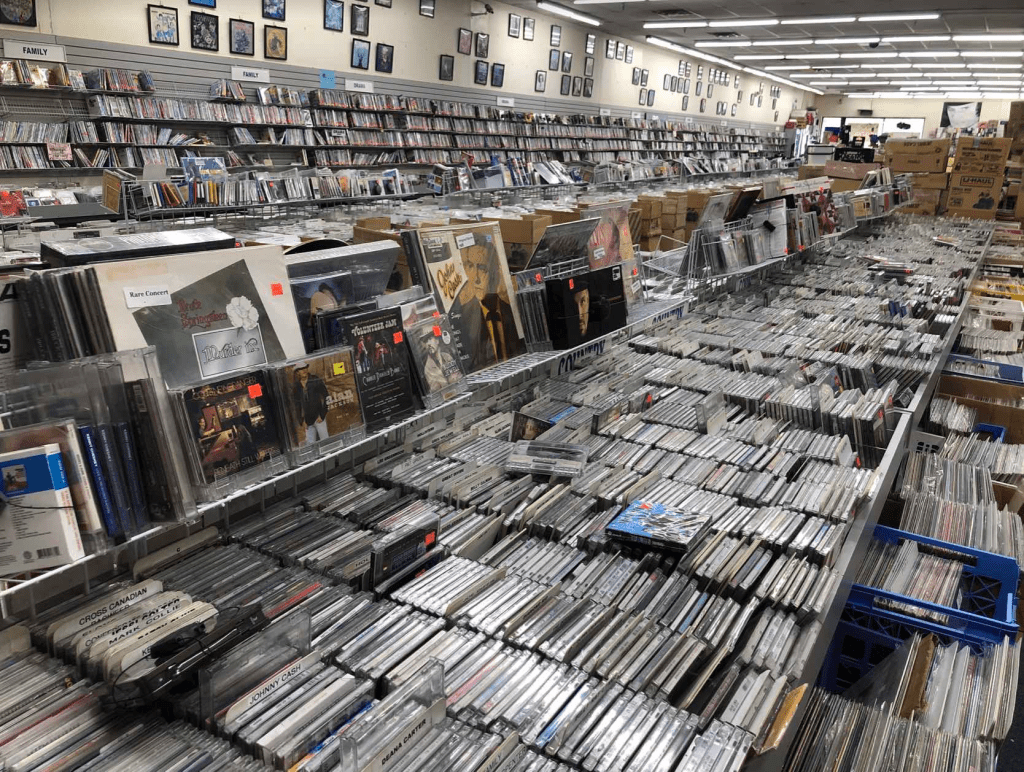
Courtesy of the CD Depot

Will CDs ever truly fade?

Researching the usage of CDs in a generation where everything is done through online services and streaming was an interesting choice, and Rashidi is well aware. His thought process behind this niche area of research was to catch a fast moment as it’s going by. As cars with CD players start to become less and less, CDs may also be used less and less. Rashidi is also aware of the resurgence of the “retro” trends coming back, such as vinyls, therefore, Rashidi believes CDs will never fully go away. There is an important history behind CDs, and there’s always a nostalgic feeling behind it. When this generation was growing up, many of their family members showed them their music via CDs, and people remained so loyal to this medium for that reason. Now, when they see their favorite artists come out with a CD of their new album, they feel as though they must get it for loyalty and nostalgia. Regardless if we are in a digital era, CDs will never fully leave.

Video of Waleed Rashidi Interview

Conversation with Dr. Puente on “Marketing and distribution lessons from Hispanic Hollywood”

By Donya Mirtabatabaie, Una Ahac, Gabby Leon-Acevedo

Dr. Henry Puente, an Associate Professor of Communications, focuses on researching U.S. Latino films, media outlets, and race/ethnicity. With a diverse entertainment background, he brings experience from special events, radio, television, newspaper sales, and film distribution. Puente authored “The Promotion and Distribution of U.S. Latino Films” and contributed to journals and books on media and stereotypes. Originally from Azusa, California, he enjoys traveling extensively across the United States, Latin America, and Europe. Since 2006, Puente has taught courses at CSU Fullerton, held a Ph.D. from the University of Texas at Austin, an MA from U.S.C., and a BA from CSU Fullerton.

Read more…

Q.  What inspired your research for this particular topic in the study?

He wrote a dissertation on Hispanic films in media and wanted to write something original. He tried to figure out why there were so few films about the Latino population. If they are a growing population in the US, why aren’t Latino movies more significant and popular? 

Q.  Are there any personal connections to this study, and is there one particular moment you would like to elaborate on?

Aside from his ethnicity drawing him into his study, he used to work in distribution and sales in the film industry, which tied into the study. However, there were not a lot of Latino movies made, so he wanted to highlight why that is and use data to show what that looked like as well.

Q.  Were there any facts or elements in the study that were different than you had initially thought before going into this study? What were some challenges when conducting the research for this study?

What surprised me when going about it was research because he had already come from the film industry, so he knew what he was getting into. However, he found the people he spoke to bitter because some of the people he talked to who worked on these films were expecting to have more work moving forward in their careers and didn’t. People felt disillusioned because they worked on the big movies and were left out of work. He had already lived it, lived in the world of cinema. There were lots of challenges trying to find the people who worked on the movies; there was no contact information and not too much social media to go from either; he felt he was a detective at times, trying to get the people to talk to him was challenging, trying to get them to be honest with him was difficult. Most people he spoke to were bitter, upset, and unhappy.

Q.  Several years from now, would you want to approach this study again and see if there could have been any changes in the data?

He would not want to do this study again; however, he was approached recently about doing a similar study with DC’s newest film, Blue Beetle. He would rather write scripts than write academic stuff. There would be a lot of changes if he were to approach it again; with the element of social media, it would be a lot easier to contact people. Puente says there might be a chance that he will do another study in the same template, but for now, ‘it’s a maybe.’

Q.  How long was the study conducted/How long did it take to finish?

“It didn’t take me that long.” While gathering research was a hassle, writing the study was a simple manner. It took Puente three weeks or less to finish writing the whole article. Now, gathering the evidence, that was otherwise. It took about a year and a half to finish gathering research for this particular article that took three weeks to write. The meaning as to why it took so long was due to dead ends and sources not wanting to talk about the manner at hand. It was understandable as the film industry is huge and comes with its own aftermath talking about a particular subject as to this study.

 Q.  Did you receive any help conducting the study, or did you do everything yourself?

Puente had the upper hand in gathering research since he worked in the film industry during the time of his article. As I said in the earlier section, it did take a year and a half to finally gather evidence due to dead ends, but Puente would ask around his co-workers, gather numbers, and even text for an interview. This would, at times, lead to nowhere, and even some of the phone numbers would be fake, but in the end, he was finally able to contact his sources and gather some information as some were careful about what they would say considering their contract with the production. Now, writing the article, that was all puente.

Q.  How did you feel emotionally when conducting the study? Were you passionate, angry, happy, or anxious?

“Not happy, mix of frustration just trying to talk to people, excitement when having a person wanting to talk.” This is what Puente said when asked about his emotions during the time of his article. It made sense as nobody wants to be shut down from their project or, in this case, study. His case had ups and downs, but in the end, Puente was able to rise to the top and write the article “Marketing and Distribution Lessons from Hispanic Hollywood.

Q.  What made you choose the research methods you went with?

While Puente voiced that qualitative research was very difficult, when asked why he chose it over other methods, he said that it was the best method for what he was trying to accomplish in his study. He also mentioned that quantitative research is not his strong suit and that it would not have worked anyway. 

Q.  What advice would you give someone interested in pursuing a similar research study? 

When asked if there was anything he wished he had known prior to conducting his research, Puente had a few suggestions. The first thing he mentioned was IRBs (Institutional Review Boards). An IRB is a group of people responsible for ensuring that research involving humans is conducted in an ethical and safe manner. Puente highlights that it was a complicated process to get IRBs approved. He also talked about how doing qualitative research was a very difficult process. For his study, he had to transcribe all the answers of his interviewees, which he notes was a very long process. 

We also asked Puente if he had any advice for those looking to do similar qualitative research. His most significant piece of advice was to “ask good questions and try to keep people on task.” He mentions how those being interviewed can often go off on tangents and get off-topic. He also added that if they do go off on tangents, to only transcribe the portions where they are answering questions. When it comes to the questions asked, he also mentioned that a good question is very important and also challenging. He says questions should not be too specific or too broad. 

Q.  Were there any notable differences in opinions, beliefs, or attitudes among participants or subgroups in your study

Puente noted that among those he interviewed for his research, there were a couple of different attitudes people had toward the subject. Some were extremely excited to speak on the project they had worked on and were proud. On the other hand, there were others who were more upset. They had expected to gain careers and new opportunities from working on the movies they had taken part in and were disillusioned that it did not work out the way they had expected. 

chart from Dr. Puente’s study “Marketing and distribution lessons from Hispanic Hollywood

View our full interview with Dr. Puente below.

Interview with Mark Guohua Wu


By: Brandon Caudill, Tyler Quach, Everardo Serrato & Jericho Tiojanco

Mark Wu, California State University, Fullerton


Mark Wu is a presitgous professor at California State University, Fullerton. He has been conducting his own research and teaching at many prestigous universities all over the world for over 20 years now. He also worked for many Fortune 500 companies across the globe. Professor Wu research focuses more on the Advertising side, winning many awards along the way. With all of his accollades and credibility we felt like he was the perfect person for our group to interview.

We had the privilege to interview Professor Mark Wu on October 25, 2023. We discussed about a variety of topics in terms of research. We started off with a basic question on ways to conduct research and asked him about his opinions on certain topics regarding research. All of us being Advertising Majors as well we were interested in his research that involved social media and how it can be used to advertise products to the consumers of today.

What we wanted to focus on was Professor Wu’s research in regards to Social Media. Bringing up some of his older works like “Traits, Predictors, and Consequences of Facebook Self-Presentation”. We wanted to know how that research would apply in todays social media platforms such as TikTok, Instagram & many others. We were also curious on his thought on AI technology and how it can be used in research today as well. These questions helped us learn more about how to do research and also learn about how research may be conducted in the near future.

Read More: Interview with Mark Guohua Wu

Best Way to Avoid Bias & Errors

When answering this question Professor Wu helped us learn how we can minimize as many errors as possible in our future research. He brought up how there are multiple different forms of research errors such as administrative error, instrument error and process error. He mentions the fact of how one administers their survey can be the difference between a good amount of error and a few.

Another, tip that Professor Wu gave was for sampling and non-sampling errors. For sampling error that is a fixable, by increasing the sample size or by using probability sample rather than convenience sample. While for non-sampling error it is not as easy. The way to minimize non-sampling errors is to make sure the survey instrument is created correctly. This is because non-sampling cannot be fixed after the fact.

The final point that Professor Wu made that we thought was interesting was when he said, “You cannot avoid errors, the best you can do is minimize.” This opened our eyes on how we will conduct research and also approach errors that we may face.

Does your research in “Traits, Predictors and Consequences of Facebook Self-Presentation” apply to social media today?

The thing that Professor Wu brings up when discussing this specific research is that even thought this research paper is over 10 years old, the findings from this research still apply to many of the social media platforms today. What the research paper mainly focuses on how Facebook affects the way people interact and present themselves on the platform.

The reason the Professor Wu believes this is the case is due to human nature and the way that people interact with social media hasn’t changed. He brings up a phenomenon that is used in media called Echo Chamber. An echo chamber in social media is when a person only encounters ideas that reflect their own. This reinforces their ideas that they had already believed. This keeps people on social media because they like to see things that they agree with. Professor Wu mentions the platforms that partake in this phenomenon such as TikTok and Youtube.

Another, topic that Professor Wu mentions that reflect this belief is that we as people are more influenced by what others do more than we know. This is part of the reason why a majority of people post on social media. They basically want to get gratification and assurance from the content that they are posting on certain platforms.

The final point that he talks about is how we as researchers for advertising are always looking to study human nature and how people think. By doing this it allows for researchers to get a sense or idea of what society may think as well.

Sun, Tao; Wu, Mark (2012). Traits, Predictors and Consequences of Facebook Self-Presentation” Sage Publishing.

Ethics of AI technology use in Research

With AI technology such as Chat GPT becoming more significant and many workplace within the Advertising space starting to use it capabilities, we thought it was appropriate to get Professor Wu’s thoughts on this topic. AI technology has become the latest trend in terms of almost everything. This is due to it seemingly unlimited capabilities and its vast amount of information that is pulled from the internet. Many companies hiring nowadays want people who know how to work with such tools, which is why it is important for us to learn more about the topic now.

One of first points that Professor Wu discusses with us for this question is that with AI technology it allows researchers to get a more personal idea of what consumers may want. This is what companies are looking for, so they can directly target consumers with Advertisements that will most likely fit them. The use of AI technology has potential to be used for great things in research.

The view of ethics that Professor Wu had on the use of AI technology in research is, he thought it depends on how the technology is used. He believes that if the tool is in the correct hands than there is nothing wrong with it. But, when organizations start to use AI as a tool to promote propaganda or political agenda then it starts to be used for wrong purpose. Also, if AI is used to exploit people. This is because the ability to gather information about a person or society in general has become much easier than before with AI.

An Interview with Dr. Jeong about Privacy Concerns on Social Networking Sites

Blog post by Alyssa Montes, Taylor Perez, Katie Poppins, and Michael Van de Brooke

We had the pleasure of interviewing and getting to know the knowledgeable Professor Yongick Jeong. Originally from South Korea, a CSUF alumni, now teaching media research and media analysis at Louisiana State University. His interests are in advertising, news and entertainment media, and measuring advertising effectiveness. He’s currently working on a new research project involving AI. Professor Jeong is someone who appreciates different theories which in turn creates a better understanding of his research.

We took an interest in the work he had done with Yeusueng Kim, titled, “Privacy concerns on social networking sites: Interplay among posting types, content, and audiences”. He delves into topics such as SNS (social networking sites), types of posting, the information types, young SNS users, as well as privacy concerns of the audience using Facebook and Twitter.

READ MORE

How do you think the fact that participants were chosen from a mass communications research pool affected the results? How do you think choosing from a group with less of a communications emphasis would have yielded different results?

Dr. Jeong is quick to acknowledge that as a result of who was readily available as participants meant that his findings likely wouldn’t be directly generalizable to the broader population. However, as he explained, when one works in academia at a university, the portion of the population that a researcher has easy access to are the students learning about their field. He added that a more generalizable study would have focused more on individuals of average age, which he posited was the 37-55 age range.

Why did you decide to use surveys to collect data? Did you find any advantages or disadvantages of that decision? Were other quantitative or qualitative methods considered and rejected?

Professor Jeong explained that he used surveys to collect data for his study because of the type of research questions he wanted to answer. He created the surveys based on what information he wanted to discover. By using surveys he was able to understand what people thought about certain issues and how it impacted them, instead of using a quantitative method with less of an opinionated response. He felt that using surveys to collect data allowed him to find out what people were actually feeling and thinking, which improved his data. Professor Jeong found that using surveys was the best way to answer his research questions.

How do you feel that SNS influencer aspirations have affected people’s regard for their online privacy?

Professor Jeong mentioned many theories throughout our interview, but a theory he mentioned that answered this question was the privacy calculus theory. Professor Jeong states about privacy calculus theory that, “…when I decide to share my information, I calculated the benefit and loss, what can I get and what am I going to lose…some influencers because of finance and reward and reputation or interest, they easily give up their benefits or their privacy…and as a consumer we try to calculate.” As humans, we tend to calculate the benefits and losses of a certain decision a lot and this theory is a great way to explain why some people throw their privacy away, because in someone’s mind, the benefits of publicity outweigh the benefits of privacy.

The COVID pandemic made people especially dependent on the internet for work, social life, etc. Do you feel this shift has affected people’s feelings regarding their online and social media privacy?

Within our society, smart devices have become necessary and something we have become highly dependent on. Acknowledging this, Dr. Jeong approaches this question through the use of the concept of the “privacy paradox,” which centers on the matter that many individuals today use the internet and smart devices in their daily lives despite the known dangers of their usage. Despite privacy concerns and information usage, these devices and their counterparts continue to be prominent within our society for a number of reasons, with one being known as the “fear of missing out,” or “FOMO”. Dr. Jeong explains that FOMO can be a big contributor to social media usage as many individuals feel obligated to participate due to the idea that others will know about information they may miss out on. Dr. Jeong continues on to the potential risks, including the knowledge that criminals and ill-intentioned individuals also have access to devices and can do harmful things with our information, but many continue to use them and input their information. He then mentions that with our dependence on devices, there is a need for improvement in policies and regulations within the United States, as other countries have become advanced in those areas for the safety of the individuals. Throughout his response, Dr. Jeong expresses his concern about our increased dependence and dangers that come with our devices and media.

Your study focuses on young adults, partly because they are the largest age group on SNSs as the article says. Did you look into other age groups who may be more vulnerable to privacy breaches?

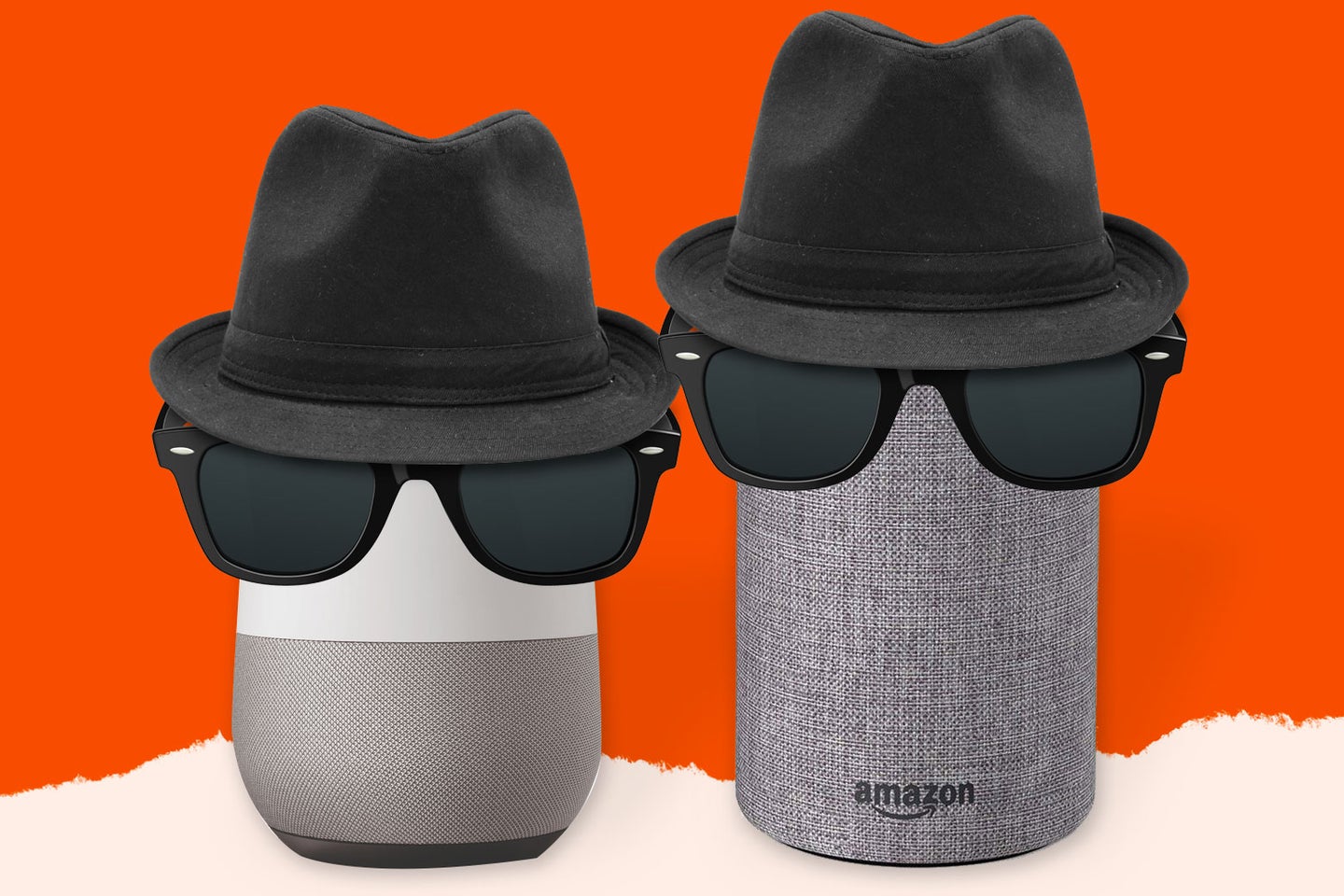
Though Dr. Jeong did not look into privacy issues regarding other age group’s social media use at the time of the study in 2010, he reports that he is now at his current position at Louisiana State University. He is currently focused on privacy matters with relation to artificial intelligence (AI) and smart devices like Amazon’s Alexa, Google Home, and more. He finds his current inquiry to be of great importance, warning us of the potentially existential threat that is AI.

So generative AI is scary, very scary. So when that is combined with technology, then we may see the end of the world sooner.”

– Dr. Yongick Jeong
https://youtu.be/DlUjlYXef_w?si=0S03M_uZ6wiUNTWd

An Interview with Professor Assaf on the Fundamentals of Communications Research

By Aidan McElhany, Jake Cipres, Ashley Abercrombie, and Fernando Calvillo Alcantar

With the rising popularity of social media platforms such as TikTok, Instagram, and YouTube, many have expressed their concerns about how the excessive use of these platforms will affect our mental health and other aspects of our well-being. In particular, the short-form content present on TikTok and YouTube Shorts has been criticized for its potential negative effects on users’ attention spans. Our research study aims to find a correlation between the use of social media platforms and its influence on the attention spans of media users. The study will examine two variables in regard to social media usage. The first is which social media platforms are most widely used. The second is how much time media users spend on each platform on a daily, weekly, and monthly basis. Additionally, the study will examine signs of a shorter attention span, such as restlessness, inability to focus for long periods of time, etc. The data will be gathered through a convenience sample survey consisting of students at California State University, Fullerton.

Continue reading “An Interview with Professor Assaf on the Fundamentals of Communications Research”

Interview with Communications Scholar Elise Assaf on “Journalistic Representations of Mental Health Labels”

By: Dominic Samaniego, Lauren Sharp, Armando Sanchez & Gabriela Angiuli

Elise Assaf

On Tuesday, October 24th, we conducted a Zoom interview with Cal State Fullerton communications professor Elise Assaf. Assaf primarily focuses on public relations studies and entertainment courses for undergraduate-level students in the communications major. This is part of our term project for Rosalyn Du’s course on the principles of communication research. Assaf’s background in communications research, public relations, and disability studies made her the perfect subject for the interview portion of the term project. The majority of our interview questions primarily focused on her dissertation. “Hidden Power: Journalistic Representations of Mental Health Labels.” Our brief interview with Dr. Assaf gave us much insight into the research process and all the elements of creating something as wide-scale as a dissertation. From there, we gained additional insight into the various concepts we are learning about in Dr. Du’s course. Speaking with expert and scholar Dr. Assaf helped us gain a better understanding of research methods and the implications of each. We were able to gain more perspective and insight from someone who has sufficient experience in conducting research in the field of communications.

Read more…: Interview with Communications Scholar Elise Assaf on “Journalistic Representations of Mental Health Labels”

Get a glimpse of the interview here: Preview of Interview with Elise Assaf

Some other topics covered in this interview include research methodology, lessons learned from the research, and advice for future scholars hoping to engage in research during their undergraduate careers. 

Dr. Assaf’s research gave us a clear idea and understanding of just what exactly goes into a research study. Such elements include content analysis, longitudinal study, qualitative research, and critical discourse analysis of literature to examine how linguistic elements hold great power and influence, more particularly in the field of mass communications. 

During her time obtaining her Ph.D., she gained an interest in disability studies, which focuses on including students in the classroom as opposed to separating them in a special education classroom. Combined with her fascination for the topic and her personal experience, she decided to explore mental health even further. Assaf shared that she has various mental health diagnoses. She shared that when her younger brother was going through his diagnosis process, he was subjected to many different labels. 

Interviewing Dr. Assaf gave us insight into the importance of selecting a sampling frame, especially in the context of deadlines and complex time frames. She emphasized that selecting content that is widely accessible and engaging in convenience sampling is often the best route to avoid tricky time frames. She mentioned that it is the most common way to select a sample for those engaging in undergraduate and graduate-level research. 

Learning about people’s perceptions of someone with schizophrenia or schizoaffective was eye-opening. There were a lot of people that would ask if he’s dangerous and does he have voices in his head, those stereotypes that you see in film and TV and communicated on other platforms.

Dr. Assaf’s connection to the topic of mental health inspired her to gather information for the dissertation that she wrote. The process of data gathering in the study took place in a six-month period from July 1, 2018, to December 31, 2018. In that period, she gathered the instances when mental health terms were used in three national publications. She chose the three national publications so that they would be more accessible for future cases of researching the topic.

You want to make sure you have a data set that is broad enough, wide enough that you have enough data to analyze but also that it is narrow enough that you can complete it in the time you have.

Figures 4-2 & 4-3. Pulled from Dr. Assaf’s dissertation.

Through the computer program she used to filter through all of the many articles posted in that time frame, she was able to gather more than sufficient data. For one, two different types of models were used to distinguish the use of both mental health and mental illness. These models were if the terms were used either medically or socially. The social model showed that “mental health” was used medically close to 88 times while it was used in social connotations less than 25 times. The term “mental illness” was used less than 55 times in the medical connotation. The term was never used in the social connotation at all. Her research also goes into depth about who said the terms in the articles or news stories and their placement in the stories. 

In developing the questions, initially, Dr. Assaf framed her research around the language used in newspaper publications in academic settings, more specifically in college campus newspaper publications. Later, she expanded and tied her research to her communications background and honed in on major newspaper publications. The questions presented in her research were designed alongside her committee and were carefully designed. When asked in our interview about the lessons she learned in conducting the study, there were two main things she noted. The first thing she mentions in her response is the importance of selecting a subject that is “interesting enough to you to sustain you,” as conducting research of this level can last multiple years, and finding the energy and passion for conducting the research is of utmost importance. In addition, she advises those on the importance of being “mindful of who it is you are writing the content for.” For example, keeping in mind the different mediums in which the research could be relevant, such as in conference settings, and ensuring the research is relevant and useful.

Dr. Assaf emphasized how imperative it is to make sure your research is adding to the field in which the research is being conducted and providing new information about the topic, mentioning that “the authority that we place with certain people is very evident with these journalistic pieces.” Knowing where the quotes are coming from is beneficial as a researcher, as specific sources’ choices of words can impact readers’ perspectives, Dr. Assaf emphasized. 

Commonly used rhetoric that three major publications have used. Pulled from Dr. Assaf’s dissertation.

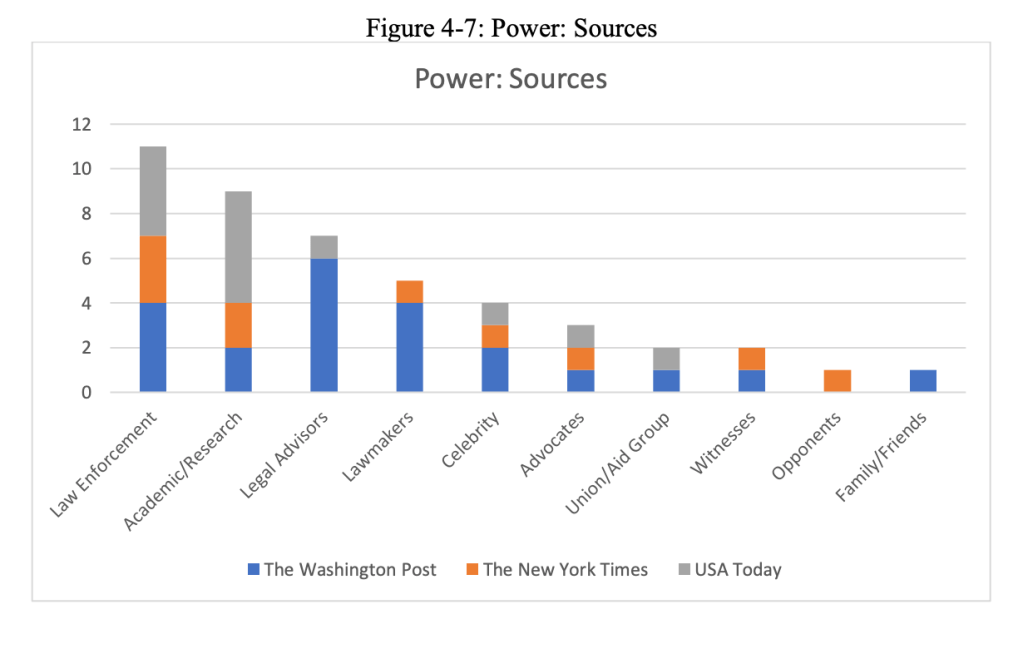
In the abstract of her dissertation, Dr. Assaf mentions, “potential ramifications of hidden power, as well as recommendations on altering the use of the key terms and sources used within the article, are discussed” (Assaf, 2020, p. v). The newspapers that were analyzed through her research made many implications of the “dangers” of people with mental health diagnoses, therefore feeding into the stigma surrounding mental health. In the section of her dissertation, “5.1.5 Predominance of Sources with Hidden Authoritative Power,” she mentions, “these dominant perspectives were more likely to present an individual with a mental health label as an aggressor rather than a victim or a neutral party, increasing stigmatizing language, perpetuating stereotypes, and further unbalancing levels of power” (Assaf, 2020, p. 106). The chart below shows the power sources in which the content of the publications and how detrimental the language used by these sources is since their words are being read on a large, national scale.

As Dr. Assaf’s study was originally published in 2020, we found it important to see if there were any notable changes in her observed findings since her study was done. As we discussed the constantly evolving state of the newspaper medium, Dr. Assaf discussed how she noted a difference in how mental health is mentioned in the media. Although she didn’t specifically focus on the correlation of mental health to gun violence in her research, a popular topic in the research of mental health at the time, she has found a decrease in the number of headlines assuming a mental health diagnosis on a gun violence perpetrator. As we focused heavily on discussing and understanding Dr. Assaf’s research methods during our conversation, we learned how research and findings can change.

As we concluded our time with Dr. Assaf, she encouraged media consumers to ensure the sources their information is derived from are reputable. With an influx of news being distributed through blogs and social media, it is important to be aware of reactionary language to encourage online sharing, who the information is coming from, and where they get it. These simple ideas can help consumers gain the factual and necessary knowledge that they’ll continue to carry and inform others with.

View the full interview with Dr. Assaf here:

Full Interview with Elise Assaf

An Interview With Dr. Ceisel: A Talk About Qualitative Research

By: Courtney Iseman, Priscilla Bevel, Nicole Anita

Professor Christina Ceisel

Christina Ceisel, California State University, Fullerton

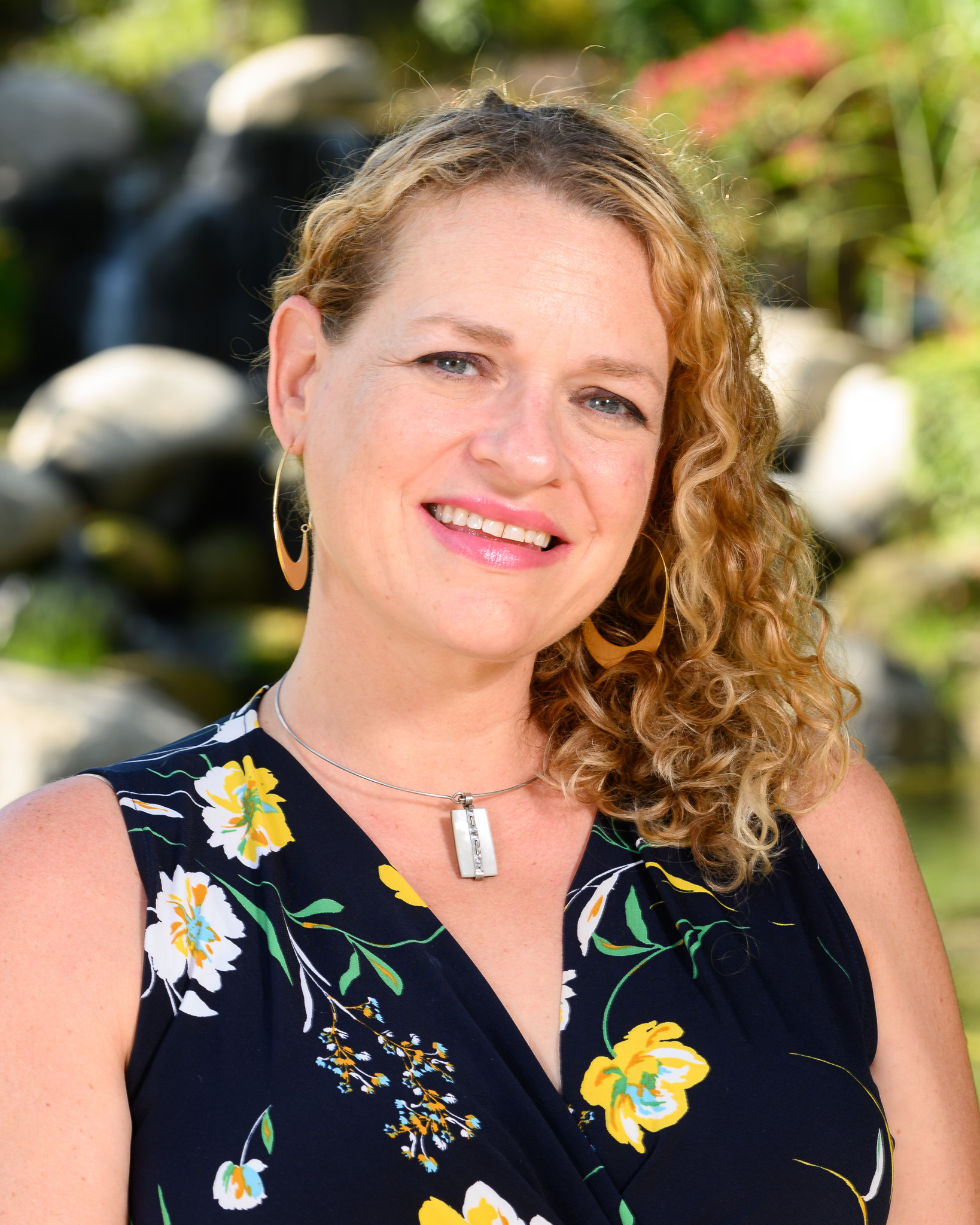
On Wednesday, November 1st, we interviewed Dr. Ceisel about research methods, specifically her experience with qualitative research. Dr. Ceisel earned a PhD in communications research at the University of Illinois at Urbana–Champaign. She also has a master’s degree in social science and a bachelor’s in media studies. Dr. Ceisel is trained in qualitative research methods using discourse analysis and ethnography. She also does market research and consulting by doing surveys and focus groups.

Read more: An Interview With Dr. Ceisel: A Talk About Qualitative Research

In our interview, we asked her specifically about her study titled El Rock Star Perfecto?: Theorizing Juanes and New Directions in Crossover Celebrity. For this study, she focused on the Columbian rockero, Juanes. Her topic was developed while discussing with a colleague the traction and popularity Latin music artists were gaining in the U.S. At the time, artists such as Shakira and Jennifer Lopez were at the top of the charts for music and had the world by storm. Dr. Ceisel was fascinated by how a country like the United States, with its primary language being English, would have such a demand and liking for Latin music. This developed the foundation of her research on Latin music. In Dr. Ceisel’s previous research, she goes to festivals, observes and interviews people, and later interprets her findings into her research. Dr. Ceisel’s approach to studying Juanes uses discourse analysis by reading and taking notes on how news outlets would portray the Columbian singer. She even studied how they talked about him and the market for Spanish and Latin music.


For this specific study, she focused on using qualitative research methods. When collecting information, she mentioned how instead of picking out specific terms, she took notes across all the articles she gathered, noting specific descriptions of Juanes’s work and performances. She focused on identifying the adjectives, themes, and tones of the coverage that was being published about him. She then used the information she gathered to understand how those aspects led him to a successful career.


Our group is planning to incorporate more quantitative methods into the study we are going to conduct. However, we are also interested in incorporating qualitative methods as well. Dr. Ceisel gave us some insight into why she prefers qualitative research methods.

“I think context is really important, and with quantitative work, surveys and such can give you a lot of interesting information, but I always want to go a little bit deeper. For me, it’s not quite enough. I find interviews and ethnography to allow me to tie things together a little bit more deeply.”

She continues to discuss the importance of tying the method you want to use to the research question you are asking. In the Juanes study she conducted, she didn’t interview anyone due to lack of access, so for this particular study, Dr. Ceisel found discourse analysis to be more efficient in getting the information she was looking for.


We asked Dr. Ceisel what made her interested in researching topics focusing on popular culture and media. She discusses how media matters and “really appreciates the way in which we can understand our world.” Growing up watching many television shows and films, she was always fascinated by how things occurred. Now, as a researcher, she can find answers and information to things she finds interesting. Once she began to study topics within media, she was able to take her previous thoughts and ideas on a subject and be able to prove why her beliefs were correct.


For our research study, we are looking to find and compare how people’s screen time and media consumption have changed since the pandemic. Although we are taking a more quantitative approach, we asked Dr. Ceisel if there are any specific methods she would suggest for researching this type of information. For screen time, she said we could look at quantitative aspects such as phone usage and screen time information our devices track. She gives the idea of surveying people and asking how long they spend on their devices. If we want to add a qualitative dimension, she suggested asking people how they feel about the increase in screen usage after the pandemic. She also added the idea of asking people why they continue to use social media even though people may not always feel great about being on it. 

“There is a lot of disconnect in what we say we want and how we actually behave, and that’s a good spot for qualitative work.”

Types of Research Methodology: Uses, Types & Benefits | EDUCBA

Pedamkar, Priya. Qualitative vs Quantitative Research Pros and Cons. 30 Aug. 2023. Types of Research Methodology, EDUCBA, https://www.educba.com/types-of-research-methodology/. Accessed 1 Nov. 2023. 


When asked how to conduct a successful study in media, Dr. Ceisel highlighted the importance of being precise in what you seek. Not only that, but she also touched on how being interested in the topic you are researching is another critical factor, as you are likely to be more passionate about the subject and motivated to find answers.


After conducting our interview, we took away how important the human connection in a qualitative research method can impact a study compared to the survey benefits from quantitative research. Diving deeper and asking people how they feel about a topic can provide more extensive data rather than asking surface-level questions. Overall, Dr. Ceisel’s insight on qualitative research has inspired us to use more meaningful and detailed questions in the study we will conduct to help reach more significant and more in-depth results.

Zoom Interview Video

Interview with Dr. Frank Russell on Twitter and News Gatekeeping

By: Elizabeth Nunn, Katie Alves, Lucy Karyagina, and Paola Madrigal

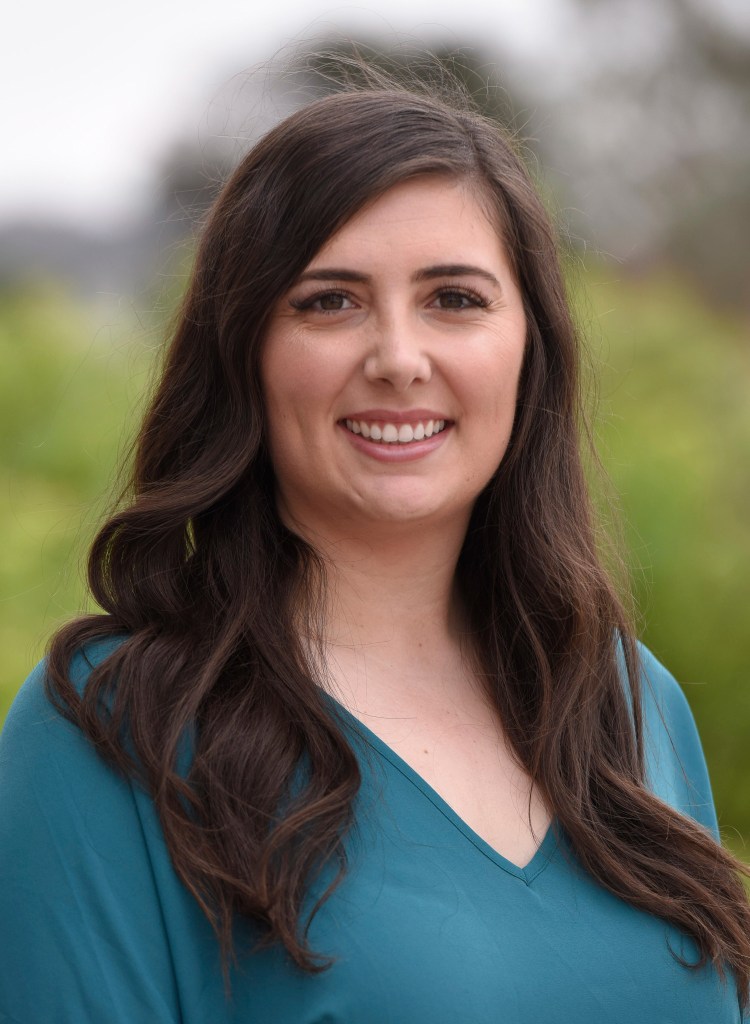
Frank Russell, courtesy of CSUF

Our group was given the privilege of speaking with Dr. Frank Russell surrounding his published research work “Twitter and News Gatekeeping: Interactivity, reciprocity, and promotion in news organizations’ tweets.” Frank Russell is a journalism associate professor in the Department of Communications at California State University, Fullerton. He earned his Ph.D. in journalism while at the University of Missouri, along with a Center for the Digital Globe graduate certificate. His previous jobs have included editor, reporter, and more while working for the San Jose Mercury News, The Seattle Times, Puget Sound Business Journal, and the Los Angeles Daily News. Russell now teaches classes on News Literacy, Digital News Reporting and Writing, Editing and Design, and Principles and History of American Mass Communications. We sat down with him to ask about his process while completing this Twitter-focused research on journalism, what he would do differently, and his overall thoughts.

Read more: Interview with Dr. Frank Russell on Twitter and News Gatekeeping

We are most interested in Professor Rusell’s study titled “Twitter and News Gatekeeping: Interactivity, reciprocity, and promotion in news organizations’ tweets” precisely because it is in the same realm as what our group is interested in doing for our own research.

Q: What was your inspiration for this study? 

There were a few things that inspired Professor Russell to create this study. But the main reason is that Professor Russell had the question of how were the biggest companies in media using Twitter. As a journalist himself, understanding the use of a platform and if it will grow into something more is something important to him and other journalists. Back in 2013, Professor Russell and his colleagues found themselves starting this study during a political crisis. They were interested in seeing where it takes them during such a distressful time and how it will benefit them. 

Q: What were some of the biggest challenges and limitations you faced when conducting your research?

Jokingly, Professor Russell shared with us his lack of being a “Super Computer” as his biggest challenge. Completing a study like this, where he is trying to understand the uses of social media and what can come from it, can be very extensive. And with a lack of resources, that can heighten the issues significantly. We can understand how much of an effect that would have on a study, considering it revolves around how Twitter is used in journalism. Not having enough resources to access Twitter can slow the process down.  Everyone could benefit from having their own “Super Computer.”

Q: When conducting this research study, did you prefer a quantitative or qualitative analysis method?

Professor Russell does both quantitative and qualitative when doing his research. The quantitative work he does is typically content analysis, which is what he did for this research study. He also uses discourse analysis, which he defined as “looking at what people say or write and trying to figure out things about a phenomenon based on what people [who] are part of it say or write.” When conducting his research, Professor Russell looked into the relationship between journalism as a social institution and Silicon Valley platforms as a social institution.

Q: How did you prepare for the study? Did you take any steps beforehand, gather any sources, etc.?

When preparing for this study, Professor Russell hired two master’s students to work as coders, whom he also acknowledged in the research. He also took the time to do an extensive literature review beforehand. In preparation for the study, he decided to go about it based on what he had learned in research method classes he had previously done. He even took a class in quantitative content analysis, where he ended up doing a different study related to Twitter as well.

Q: After you concluded your research, did you see any flaws with the reciprocal journalism model?

Professor Russell shared with our group that he didn’t see any flaws with the reciprocal journalism model. He then went on to say that the reciprocal journalism model had not been adopted at the organizational level while adding that there was evidence showing that individual journalists using Twitter were using this reciprocal model. Russell defined the idea to us as “journalists and audience members… interact with each other with reciprocity, or with respecting each other as equals, whereas organizations were taking kind of a broadcast mode.” He further explained that these organizations using Twitter were mainly trying to get clicks and interactions as opposed to using it as a unique platform for storytelling. Russell left us with one last thought: because of how much Twitter has changed since his study was completed, he is unsure if the platform as a whole, will be available for individual journalists anymore.

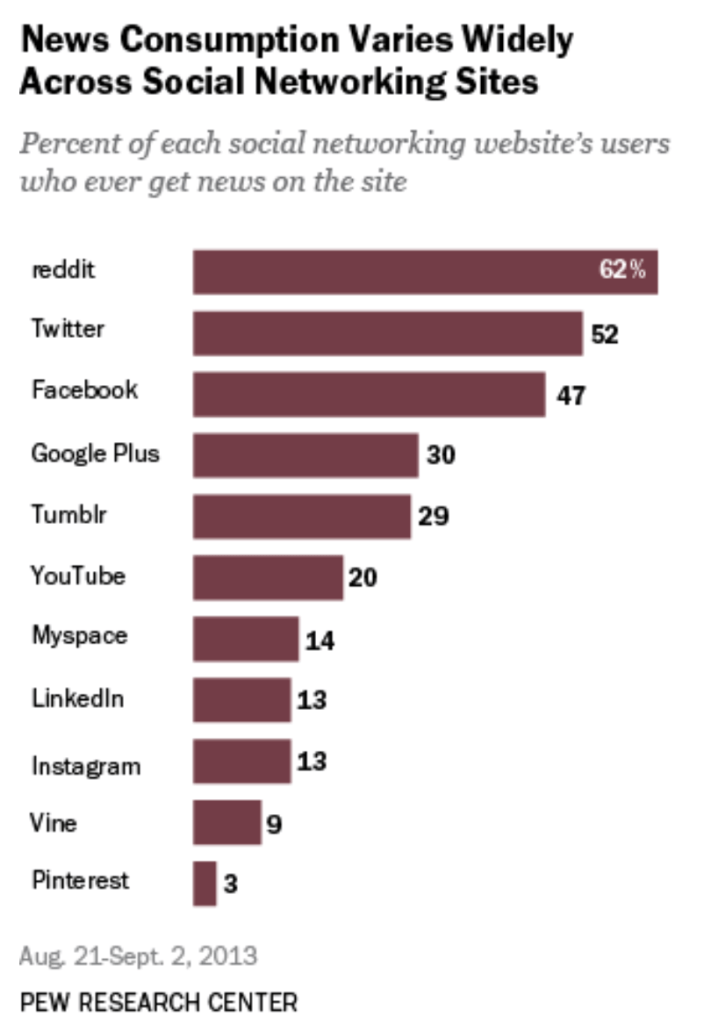
Holcomb, Jesse, Jeffrey Gottfried, and Amy Mitchell. 2013. “News Use Across Social Media
Platforms.” Pew Research Journalism Project, November 14. http://www.journalism.
org/2013/11/14/news-use-across-social-media-platforms/.

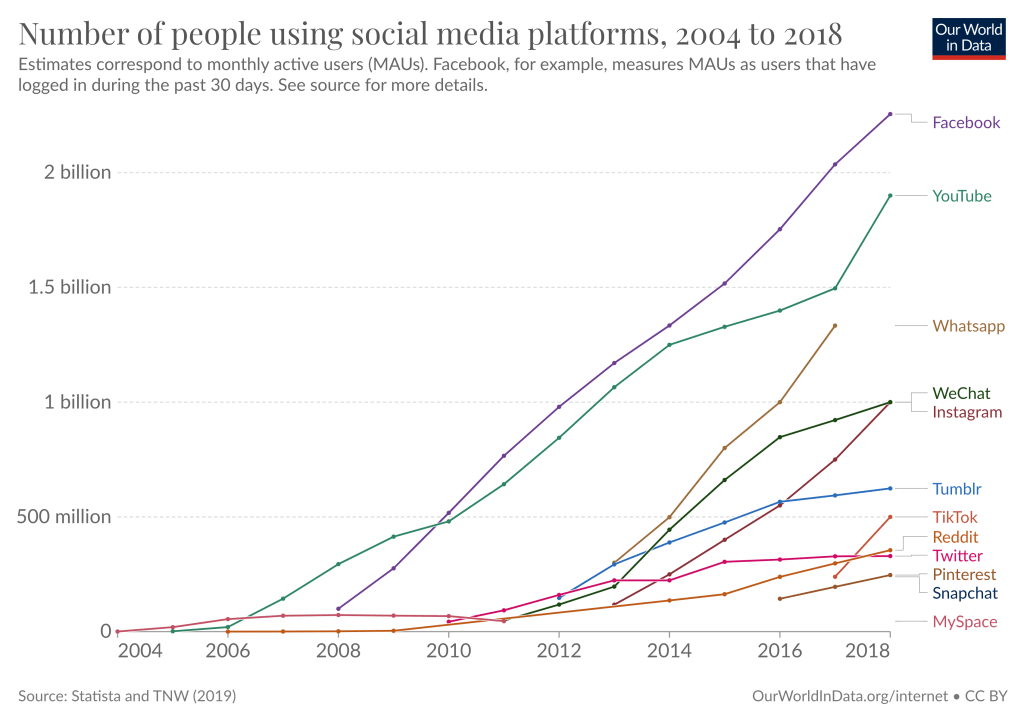
Professor Rusell refers back to this image and research because, as one may notice, Twitter is the second most used social media network. This information proves that the reason why most news organizations were using Twitter is because they just wanted to get clicks and interactions. It is also important to note that about half of Twitter users view the platform as a news source, which makes them less likely to turn to traditional media for news.

Q: Would you have done anything differently if you did it all over again?

Professor Russell explains that if given the opportunity to do it all over again, he would not do anything differently. This is because he was able to answer his own questions effectively in the way he conducted the study. It is also important to note that this type of research study, using Twitter could not be done again due to new Twitter guidelines with Elon Musk’s takeover. He also expressed that this research study, in particular, was the easiest to get published, so there would be no need to change anything. 

To summarize, after talking to Professor Russell about his past studies and the journey he took to complete them, we felt as though we had a much better understanding of the kind of process it takes to create a research project and how much time and effort is genuinely involved. It was wonderful getting to speak to someone such as Russell, who has completed many different projects during his career, and we are grateful that he was willing to open up to us about it. He helped guide us into a direction we should go for our own research project and left us with some insight to think about. While his research was a unique project that could not be replicated anymore, it inspired us to make our own research project surrounding social media in a new way, different than what it used to be. Our interview with Russell will continue to inspire us to learn more about the research process. 

Interview with Professor Russell

Conversation with Dr.Assaf on Research

On Friday, October 20th

By: Cathering Dahlberg, Krystal Ramirez, and Megan Vu

Introduction:

On Friday, October 20th, we had the privilege of interviewing Dr. Assaf. Some background on  Dr. Assaf is that she earned her Ph.D. in Education with an emphasis in disabilities studies from Chapman University. She also holds an M.A. and a B.A. in Communications with an emphasis in public relations from Cal State Fullerton. In addition, she is an Assistant professor from the Department of Communications at California State University Fullerton. She teaches public relations and entertainment courses in the undergrad communication program. 

Read more…: Conversation with Dr.Assaf on Research

During the interview, she spoke on various research topics, such as mental health, social media, and sports in the eyes of communication and the impact/effect. The inquiry was based on her experience conducting research, the type of study it was, why she chose to research that topic, problems during the research process, interesting findings from the research, and advice she would give new researchers and students. 

Interview questions:

Q: Can you give us a quick summary of your research?

Dr. Assaf’s research consists of mental health and mass media with a spefic focus on the representation of mental health on social media platforms. Using a qualitative research approach, she dives into the intricate ways in which mental health and various disabilities are portrayed in the media. Dr. Assaf uses her background in disability studies to help navigate her through her research. A central theme of her research follows the concern of misrepresentation of mental health in the media, prompting her investigate more about the issue. 

Q. How did you come up with this research? What is the reason for choosing mental health?

Dr. Assaf stated that the reason for coming up with this research was because it was an academic requirement for her graduate program. She stated, “a lot of communication is coming out on stress and mental health.” Secondly, she was diagnosed with anxiety and depression; a family member was also diagnosed with other mental health issues. Dr. Assaf shares that mental health has been overlooked/underrepresented and wants to bring awareness of mental health. It was joint research by having mass media and mental health in her research. 

Assaf, E. A. (2020). Hidden Power: Journalistic Representations of Mental Health Labels[Doctoral dissertation, Chapman University]. Chapman University Digital Commons. https://doi.org/10.36837/chapman.000137

Q. How did you conduct your research? Surveys, interviews, groups?

In one of her research studies, she used a lot of content analysis but also used it as qualitative research. She stated she liked storytelling because that is a way she communicates with people better. Also, getting to know other’s stories. Regarding content analysis, Dr.Assaf analyzed in her research study how phrases and words were used in the texts using articles based on how authorities like police officers and law enforcement communicated on mental health. 

Q: What problems arise when conducting your research?

While conducting her research, Dr. Assaf discussed the problems that she faced. She explained how her main problems came from the committee’s that she worked for. They wanted her to prioritize things they thought were important and interesting, rather than ideas of her own. She went on to explain how people in charge had specific requirements to be met which sometimes conflicted with her research process. Some examples were stringent guidelines and a rigorous review process in which she had to abide by. If an editor wanted something changed, she would have to change it. While sometimes Dr. Assaf found herself annoyed with these rules, she admitted there were times where the feedback improved her study. In terms of textual analysis with publicly accessible content, Dr. Assaf noted she had to avoid hyperlinks since they were subject to editing or had a possibility of “dying.” She considered screen grabs and pdfs as more reliable alternatives. Despite these challenges, Dr. Assaf relied on her creative problems solving and adaptability to overcome these obstacles. 

Q: What has been the impact of your research?

Dr. Assaf’s research has had a great impact on various aspects of her academic and professional career. It played a major role in her having her current job as a professor and graduating with a doctorate degree. Her interdisciplinary approach has allowed her to have meaningful conversations with a variety of different groups such as students, faculty, mental health advocates, journalists, and many more. Dr. Assaf aims to inspire and bring positive change to her peers while fostering awareness at the same time. As her research continues to develop, Dr. Assaf hopes to expand her outreach to a larger audience while making a significant contribution to the work she is passionate about.

Q: What were the most interesting findings in your research? 

Upon hearing this question, Dr. Assaf reflected on her authoritative research in journalism. She initially was researching representations of mental health in journalism. With a deeper approach, she started to look directly at who was making the quotes and comments or which people were specifically cited. She noticed a common factor that all of these people had. She found these people to be law enforcement and legal individuals like lawyers and judges. Dr. Assaf realized that journalists would normally be receiving their quotes from these authoritative figures and found it interesting considering the role journalists have as the “gatekeepers”. Another thing that Dr. Assaf found interesting, although it wasn’t a finding in her research but through a literature review, was that 6 out of 10 people don’t read beyond a headline. She considered this problematic as headlines can give a false view to what the whole article is actually about. She talks about how this is typical of people as it is realistically hard to expect people to read everything that they come across. Through her research she found that people can have strong opinions just based on a headline, which is where it can seem more alarming. By only reading the headlines, people are not including the context, which Dr. Assaf believes in the key to understanding information. 

Q: What advice would you give to new researchers?

The first piece of advice Dr. Assaf would give to new researchers is picking a topic that is worth your interest. Doing a full blown study that could take months or years to do, she explains that you would need to research something that you could sustain your interest in for the duration of the study. She talks about how a short-lived interest would make it harder to finish the study since it’s harder to put in research and effort into a topic that you’re interested in anymore. From generally doing the study, to trying to get your research published, and revising for the publications, it takes a lot of time to complete your research. She said that “it’s a time-consuming process..you want to make sure that you’re still interested in it years down the road.” She added another piece of advice, which is that your data set is appropriate for the time period that you are conducting your research. She talks about finding that “sweet spot” of having enough data to look at and analyze, where your findings are also substantial, but also not overwhelming yourself with so much data that you can’t complete within a certain time period.

A Look Into 1950s Gay and Lesbian Community with Professor Craig Loftin

By  Adriana Arias, Meghan Hsieh,, Jacob Guillen, Xzachary Rositas

Renowned academic Craig M. Loftin holds a Ph.D. in U.S. History from the University of Southern California and is a pioneer in the field of queer history research. He is an esteemed professor in the American Studies Department at California State University Fullerton, offering much experience and insight into the academic world. In addition to his work as an educator, Loftin is a well-known writer and editor. The study of LGBTQ+ history and culture has benefited greatly from his essential works, which include “Masked Voices: Gay Men and Lesbians in Cold War America” and “Letters to ONE: Gay and Lesbian Voices from the 1950s and 1960s.” This article explores Loftin’s most recent research project and highlights his significant contributions to the study of queer history.

Academic Craig Loftin began extensive research for his novel “ Masked Voices: Gay Men and Lesbian in Cold War America ” while undergoing his Ph.D. program in American Studies at the University of Southern California. Throughout his book, Loftin  utilizes direct letters that gay and lesbian individuals  sent to ONE magazine in order to interpret the historical background of these individuals during the Cold War—a period of increased anxiety because of the communist party. Through careful examination of each letter, Loftin was able to decipher the significance behind each letter to further understand the context of each letter . Professor Loftin then implemented a systematic division amongst these letters by categorizing each letter through key terms in order to highlight specific themes as part of his research method, which he would ultimately use for his Primary Research. 

Read More : A Look Into 1950s Gay and Lesbian Community with Professor Craig Loftin

What sparked the interest of the LGBTQ+ community during the 1950s rather than other eras?

As an Undergrad, Loftin was always interested in 1950s history, due to it being a time of mass hysteria for the American people because of the Communist Party and the McCarthy Era. However, when Loftin arrived at USC as a grad student,  he was introduced to classes that talked about the LBGTQ+ community, which for him was  a new topic of classes that would further inspire him to write his book. By attending these classes Loftin was able to integrate his personal experience, as a gay man, to what he was being taught in classes.  This would then further spark interest in understanding LGBTQ+ history during the 1950s which ultimately would be the topic of his book.

What steps did you take in order to prepare for your research study?

To prepare for his research study, Loftin first had to understand what type of data he was collecting. Loftin began to collect qualitative data from letters that he was able to find from the ONE magazine archives provided by USC libraries. By reading each letter and understanding the significance behind these letters , he was able to create a coding system in order to organize his data. By creating this coding system Loftin was able to sub categorize each letter in order to understand what these letters were addressing. An example of this would be if a letter emphasize family matters, he would write a coding word to place all family letters together and so on and so forth. By doing this Loftin was better able to use his research in a more productive way which would eventually help him write his dissertation for his class.

How do you consider the accuracy of the data before using it in your work?

Due to ONE Magazine being the first public  LGBTQ+ Magazine, much of its contents were personal letters that gay and lesbian individuals would  send out to the magazine. Due to these letters being more personal testimony rather than actual data, Loftin had to find a way to connect these letters to what was occurring during that time in history. After carefully analyzing each letter, he was then able to find historical context in order to analyze the real message behind these letters, to further help him understand the actual history of the 1950s. 

How do you consider the accuracy of the data before using it in your work?

Due to ONE Magazine being the first public  LGBTQ+ Magazine, much of its contents were personal letters that gay and lesbian individuals would  send out to the magazine. Due to these letters being more personal testimony rather than actual data, Loftin had to find a way to connect these letters to what was occurring during that time in history. After carefully analyzing each letter, he was then able to find historical context in order to analyze the real message behind these letters, to further help him understand the actual history of the 1950s. 

What struggles did you face while collecting your information and data? And how did you overcome it?

When preparing to write his dissertation, Professor Loftin went to his USC library to find articles about the LGBTQ+ community in the 1950’s. However, the library was recently bought only 2 years prior. It was still filled with hundreds of boxes with archives that haven’t been sorted. This is when the librarian told Loftin that he can volunteer in the library and whatever articles he finds he would be able to use for his dissertation. While sorting out these archives he found boxes with ONE magazine letters which had never been seen by the public. In these personal letters he was able to collect his data thus furthering his use of these letters for his dissertation. The struggle he faced in this case was looking through all the boxes to find what articles he could use for his dissertation which did take a couple years to find.

If we were organizing a study on the same topic, would you advise us to use your method of collecting data? Why?

Loftin expresses that he believes that by reading these letters thoroughly in its entirety is a vital way of conducting his research, as reading them repeatedly until full comprehension is needed for a proper way of understanding. Loftin states that although his job as a historian is to interpret what the letters mean and relate to historical events, he also intends for the letters themselves to convey their own messages. Thorough reading and understanding these historical documents is a crucial point of research, as the results are that of qualitative discoveries. When students conduct these studies, they will find that it is much help to research this way, as everyone’s interpretation may be different and lead to new discoveries.

In your opinion what is the most important thing to remember in researching? Any tips?

Professor Loftin believes that the most important part of research is to be patient when looking for data. He emphasizes that while research can be a long and tedious process, it takes time  to formulate and collect all data. If you are passionate enough about your topic, operations will eventually run smoothly when key evidence is revealed. It is good to be passionate and have excitement for your work, however, there is no room for impatience in research as it is easy to make regrettable mistakes. 

Conclusion 

Interviewing Professor Loftin granted us great knowledge to take away and apply in our own research. In doing research, there are many possibilities and tactics that can be used to make it successful and effective. He explained the difficulty of finding the research itself and how long it may take to understand and perfectly translate this information giving one of the key takeaways; patience. It is clear that in order to create a piece of media, one must take much time to find it and then comprehend it to the fullest extent. There is also a chance of running across information that is unexpected that may help in the process. Of course, in the end, the most important thing to take away from this interview is being passionate about the topic one seeks to research about.

“Masked Voices: Gay Men and Lesbians in Cold War America” by Craig Loftin Research Overview