Professor Dennis Morgan, teaches advertising, marketing/ sales, and entrepreneurship at Orange Coast College, Costa Mesa. He is also the head of the Business Department at Orange Coast College. Not only an academic, but he is also a practitioner in the marketing industry and consulting over 500 different industries. Some of his more prominent clients include IBM, Motorola, Bank of America, Subway, and more. However, the majority of his focus leans toward consulting small businesses and start-up companies. Throughout the interview, Morgan mentions some of the research he conducted throughout his years as a scholar. One of the research topics that stood out for our group was the topic regarding small marketing businesses. Dennis published a book on this topic, “The Complete Guide to Marketing a Small Business Or Product Successfully.” We were able to get some interesting insights and information about his field of study and research methods.
Desiree Arevalo, Jamie Richardson, Emily Bell, Jessica Ryan
In order to further analyze and bring awareness to the published study, The Watchdog Joins the Fray: The Press, Records Audits, and State Access Reform, conducted by Emily Erickson, we have written this blog post to allow our readers to learn more about the scholar, her published study, and her contributions to the field of journalism and government transparency. As the press plays an important role in holding governments accountable, this study sheds light on the effectiveness of public records audits in promoting transparency and accountability in government agencies. Through our blog post, we hope to provide readers with a deeper understanding of the importance of public records audits and the role that journalists and the press play in advocating for government transparency and accountability.
For our research project, we decided to interview the scholar Andi Stein. She is currently a professor at Cal State- Fullerton in the Communications department. We decided upon her due to her concentration in Public Relations and testing the effectiveness of communication tools. The study we acquired information from her research done in 2006, “Employee Communications and Community: An Exploratory Study”. This research was conducted as a qualitative research through a survey, due to the high volume of employees that were going to be studied.
Read More…
The project was set to study how employees and employers communicate with one another in the workplace. As well as what tool of communication was more effectived in the departmental, regional, or organizational levels. The five different communications tools that were being observed were: face-to-face, telephone, personal writing, formal writing, and numeric. The study was conducted for the hospital PeaceHealth in the Pacific Northwest. During that time, the use of technology as a tool for communication was still being introduced so PeaceHealth was more than happy to aid Professor Stein in her research. They provided her with the tools and access to conduct this research because they wanted to improve communication within the company. Not just one location, but to also see if they could improve communication between different PeaceHealth locations and be a community as a whole. The study was conducted as a survey sent to the emails of the 7,500 employees at PeaceHealth. They were encouraged to answer and divided upon their answers.
As students, we wanted to learn about the purpose and methodology of the research conducted by the interviewed researcher. We were interested in understanding the specific research questions that were being addressed, the sample population that was used, and the methods employed to collect and analyze the data. We were also curious about the key findings and implications of the research. What were the most important takeaways from the study, and how could these findings be applied in real-world settings. Additionally, we wanted to understand the limitations of the research, such as any potential biases or confounding factors that may have affected the results.
Furthermore, we were interested in the researcher’s personal experience conducting the study. We wanted to know what challenges they faced during the research process, how they overcame these challenges, and what they learned from the experience. We also wanted to know if there were any unexpected findings or results that emerged during the study, and how these were addressed.Overall, as students, we wanted to gain a comprehensive understanding of the research process and the impact that research can have on real-world organizations and individuals. We hoped to learn about the importance of precise methodology, effective data analysis, and clear communication of results in the field of research.
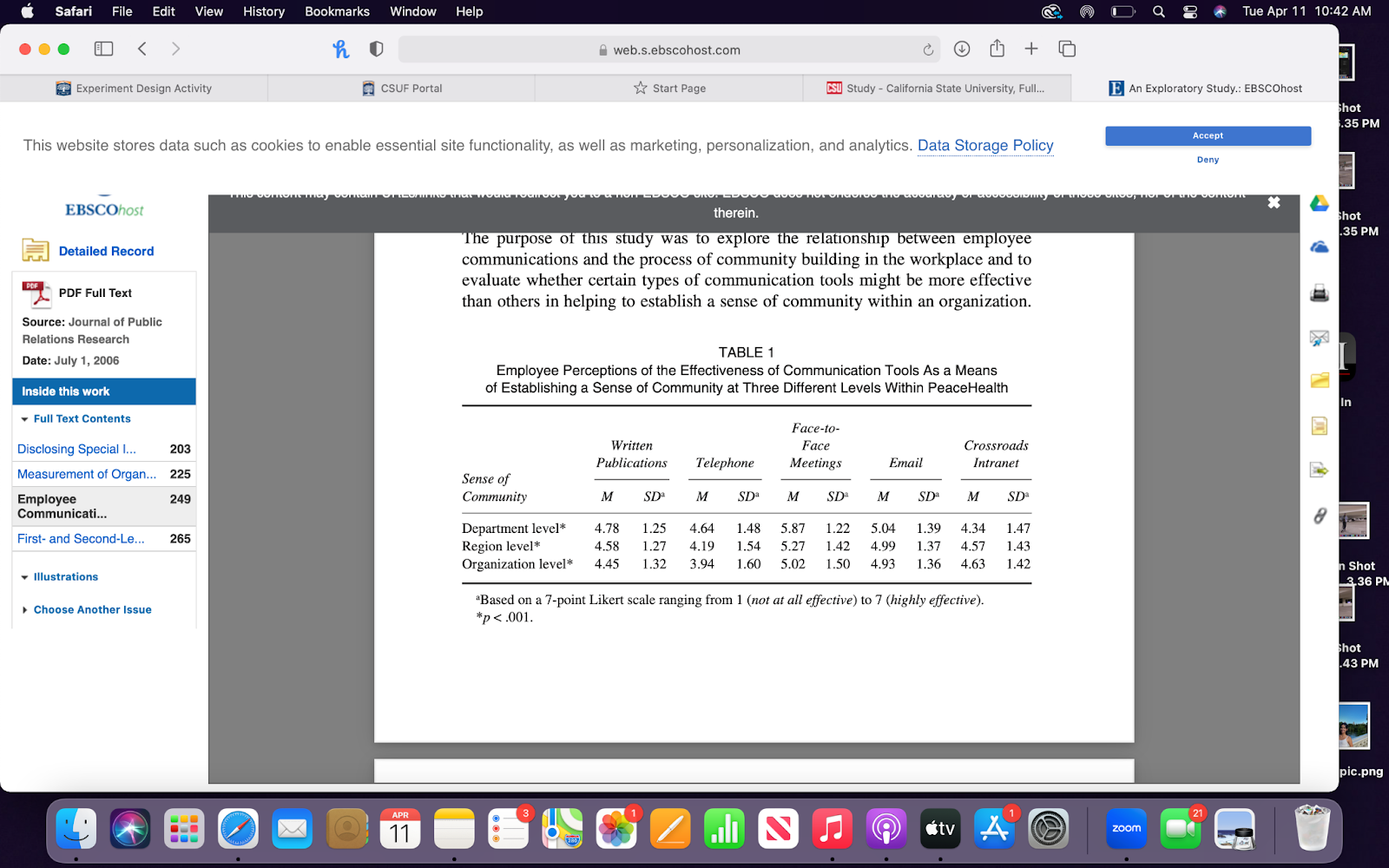
Our group was interested in the tools Professor Stein used in her research to achieve her results. She studied digital resources at a time where print media was just being segued out for digital to become more common. As mentioned before, the survey issued via email to 7,500 employees of PeaceHealth used a qualitative approach that she was unfamiliar with but learned how to do via her research. Part of what PeaceHealth wanted to test was the viability of the corporate Intranet as a method of maintaining connection and community between different locations of the same company. As the basis for her research, Stein used Daft and Langel’s Richness Theory which posited that different methods of communication would differ in effectiveness depending on the message being delivered. To explain in more detail, this theory found that people preferred face to face communication, but since it was conducted in 1984, the addition of email and the internet added a new layer to the study. Surprisingly, Stein did find that people still preferred face-to-face communication, though email was the second most popular option. She expected that print communication would still be preferred to email, but the speed and convenience of digital communication influenced the results. Overall, by utilizing a qualitative survey sent out to the employees of PeaceHealth and basing her research on the Richness Theory of communication, Stein conducted successful research and found the results necessary for her dissertation.
My group and I were also interested in the overall purpose of Andi Steins research study as well as what her greatest takeaways were. After various questions via our interview with Steins, she informed us of many different insights regarding the world of employee communication. She mentioned that employee communication is constantly changing and evolving within the workplace. Stein was looking to improve employee communication within a company in several different locations. This interested her due to a lot of change in communication methods in the late 1990s and early 2000s as a result of the invention of the internet.
The study comparing digital vs. print communication and what the future holds for communication sparked Andi Stein’s interest. Within her research study regarding employee communication, Stein stressed the fact that it is important to ask employees what they think is working and what is not working within their workplace. She stressed the importance of every member of the company being valued and respected whenever they needed something of importance to be communicated. Whether that be within their day to day work or within the entire company as a whole. For example, older managers could be wanting to use emails as a way of communication, but younger employees would prefer to communicate via text message. This small insight proves that ways of communication have changed very drastically in such a short period of time due to the vast advancements in technology.
My group and I also asked Stein what she found most surprising during her research process. She told us that her most surprising discovery was that face to face communication is the most preferred method while the second most preferred method was email. This intrigued her because she assumed Email was the quickest way to contact someone, but to her surprise, people preferred an in person interaction. I believe this can tell us that although technology is always improving, you are never going to be able to replace meaningful human interaction with online ways of communication.
Please see below for our visuals and interview
Image from survey results of the effectiveness of each communication tool by department at PeaceHealth (2006).
By: Carlo Malig, Alex Lopez, Simone Spencer, and Anthony Tran
Christian Seiter, courtesy of CSUF
The Study titled “COVID-19 Risk Perceptions and Intentions to Engage in Familial Advance Care Planning: The Mediating Role of Death Anxiety” explores the impact of COVID-19 risk perceptions on intentions to engage in familial advance care planning (ACP) and the mediating role of death anxiety. The study surveyed 353 adults in the United States using an online survey. The results showed that COVID-19 risk perceptions were positively associated with intentions to engage in familial ACP, and that this relationship was partially mediated by death anxiety. The authors suggest that the findings may inform strategies to increase ACP engagement during the COVID-19 pandemic by addressing death anxiety as a barrier to ACP.
by Samantha Davis, Brooke van den Oever, & Ximena Sanchez
Dr. Jiwoo Park is an assistant professor in Cal State Fullerton’s Department of Communications. She teaches and conducts research primarily in the realm of digital media. As a group, we were fascinated by her article “Digital Media-Driven Korean Popular Culture Consumption among First-And-A-Half Generation Korean Immigrant Children”. We recently had the opportunity to interview Professor Park via Zoom to learn more about the research process behind this article.
Elise Assaf is an assistant professor in the Department of Communications; she teaches public relations and entertainment courses in the undergraduate communications program. In addition to her Ph.D. in Education from Chapman University, Dr. Assaf holds an M.A. in Communications and a B.A. in Communications, emphasis in public relations, from Cal State Fullerton.
We interviewed Professor Robert Meeds, a professor at California State University of Fullerton, on his 2007 study Factors affecting information processing of internet advertisements: a test on exposure condition, psychological reactance, and advertising frequency. The interview consisted of questions regarding the reason for the study, the methods used, his perspective on the study looking back, and how he views the industry of internet advertisements today. The interview was 35 minutes in length and conducted through Zoom.
What was the reason for the study, and what question were you trying to answer?
When originally asked, Meeds began to explain how the experiment was his student’s idea. At the time, he was teaching at Kansas State University, and one of his graduate students, Cong Li whom he was an advisor to, was doing an experiment to get into his PhD progam. The experiment was mainly Li’s idea to make him more attractive to the competitive program he was applying to.
As Meeds explained, the Internet was a completely different time in the early 2000s. He discussed how internet advertising had some annoying and intrusive qualities. There were no regulations of the types of advertisements and it was believed that ads would slow down page loads, making it even more frustrating for Internet users. This study was, “trying to understand, what were the factors that influenced people’s attitudes toward internet advertising.” Overall, both Meeds and Li were studying the psychological reactance of users, which was a big predictor for people’s attitudes about internet advertising.
When was the study conducted? How long did it take to conduct the study and gather results? Was it easy to make time for it in your schedule?
Professor Meeds and his colleague published this study in 2007. The study was conducted two years before that, in 2005. The experiments that were conducted in the study had to be approved through IRB since the subjects in the study were people. Along with receiving their participant’s consent to participate in the study, this resulted in the study taking about three to six months to conduct. Professor Meeds said this particular study was easy to fit into his schedule because he was only teaching three classes a year. He was teaching at Kansas State University which is a research based university, so they had time built in for research.
Photo by Flavio Negrini
Was there anything in your results that surprised you?
Although Meeds does not recall on this particular study if he had differing expectations from his results, he finds the way in which our brains respond to stimuli to be surprising at times. He says the way we respond to advertising is the same way we respond to everything else in our environment, visually and physically. Since his research is based on how people process information, he finds it interesting that the human information processing system can actually be very predictable.
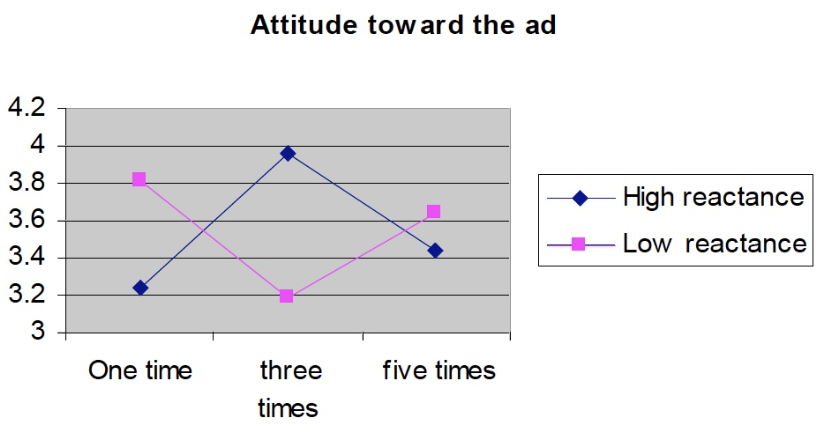
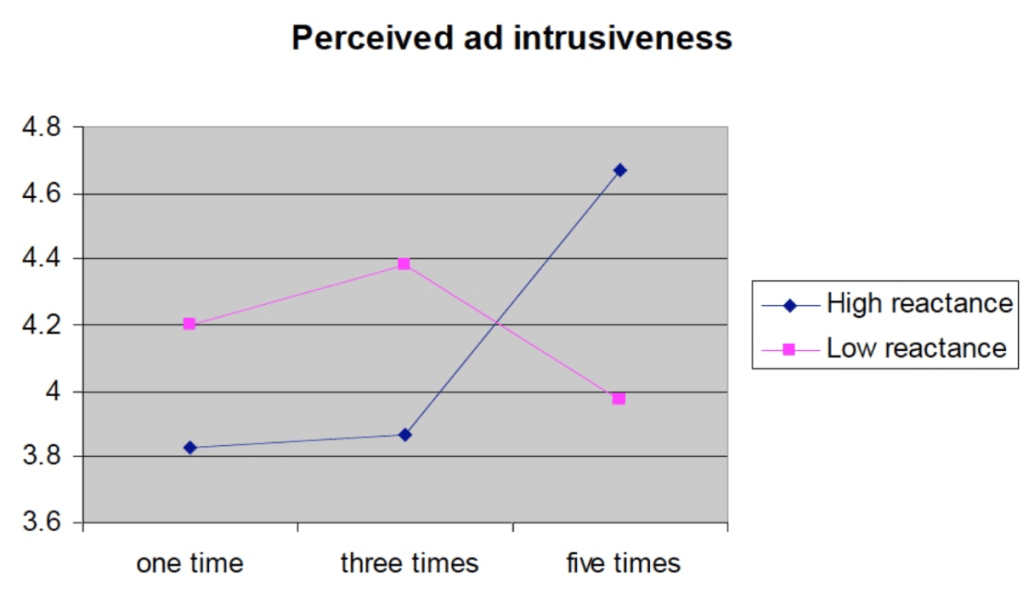
Why do you think that H5 did not show any significant results for the effects between psychological reactance and exposure condition?
Since it had been a while since he had looked over the study, Meeds wasn’t entirely sure as to why this hypothesis did not show any significant results. He went on to say that if the high reactance and low reactance people were more negative about being exposed to ads in general, then there would be no interaction effect, or no difference between the reaction of the two. This hypothesis showed that the exposure condition had a main effect on both high and low reactance people, thus not showing any significant results.
In your experience, what is the hardest part of gathering survey and questionnaire based research?
Professor Meeds said the most stressful part of designing an experiment is that one mistake can cause the whole experiment to be invalid because that would cause an internal validity flaw. When conducting surveys, it is easier to work around a mistake because you are making correlational analyses. Instead, with experiments, by definition, you are trying to isolate differences based on groups, so if you make a mistake, months of work could be considered invalid.
If you were to conduct this study again, is there anything you would change?
As discussed in the interview, psychological reactants are still valid in today’s society with the types of advertisements being used. Meeds explained how those are, “very stable personality traits,” and how it would be interesting to do the study again with a focus on the different formats on mobile ads. He mentioned that advertising frequency is a huge problem in today’s industry, and that the type of pop up ads that are being used nowadays are completely different from what is being used today.
(Meeds & Li, 2007)
We also discussed how although the ads aren’t as intrusive, the industry is continuously finding ways to sneak in ads without having consumers even realize that they are ads. Additionally, peoples’ attention spans have decreased significantly, and it has become more difficult for companies to get and keep consumers’ attention when it comes to products and brands.
Do you think the way ads are perceived are changing for better or for worse? What do you think the future of advertising looks like?
Professor Meeds believes general consumer cynicism towards advertising ebbs and flows throughout different periods of time. When people first began to see new advertisements on platforms such as Tik Tok, it was perceived in a positive light and people found it interesting. As time went on and people became accustomed to the ads, people began to react negatively. This pattern goes for any advertisement on a social media platform over a long period of time.
Advertising adapts to how people are consuming media.
Professor Meeds
According to Meeds, the advertising industry advances faster than other forms of messaging, such as journalism, because there is a lot more money that supports it. The advertising industry will transform to fit whatever the future of media is. In terms of attention spans and how they continue to get shorter, Meeds points out that ads nowadays can be as short as 5 – 10 seconds when decades ago, the norm used to be 60 seconds.
(Meeds & Li, 2007)
The advertising industry struggles in a few areas. Professor Meeds believes that the ad industry is still behind on mobile advertising, despite the fact that digital advertising is the biggest financial component in the United States. He believes that the field has not figured out how to effectively communicate from a design and visual communications standpoint in the tiny space that is the standard phone screen. Although animations and other features are used in digital advertising, one cannot promote visuals like they do on billboards.
To adapt to the ongoing changes of advertising, Professor Meeds has altered his courses to accurately fit the new media and trends. In his COMM classes, he used to assign print ad assignments, but they have been replaced with social media ads and animated banner ads. He has to keep up with the new techniques enough to be able to provide insightful assignments for students.
What is the most important thing to remember in the research process? What is your biggest tip?
Work backwards.
Professor Meeds
Professor Meeds provided us with a simple tip: work backwards. When going about any research process, Meeds states we should first figure out where we want to end up, and formulate a plan backwards from that to achieve said results. Although this is not the way we are taught in class, getting an idea of where we want our study to end up, and working backwards from there is a good way to go about it in hopes of receiving the results we want.
By Belize Tesoro, Tania Montoya, Marco Morales, and Sydney Taylor
As we have learned throughout the semester, research is a crucial aspect to every industry, especially communications. Research aids the branches of communications in several ways, for example, content analysis allows researchers to uncover the attitudes media industries such as journalism and entertainment has towards constituent groups. These findings allow us to examine the state of society and better understand its social structures. With the powerful impact that mass communications has on culture, proper research and methodology is essential to ensuring that the information that is disseminated is relevant, consistent, and accurate.
By: Jose Rodriguez, Jaime Figueroa, and Jon Espinoza
Dr. Henry Puente is an Associate Professor of Communications at California State University, Fullerton. His research areas include examining U.S. Latino films, U.S. Latino media outlets, and race/ethnicity. He holds a Ph.D. from the University of Texas at Austin, an MA in Communication Management from U.S.C., and a BA in Radio-Television-Film from CSU Fullerton.
Puente has published a book entitled The Promotion and Distribution of U.S. Latino Films. He has also published journal articles in Bilingual Review and Studies in Hispanic Cinemas and contributed to five books. These include Images that Injure: Pictorial Stereotypes in the Media and Contemporary Latina/o Media: Production, Circulation, Politics.
In Dr. Puente’s research study titled, Marketing and distribution lessons from Hispanic Hollywood, he focused on the Hispanic Hollywood era of 1986-89. This was the era in which Hollywood recognized Latinos as a people group, thus creating films for them. The films referenced in this study are “La Bamba,” “Stand & Deliver,” “The Milagro Beanfield War,” “Born in East LA,” “Salsa,” “Break of Dawn,” and “Romero.”
While he had a few questions to ask himself, the one that he made the main focus to be was; “How did the studios and independent distributors promote and circulate U.S. Latinx films during the late 1980s?”
Photo provided by Dr. Puente’s research study presentation.
Dr. Puente spent the majority of his time at the USC Cinematic Arts Library, as well as at the Margaret Herrick Library in Beverly Hills, to conduct research for his study using both periodization and generative mechanisms to help analyze Latinx films during the 1980s. He believes that periodization can be applied through any point of time, and even mentioned he would use this method nowadays if he were to conduct the same study. It can be applied to almost every study when it comes to researching ethnic groups, as this form of research and analysis can help show the history of how the group has changed historically. It was also important for him to look at this study through the lens of generative mechanisms, which focuses on explaining why certain events occur, as at the time, Latinos were beginning to push themselves into the mainstream and film industry.
What led you to do your study on Hispanic Hollywood?
Puente chose to do the topic of Hispanic Hollywood because no one had done it before. It would be an original research study. He had a lot of work to do, as much of the data still needed to be recorded or not recorded conveniently.
When you’re first starting your research, what type of research method would you recommend for someone to start with? Qualitative, quantitative, or does it depend on the topic of the research?
Puente says that choosing the type of research method will depend on the kind of information that one would want to gather. Quantitative and qualitative research both have their strengths and their weaknesses. If choosing to compile data or numbers, then quantitative research is the method to go with. If interviewing people and pouring through notes from the interview, piecing together information, is what is desired or required, then quantitative research is the method to go with.
When brainstorming, Puente suggests asking yourself, “What is my endgame?”. According to him, this will help determine the method to use.
He does acknowledge that figuring out which research method to use can be difficult. He struggled with figuring out the first question in his research process, as he didn’t know what his research would ultimately consist of. He recalled how tricky it was to start.
Puente stated that being open to pivoting during the research process is essential. You may focus in one direction, but other information and data may take you down another path. You can’t be married to your idea at that point.
For the 1980s films, you looked at them through the lens of periodization. What kind of scope would you look at it nowadays in general?
Puente wouldn’t look at the films he researched in a different way than he did before publishing his findings. While he referred to the lens that he used as periodization, he also implemented PESTLE. This is similar to periodization, but it takes a closer look at the political, economic, social, technological, legal, and environmental aspects. This is a good way of looking at the market or society when you’re doing a study. It gave an overview of how these movies were made, when, and how their production, distribution, and promotion were impacted.
One aspect revealed by using this method was that Hollywood didn’t know that Latinos existed. It wasn’t until the 1980s that Latinos were counted as part of the census. Hollywood then discovered that there was a people group that they weren’t making movies for.
Periodization can be used as a way to analyze anything.
Photos provided by Dr. Puente’s research study presentation.
Periodization is a good way of researching any topic. Especially like how you honed in on one specific group, the Latinx community. Would that transfer over to any kind of research study?
Periodization can be used to research a specific group. These groups include but are not limited to LGBTQ+, women, African-Americans, Asians, etc. It can also be used when studying movies, music, and TV.
It provides a larger lens to look at things, but at the risk of showing too much information, it can be challenging to focus on the main point you’re researching. You have to have to be aware of keeping a fine line.
Conclusion
Our interview with Dr. Puente improved our understanding of conducting proper research. He gave us insight into how a study may incorporate qualitative and quantitative research elements. My group mates and I now know better how to conduct our research for our research project. From what we have learned from our Principle of Communication Research course, we as a group will conduct cross-sectional surveys using different types of interval response scales such as comparative, Likert, and linear numeric scales. In the mix, we may also perform one-on-one interviews with people allowing us to note a more in-depth response regarding our research topic. Dr. Puente has become our reference point, and we will integrate his well-given tips and suggestions into our research process.
Renown Academic Sits Down and Speaks About Why Her Social Media Study Took a Decade
Sandy Banda, Emily Hernandez, Logan Khan
Dr. Sarah Coyne is the curriculum vitae and Associate Director at Brigham Young University (BYU) as well as a Developmental Psychologist. We sat down with her and talked about her publication Does time spent using social media impact mental health?: An eight-year longitudinal study (2020) and the trials and tribulations that were entailed within the study. She received her B.S. in Psychology from Utah State University and her Ph.D. in Psychology from the University of Central Lancashire in Preston, England. Her research interests include social media, aggression, and child development. In addition, we discussed the inspiration behind her career and her advice on using social media as a research tool.
Coyne caught the research bug when she was 20 years old when she needed to complete her honors thesis during her undergraduate degree. She asked a question no other researcher in the history of humanity had asked and then was able to answer it through like, careful research and like implementing the skills that she has learned including methodology and theory. How does viewing relational aggression in the media impact aggressive behavior among girls? It was very thrilling for her to answer. It forced on things like gossiping, spreading rumors and the impact that it created. A lot of the research at the time was all about media violence like shooting, stabbing and I wanted to see how watching that type of behavior impacted that type of aggression in real life. So she did it for her undergrad and then again for her PhD thesis.
Dr. Coyne began her study by taking participants from the Flourishing Families Project which involved families with children between 10 and 13. There was a sample of at least 500 participants and this amount was needed in order to make an effect. Although a heavy amount of the families were of European American ethnicity there were a few families that were African American, Hispanic, and Asian Americans. Education of the parents was either a bachelor;s or higher with the mother being a higher percentage. The income from families varied from mid class to low income. When they were first selected they were interviewed during the first eight months of 2007 for the first wave data sample. They were interviewed via phone call and before that they were given a letter in advance to just remind them that they were in the study and were going to receive the interview soon. Some were given home classes and those were videotaped for research purposes. As the wave phases changed within a period of time the structure of the study procedure stayed the same. The only difficulty presented was that the children were picked at a random age and there were some age gaps that were missing in the study.
Here are the questions we asked Dr. Coyne to get to know about her research career and learn more about her publication:
Can you walk us through the research process for your publication?
This project was part of a wider project called Flourishing Families, and the intent of that project is to find out how families flourish as opposed to how they fail. At Wave Three, I got hired at BYU. I asked the question: how is social media affecting these teenagers.? At the time social media was still fairly new and by wave five I was fully part of the project. We followed these kids every single summer, our students would go up to Seattle and we would follow them to their family homes and interview the teenagers and their parents and all sorts of things.
What problems or limitations did you run into conducting your research for this study?
I think the hardest part of this study was retention. Trying to track down families and kids and things like that. Something that was difficult in terms of studying media is that media changed pretty dramatically from 2009 when we first started the study, until today .So we just didn’t know what kind of questions to ask. By wave Six, we changed it to be online because the kids started to move. And then yeah, when they went to college, when they were 18, they went all over the place. I wish I could go back and ask all of the questions that now people are asking, so then I could have longitudinal data on it.
Why choose to make it an 8 to 11 year study?
I’m a developmental psychologist, so I think about everything in terms of development. Some of the major limitations of the research, including media, are the short term nature. Its hard to answer questions about social media, mental health, because it might just be that people with poor mental health use social media in certain ways because of poor mental health. Right. So by looking at it over the course of eight years, we were able to pretty much go through all of the adolescents and that early stage of adulthood. So we were able to see how things look from year to year and then really across the course of adolescence. That’s what we care about as human beings. We just want our teenagers to be okay when they leave the house, so we want to find out what is impacting them in certain ways.
Social media plays a prevalent role in today’s society, what are your thoughts on using social media as a research tool?
I think that it’s a great tool to be utilized in a variety of different ways. It’s something that we’re using right now. We’re doing an EMA study on body image and social media among adolescents. So it’s like we’re trying to capture them in the moment and seeing how they feel. But then part of it is we’re going to try to scrape their data on their social media feeds to find out what kind of content and what kind of experiences they’re having. So kind of using that as a tool in that way. We’re doing other studies where we’re using passive sensing. Right. So we’re able to collect social media, like, exactly what they’re doing and how they’re utilizing it. But possibilities are so much bigger than that. And I know that other people are using it in a lot of fun ways.
When conducting a research study, do you prefer using a quantitative or qualitative method of analysis and why?
Historically I’m a quantitative researcher. I think it’s easier to do longitudinal stuff with quantitative data. Recently though I have been dipping my toe into more qualitative studies, especially if it’s like a newer area because you kind of gotta hear the voice and then you can figure out, is this even worth studying or know it comes up with new questions. I also really like mixed methods when I can do it but most of my research has been quantitative though, for sure.
What would your advice be for student researchers or beginners who are conducting their first research study?
Just be as creative as you can and think up new methods or tweaking methods that already exist or, um, looking at something different, in a unique way. That’s like the spirit of research follow your passion, I know that that’s generic advice, but a lot of people get a research job working for a company, you know, inputting data or whatever, which is fine and we need those people, but follow your passions and I think that you’ll have fulfill career.
How do you see the long term ramifications of mental health now that social media is constantly growing?
I feel like social media can certainly impact mental health for negative and also for positive. It depends on all sorts of things like the individual, the content, the context, you know, the ways we’re using it and so on. What I’m hoping is that social media’s here to stay and that educators and government and parents will get behind, media literacy, this point of view to try to educate and empower youth to use social media in ways that help them thrive. While at the same time I hope that social media companies will partner with researchers, including some child development specialists, um, to think about how their product, um, what the impact their product might be having on youth and if there are things that we can change to have a better impact.
In terms of social media and mental health, are there any sort of disclaimers you have for newer users given your study and seeing what the trends were over those years just to avoid having such a negative and I guess toxic impact?
Yeah, I would say avoid really heavy use early on in development. So some of our research suggests that that can be pretty negative, especially for girls. I would say keep an open dialogue with your parents or somebody that you trust so that you can go to them, if you see something that’s heavy or if you see somebody mistreated, um, and they can help you learn and grow. Try to be mindful when you’re using and really aware of how it’s impacting you so you can set boundaries for yourself. I think our problem is when it’s kind of a free for all and we’re not thinking and we’re just scrolling and it’s high levels.
How do you think your study would’ve been different if it would’ve been now in modern times, rather than during a time like quarantine.
I would say it is mixed among researchers right now. Most of us kind of think that social media has a small to negligible effect on mental health in terms of time spent on it because there’s so much content like that. So I think that if we did it today, we’d find something probably similar. We definitely would’ve asked other questions. So like if you’re consistently using social media in a negative way, it’s gonna have a long term negative effect.If you’re consistently looking at inspiring, wonderful content where everyone’s prosocial we’re gonna have a really positive effect. I think that a lot of people relied on social media during the pandemic in ways that they hadn’t before in order to connect. I don’t know if that means that we kind of like to rely on it too much now or in different ways. But I am hoping that we’ll continue to look at this longitudinally to see how this generation is different from the last, they are different in a lot of ways.
Since Dr. Coyne is based in Utah, we had to use Zoom to have the best interpersonal experience, and we have the video to showcase her contributions towards the communications industry.





 The Society for Communications Research
