Impacts Media has on Mental health with Professor Assaf

By: Jennyfer Lopez Ramirez, Leah Humphrey, Lily Holman, and Sofia Vargas
Key findings include:

  1. Dominant Use of Medical Framing: Most articles apply a medical model, often casting mental health in terms of illness, treatment, and pathology, thereby reinforcing stigmatized views.
  2. Power and Source Bias: The majority of articles rely on law enforcement and legal sources for causality and authority, which often leads to depictions of individuals with mental health conditions as potential aggressors.
  3. Overlexicalization and Connotation: The frequent use of formal, medicalized language impacts readers’ perceptions by highlighting mental health conditions in terms of risk or criminality, often neglecting social or recovery-focused narratives.

Q1: How do you think the lack of tone indication or context in social media can lead to negative mental health effects?

A: Professor Assaf explained there are two sides of social media in terms of the content that audience members are getting. There is the visual and the text that they are reading. With the visual components, tone can come across more clearly. Whereas things that are written can be difficult for an audience member to understand the tone that is intended. There can be problems that occur such as not knowing if the person is mad or funny, we are not always sure how the message is going to come across to the reader. Social media tends to be much more stagnant, she explains that unlike in a text where we can ask for clarification over social media it is almost a one way communication because there is less fluidity back and forth. This issue can affect mental health because people can let that concern, of not understanding the language they are reading, make them uncomfortable and there is not outlet for them to go back and communicate for clarification. 

Q2: How did you ensure the validity and reliability of your data? 

A: During the long process of writing her dissertation, she had a committee and a chair which allowed for conversations to review and assist on some of the data she was working on. There were multiple sets of eyes going over the data to make sure her findings were reliable. She also conducted a pilot study along with another peer researcher and they agreed to be eachothers second pair of eyes and review each other’s research. During this pilot study her peer selected a random sample of 10% of the data and analyzed it with the codes. Then they went back together and matched the data to confirm they were both coding the information in the same way to improve reliability. She also made sure her newspaper sources had enough variety to confirm her data. She chose an east cast, west coast and middle america publication to ensure she covered the whole country. 

Q3: With a topic as nuanced as mental health, how did you ensure that your personal perspectives didn’t influence the interpretation of your findings?

A: Assaf explained she is very up front with her personal experiences with mental health and it did affect her research to an extent. She explained in qualitative research it is very important to acknowledge your bias and the lens you see and process this information through. In her dissertation there are two pages dedicated to why the topic is important to her which tied into how she will read and process the data. She mentioned in qualitative research it is important to communicate those biases to the reader up front so the readers understand what could impact the analysis within that study. 


Q4:
What did you find the most challenging in the research process?

A: Professor Assaf shared that the most challenging part of her research process was managing feedback from her committee. She explained that having a committee of three meant navigating multiple opinions and expectations, which could be frustrating and sometimes delayed her progress. However, she acknowledged that their input helped her grow as a researcher and ultimately strengthened her work, despite moments of struggle. She mentioned that the same challenge arose when submitting work to journals and conferences, where reviewer feedback ranged from outright rejection to conditional acceptance with required changes. This ongoing back-and-forth with reviewers had both positive impacts on her research and tested her resilience throughout the process.

Q5: Do you feel like the more you grow as a researcher it’s able to balance out or is this the life as a researcher?


A: Professor Assaf believes that challenges in research—particularly those stemming from reviewer feedback and blind review processes—are an inherent part of a researcher’s life. She shared an example from a study she conducted with her colleague, Doug Swanson, where they had to anonymize his name in citations to meet the requirements of a blind review. Ironically, a reviewer then recommended they cite Doug Swanson’s work, not realizing he was a co-author. This experience highlighted for her how, in research, if one challenge is resolved, another often arises, reflecting the ongoing, sometimes ironic, nature of the process.

Q6: Looking back, is there anything you would’ve done differently in the research process?

A: Professor Assaf reflected that, overall, she feels confident in the strength of her study and doesn’t have significant regrets. She mentioned that, in retrospect, she might have preferred including publications like the LA Times and a Midwest newspaper, in addition to the NY Times, to capture a broader geographical representation. However, she didn’t feel strongly enough about this preference to pursue a follow-up study, as she moved on to other research areas.

The qualitative research done by Professor Assaf focuses on the stigma of negativity in the media. Assaf talks about how direct messages and content are targeted towards an individual, whether from a post or direct messages. She then explains how negative content can directly impact them more when they do not have an outlet to fact-check where information comes from. Journalists also use mental health and framing in their media, this creates different interpretations of mental disorders such as schizophrenia, or bipolar disorder.

When asked about bias during this research, Assaf stated that “it’s really important to acknowledge your bias” and how it affects you during the process. In her dissertation, she explains why this topic is important and how it impacts her. It is also important to process the lens through which this information is given because that shapes the view of the message to the person reading. By Focusing on the nuances of language, qualitative data really shows the power journalists and reporters have on society.

Professor Assaf’s advice: 

Professor Assaf advised choosing a research topic that genuinely interests you, as this can make the long process of research more fulfilling and manageable. She noted that while a semester-long project may only need a few months of dedication, longer-term research can span years with frequent adjustments and revisions. To prevent burnout, she emphasized picking a topic that won’t become burdensome over time. Assaf also recommended thoroughly researching the topic in advance. She reflected on her own experience as a student, explaining that having a wealth of sources not only strengthens a paper but also makes it easier to write, as you won’t struggle to meet page requirements when you have a strong foundation of information.


Interview with Zac Johnson on Student-to-Student Confirmation in a College Setting

11/06/2024

By: Ann Sadek, Nicole Strang, Lauren Rosbottom, & Abigail Chertock

Dr. Zac D. Johnson is an associate professor at California State University, Fullerton. His work is in the Department of Human Communication Studies. After years of experience, he’s in his first semester as the department chair. Dr. Johnson’s primary research pertains to the way students communicate inside and outside of the classroom environment and subsequent effects that follow. His work is featured in many places, including Communication Research Reports, Communication Education, Communication Quarterly, and more. We were pleased to have the opportunity to sit down and discuss his published research, From student-to-student confirmation to students’ self-determination: an integrated peer-centered model of self-determination theory in the classroom.

Continue reading “Interview with Zac Johnson on Student-to-Student Confirmation in a College Setting”

Interview with Jasmine Phillips Meertins on Institutional Barriers in Relationships with Incarcerated Partners

ceciliaordaz8


By: Jizelle Hernandez, Alejandra Rodriguez, Cecilia Ordaz

Jasmine Philips Meertins, LinkedIn Profile

Overview

Dr. Jasmine Phillips Meertins is an assistant professor in the Department of Communications at California State University, Fullerton, teaching digital foundations and public relations courses. She holds a B.A. in political science from Yale University, an M.A. in international affairs from George Washington University, and a Ph.D. in communication from the University of Miami. Prior to working at CSUF, Dr. Phillips was an assistant professor at Nevada State College, teaching courses such as Public Relations Campaigns, Case Studies in Public Relations, and Social Media. She was also a Director of Education Abroad at Virginia Commonwealth University and Assistant Director of Study Abroad at the University of Miami, where she led marketing communications to promote international program participation. Dr. Phillips conducts research at the intersection of communication, culture, and media, utilizing both quantitative and qualitative methods. 

During our interview, we focused on Dr. Phillips’ research study, “Institutional Relational Maintenance Barriers and Perceptions of Relationship Quality Among Women With Incarcerated Partners,” which she conducted with her colleagues, who are also scholars with different academic backgrounds. The study highlights how institutional barriers in the prison system affect the relationship quality of women whose male partners are incarcerated. The research focuses on how these barriers impact women’s emotional connections and perceptions of their romantic and co-parenting relationships. Through both quantitative and qualitative methods, Dr. Phillips and her colleagues found that these barriers contribute to women feeling emotionally distant from their partners.

Q: What inspired you to explore the impact of institutional barriers on relationships of women with incarcerated partners?

This research opportunity came about when a colleague of Dr. Phillips, who works in the criminal justice field, approached her with the idea of collaborating on a research project. Dr. Phillips, a scholar in communications, and her colleague recognized the potential for a collaborative approach to studying issues at the intersection of their two fields. They began brainstorming ideas to find a topic where communication and criminal justice issues overlap. They identified an area of interest: how institutional barriers can impact relationships in the criminal justice system. They specifically discussed how communication challenges within the prison system affect relationships between incarcerated partners and their families. This collaborative process allowed them to develop a unique research topic that combined their expertise, leading to the study of “Institutional Relational Maintenance Barriers and Perceptions of Relationship Quality Among Women With Incarcerated Partners.”

Q: What were the demographic characteristics of your study sample, and how did you select participants?

For her study, Dr. Phillips focused on a predominantly female sample. The critical criteria for inclusion were that the participants had to be non-incarcerated women in a romantic relationship with an incarcerated male partner. Additionally, the women also had to have a child with their incarcerated partner. Dr. Phillips did not exclude participants based on age, race, or other demographic variables. The study aimed to capture diverse experiences and perspectives among women navigating relationships with incarcerated partners by maintaining this broad inclusivity. The study allowed for a more comprehensive understanding of these women’s challenges and relational dynamics.

Q: What specific data collection methods did you use to gather information from participants?

Dr. Phillips and her colleagues did not collect the data for this study. She explained that, as a researcher, she had initially assumed she would always gather her own data. However, she learned that in some cases, researchers analyze pre-existing data rather than collecting it firsthand. Dr. Phillips and her colleagues used data from a broader research project focused on incarceration, parenting, and partnership. Gaining access to interview people who are incarcerated or those visiting jails and prisons can be challenging, so they analyzed the interviews the original study conducted. Overall, learning that analyzing existing data was an option was an important insight for her research approach.

Q: Can you describe the process you went through to develop your survey questions? How did you ensure they accurately captured the participants’ experiences?

Dr. Philips discusses the limited control she had in developing the survey questions, which were primarily close-ended, allowing participants only three response options. She emphasizes that in the field of social sciences, complex variables like attitudes, perceptions, and feelings can make it challenging to verify the accuracy of participant responses. By using close-ended questions and Likert scale options, however, the survey design simplified data collection and analysis, providing a more straightforward approach to gathering responses across these nuanced variables.

Q: Why do you prefer qualitative research over quantitative?

Dr. Phillips notes her abilities to be limited in numbers. Therefore, she prefers qualitative research because it enables a more in depth exploration of complex issues. While she acknowledges the strain that a barrier like incarceration could create on interpersonal and romantic relationships, she believes that the emotions and personal stories exist and are important to outline through qualitative methods. She also appreciates the human aspect of qualitative research, it values the meaningful conversations that reveal the participants’ genuine emotions and feelings.

Q:What challenges did you face during the research process, particularly in collecting or analyzing data?

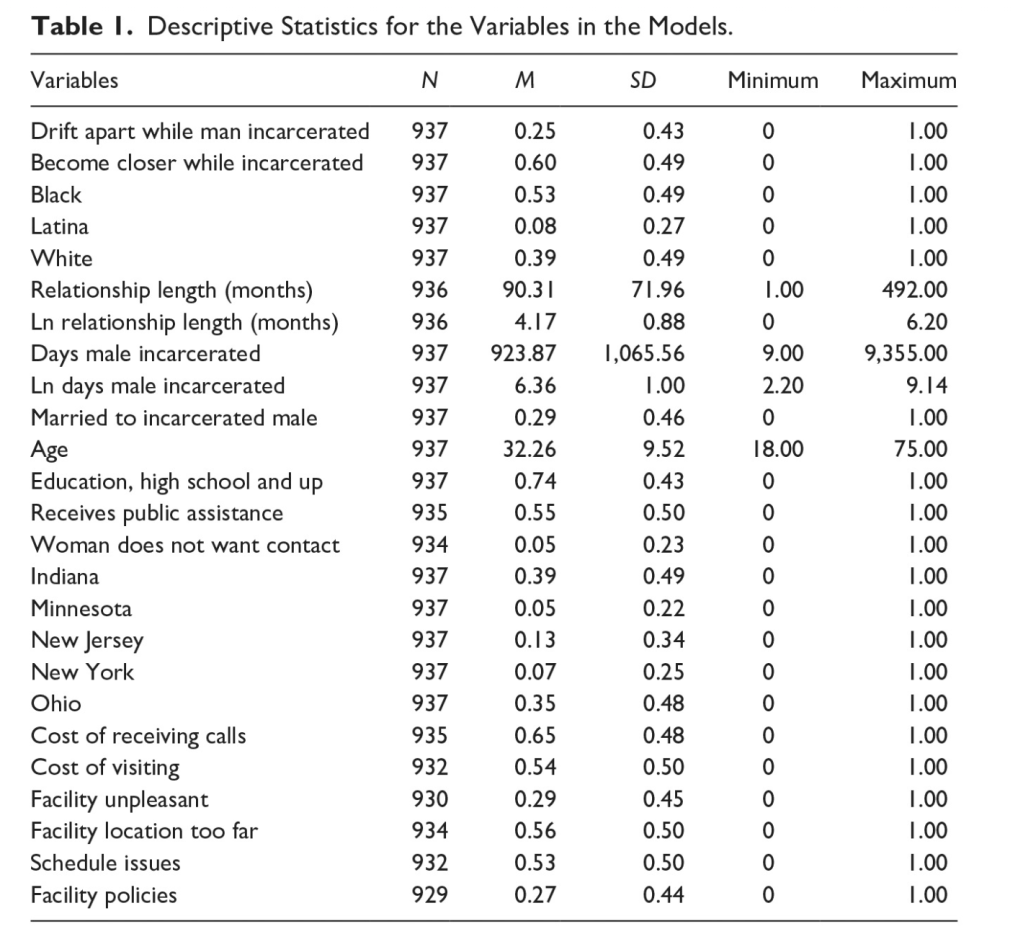
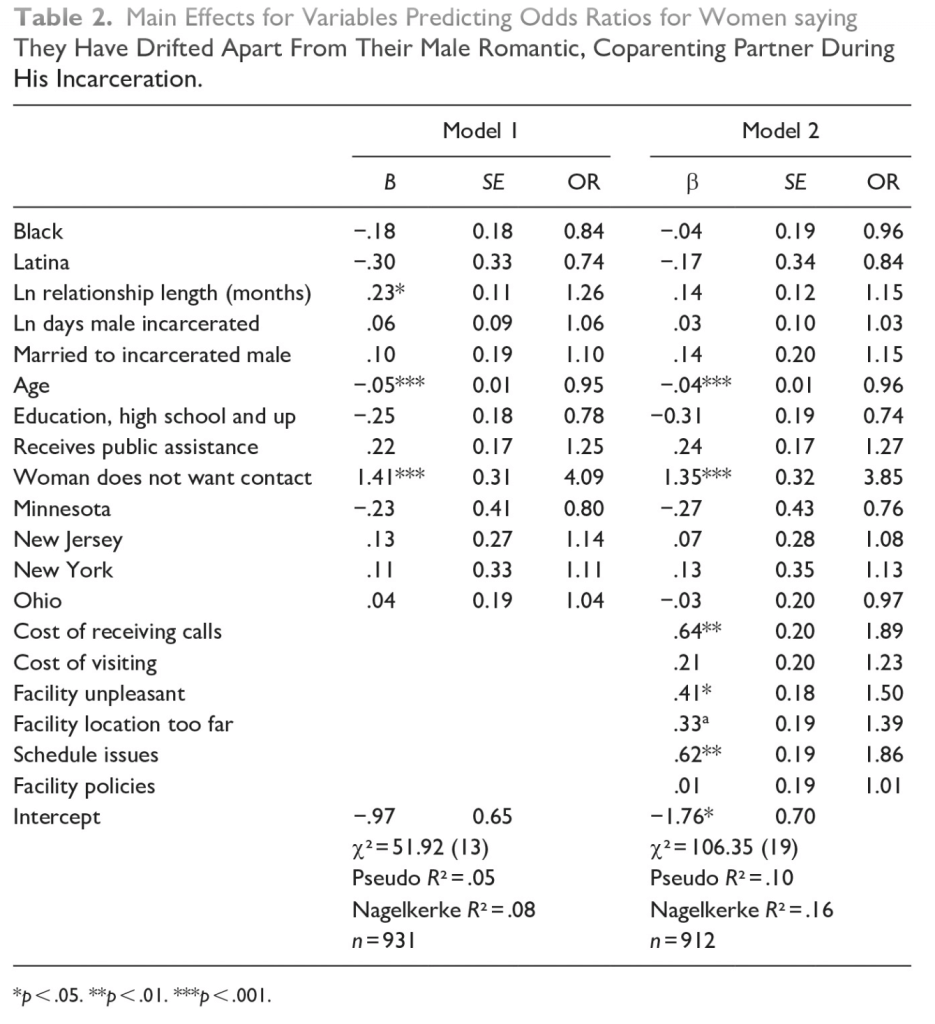
She describes that sometimes you start out with a research question and it doesn’t yield the anticipated results. Initial questions can oftentimes not align with the data that is collected. Dr. Phillips notes that researchers may “reverse engineer it”, by coming up with the results they want and then go on to asking the question. What she and the team did was look at the data set and analyze it in different ways with the hope of uncovering a distinction. Generally, there were certain variables they found not to be significant at all which would result in omitting them or refining the research question in order to understand the data from a different angle.

Phillips Table #1 :Statistical Data

Phillips Table #2

Q: Did you encounter any limitations with your data collection methods? How did you address these limitations in your analysis?

As Dr. Jasmine Phillips mentioned in the interview, one limitation of this study is that the data used was quite old between 2008 and 2014. This made the data less relevant and less applicable to current situations. Dr. Jasmine Phillips also pointed out that this is a quantitative study. There was no way to follow up with participants to clarify or further explore their responses. This made it challenging to understand the reasons behind participant’s answers. In addition, Dr. Jasmine Philips emphasized that the study was a snapshot of one day. It was difficult because it didn’t allow her or her colleagues to track participants from the beginning of their relationships or observe how their views might differ before or after. Dr. Jasmine Phillips concluded her answer by mentioning that this was a longitudinal study and would have been insightful with more varied data.

Q: What specific challenges did the participants identify as most significant in maintaining their relationships with incarcerated partners?

Dr. Jasmine Phillips highlighted that while phone access in prison is often seen as a basic issue, it is a significant problem. Many prisons still restrict phone access; when it is available, the cost is astronomical because two or three companies control it. She continues to say that this burden falls heavily on the families outside, particularly on the primary person with income, such as often being women who are also responsible for taking care of children and planning visits. Dr. Phillips added that she supports free phone calls for prisoners and mentions that maintaining contact through these phone calls can play a crucial role in preserving relationships.

Q: How can the study findings help create better support or programs to help women communicate and maintain their relationships with incarcerated partners?

Dr. Jasmine Phillips pointed out that the high cost of phone calls for prisoners harms both relationships and society. While it benefits corporations, it certainly doesn’t help the individuals or families involved, especially when we live in a period where you can easily talk to someone halfway across the world for free. She emphasized the absurdity of continuing to restrict prisoners’ access to communication, as they are already incarcerated and facing numerous challenges. She continues to mention that several states, including California, have begun to address this issue. She believes this is an important issue to pay attention to. 

To Conclude…

Dr. Jasmine Phillip’s research highlights how prison-related barriers like expensive phone calls hurt relationships between women and their incarcerated partners. These challenges often create emotional detachment between families, resulting in a loss of connection. Dr. Phillips states that making communication affordable or accessible would help these relationships flourish. As states across the country, including California, begin to address this issue, many families have hope that there will be a better support system for prisoners and their families.


Full Interview with Jasmine Phillips