Interview with Irene Matz on Gender inequity in Debate, Legal and Business professions.


By: Xiuhnel Venegas, Yazmin Lopez, Justin Chee

Date: November 6, 2024
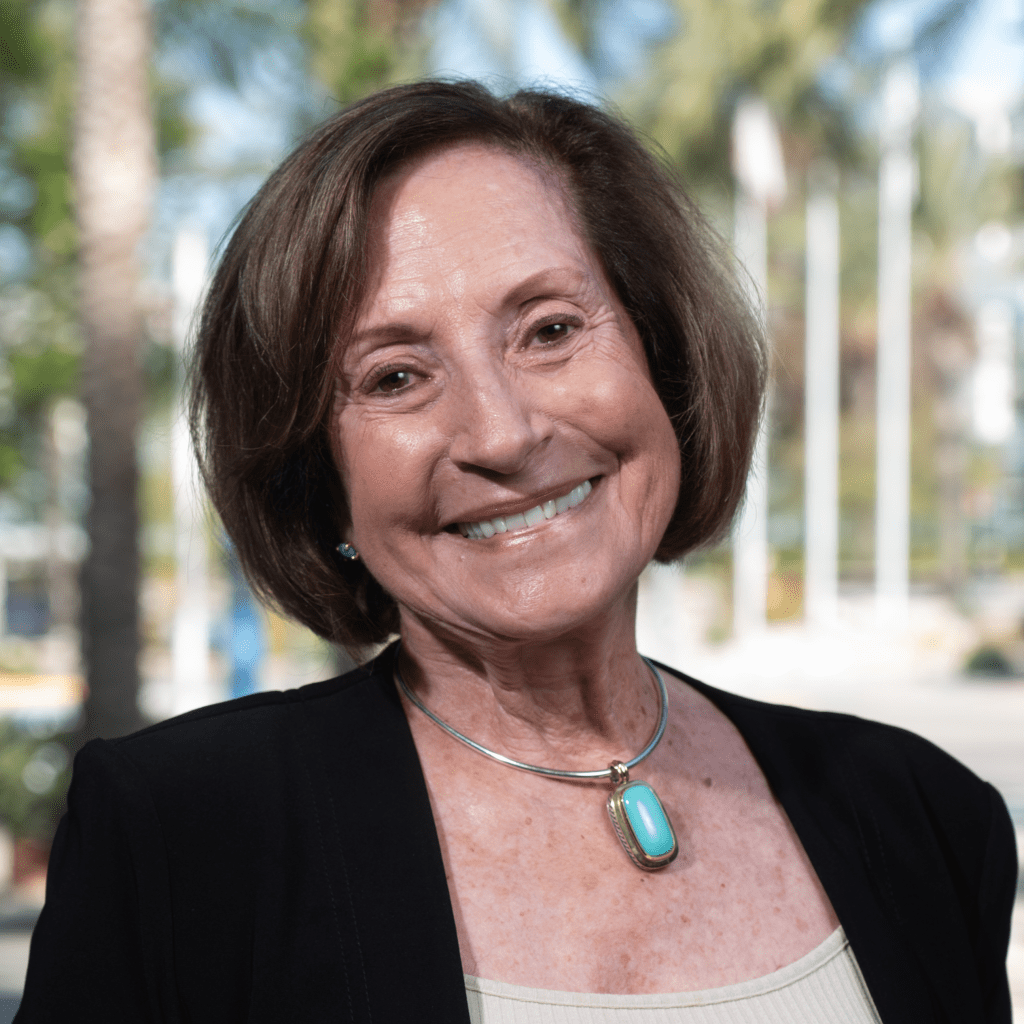
Dr. Irene Matz, Ph.D., is an associate professor in the Department of Communication Studies at California State University, Fullerton, where she previously served as associate dean and interim dean of the College of Communications. She managed a faculty of 180 and a $8.5M budget, and established international partnerships, including an exchange program with the University of Havana. Dr. Matz holds a doctorate in education from Claremont Graduate University and has received several awards, including the Distinguished Faculty Award (2019) and the University Faculty Leadership Award (2020). Her research focuses on leadership, women leaders, ethics, and organizational communication. She also chaired the Faculty Affairs Committee for the Academic Senate from 2019-2022.


Question #1: What made you want to research gender disparity in debate, legal and business professions?

Dr. Bruschke collected data and enlisted Matz to help write up research on the trend of women in debate and legal professions. Matz was looking at gender research and women in leadership positions which made Bruschke invite Matz to assist in the research study. While participation in debate was declining for women, Bruschke wanted to explore the broader trend. Matz emphasized the importance of equal representation and opportunities for all, regardless of race or gender, particularly in university settings, and stressed the need to monitor inequities.

Question #2: In your review of the literature section, you noted that the trend of women’s underrepresentation in argumentation and debate will continue to worsen. Do you believe they are still possibly underrepresented today?

Matz acknowledges that while women in the workplace are improving, progress has been slow. She emphasizes that mentoring is crucial for helping women enter male-dominated fields, but there is still a long way to go for equal representation. Although more women are entering the workforce, they remain underrepresented at higher levels. She also believes the younger generation is more willing to seize opportunities that will elevate them in their career. Matz hopes progress continues and that women’s representation improves at a faster pace.

Source: Women in the workplace 2024, McKinsey & Company and Leanin.org

Question #3  In your literature review, how did you decide what information was important to include on this topic?

Matz advises beginning with literature directly addressing the hypothesis you aim to explore. She suggests consulting researchers with experience in the relevant field to ensure that the insights gathered are credible and valuable. Additionally, Matz recommends examining these researchers’ reference pages to uncover further resources on the topic. Research can start either with a particular topic or with a notable expert. For example, Matz mentions a former California State University Fullerton professor who was a prominent figure in her field, later on contributing to juror selection in court cases. By focusing on established professionals recognized in their field, Matz emphasizes the importance of understanding expert perspectives before going deeper into the topic.

Question #4: What criteria did you follow when deciding what data goes into the study and where to gather your data from?

Matz became interested in women’s leadership after noticing three women in leadership roles being asked to leave their leadership position. This led her to explore how that could happen. First, she conducted a pre-study to test her questionnaire and used focus groups to gather feedback on her research approach. Both helped her understand leadership styles and how life experiences might shape them.

She looked at leadership across four states in government, education, and business, gathering data on different leadership styles. Matz found that the issue wasn’t about gender but about the style of leadership used. She focused on five styles: autocratic, consultative, consensual, collaborative, and laissez-faire, which helped guide her study and conclusions.

Question #5: After gathering your research, do you still believe mentoring is an effective option to increase women’s inclusion in debate and the workforce?

Matz strongly believes that mentoring is a key strategy for increasing women’s inclusion in debate and the workforce. Reflecting on her career, she shared how mentoring moments played a significant role in her development. She recommends mentoring for all women, emphasizing that having a mentor is incredibly valuable. Matz referenced the book First Friends by Gary Ginsburg, in which the author discusses American presidents and highlights the importance of having someone who can be candid and objective in offering advice. She stressed that it’s crucial to have a mentor who can speak openly about the challenges women still face, while also being supportive and encouraging. Matz believes that the support and encouragement provided through mentoring are essential for personal and professional growth.

Full Interview below.

The Influence of Streaming on Traditional Television: Insights from Cerise Metzger

By Camren Willis, Lorena Galindo, and Chester Clark

As streaming platforms continue to disrupt traditional media, understanding their impact on TV viewership has become a key area of interest in communication studies. Our team interviewed Cerise Valenzuela Metcalf, a communications scholar, to discuss her perspective on this cultural shift. Our conversation focused on how streaming services are reshaping ratings, viewer demographics, and strategies for attracting and retaining audiences across generations.

MORE

Breaking Down the Impact of Streaming Platforms

We began by asking Cerise about the overall impact of streaming on traditional TV ratings and revenue. Although this isn’t her primary research area, Cerise shared insightful perspectives on why streaming has taken such a strong hold over traditional viewing methods. With streaming platforms offering on-demand, customizable content, audiences have shifted away from scheduled programming. This shift impacts long-established networks, like NBC, which must now compete with highly tailored and easily accessible alternatives.

“If your goal is to gain viewership, but someone can stream an event or show on demand, possibly for free, they’re less likely to turn to traditional television.” – Cerise

Cerise pointed out that, unlike traditional TV, streaming platforms use algorithms to deliver content specific to viewers’ preferences. This capability gives streaming an edge, as viewers get exactly what they want without sifting through programming that may not interest them.

Examining the Generational Divide

When asked about demographics, Cerise emphasized a clear divide: younger audiences are gravitating towards streaming, while older generations still favor traditional TV. However, this trend is not solely based on age; it also involves familiarity with technology. She highlighted that those in their twenties and thirties, and even viewers up to their sixties, often find streaming easier and more convenient. In contrast, seniors might hesitate to use newer technology or need assistance in navigating streaming services.

“We live on our phones, but an older person is more likely to stick with traditional TV, where things are familiar.” – Cerise

Cerise added that younger audiences generally have higher expectations for ease of access and are more likely to explore a range of streaming services. Older viewers, however, tend to stay loyal to traditional formats that align with their viewing habits and values, like scheduled news broadcasts or printed newspapers.

Strategies for Viewer Retention and Marketing

This generational divide prompted a discussion on how streaming platforms approach marketing. Cerise shared that streaming companies must strategize carefully to retain loyal viewers across demographics. For younger viewers, platforms rely on social media marketing, while for older demographics, simpler interfaces and traditional ads may be more effective. Simplifying access is key to attracting older audiences who may not be as comfortable with technology but are open to exploring new viewing options.

“Marketing on both social media and traditional TV can help streaming providers appeal to different age groups. By making their platforms easy to access, they can gain more loyal viewers.” – Cerise

Cerise’s point underscores the importance of multi-channel marketing strategies. Streaming platforms not only capture new viewers but also cultivate long-term loyalty by continually evolving and appealing to both tech-savvy and traditional audiences.

Exploring Methods for Researching Audience Trends

As we moved to more practical questions, we asked Cerise how we could analyze the shift from traditional TV to streaming. Since streaming platforms often keep their viewership data private, she recommended some alternative research approaches. One suggestion was to conduct surveys or polls among college students or on professional sites like LinkedIn. These surveys could reveal generational preferences and viewing habits, allowing researchers to build a picture of the shifting media landscape.

“You might consider reaching out to the alumni network. Former students in the communications field, especially those in marketing or analytics, could offer firsthand insights into viewer data.” – Cerise

This advice to use the alumni network for research speaks to the value of connecting with industry professionals who might share useful, albeit informal, insights on audience metrics.

Leveraging Alumni Networks and University Resources

Cerise also mentioned that universities often maintain strong alumni networks, a valuable resource for researchers in fields where data is difficult to obtain. Students can reach out to alumni working at media companies or in audience analytics roles to gather insights on streaming and traditional viewership trends. For instance, Cal State Fullerton’s alumni network could connect students with graduates in roles at major networks like CBS or digital media companies.

“Sometimes it’s flattering for industry professionals to receive outreach from students who are genuinely interested in their work and experiences.” – Cerise

Cerise also recommended the use of university library resources, such as peer-reviewed journals that analyze shifts in media consumption. Through these sources, students can access existing research and perhaps identify new areas for exploration.

Conclusion: A Changing Media Landscape

Our discussion with Cerise Valenzuela Metcalf highlighted the profound impact streaming platforms have on traditional television. Her insights brought attention to the advantages of streaming’s tailored approach, the challenges facing traditional TV networks, and the ways in which audiences of all ages are adjusting to new content delivery methods. By adopting multi-channel marketing strategies and engaging alumni networks, researchers and students alike can delve deeper into understanding this shift.

This team project allowed us to combine insights from our conversation with Cerise with practical research methods, all aimed at uncovering the nuances of viewership in a digital age.

Our Interview With Cerise Metzger

Interview with Jasmine Phillips Meertins on Institutional Barriers in Relationships with Incarcerated Partners

ceciliaordaz8


By: Jizelle Hernandez, Alejandra Rodriguez, Cecilia Ordaz

Jasmine Philips Meertins, LinkedIn Profile

Overview

Dr. Jasmine Phillips Meertins is an assistant professor in the Department of Communications at California State University, Fullerton, teaching digital foundations and public relations courses. She holds a B.A. in political science from Yale University, an M.A. in international affairs from George Washington University, and a Ph.D. in communication from the University of Miami. Prior to working at CSUF, Dr. Phillips was an assistant professor at Nevada State College, teaching courses such as Public Relations Campaigns, Case Studies in Public Relations, and Social Media. She was also a Director of Education Abroad at Virginia Commonwealth University and Assistant Director of Study Abroad at the University of Miami, where she led marketing communications to promote international program participation. Dr. Phillips conducts research at the intersection of communication, culture, and media, utilizing both quantitative and qualitative methods. 

During our interview, we focused on Dr. Phillips’ research study, “Institutional Relational Maintenance Barriers and Perceptions of Relationship Quality Among Women With Incarcerated Partners,” which she conducted with her colleagues, who are also scholars with different academic backgrounds. The study highlights how institutional barriers in the prison system affect the relationship quality of women whose male partners are incarcerated. The research focuses on how these barriers impact women’s emotional connections and perceptions of their romantic and co-parenting relationships. Through both quantitative and qualitative methods, Dr. Phillips and her colleagues found that these barriers contribute to women feeling emotionally distant from their partners.

Q: What inspired you to explore the impact of institutional barriers on relationships of women with incarcerated partners?

This research opportunity came about when a colleague of Dr. Phillips, who works in the criminal justice field, approached her with the idea of collaborating on a research project. Dr. Phillips, a scholar in communications, and her colleague recognized the potential for a collaborative approach to studying issues at the intersection of their two fields. They began brainstorming ideas to find a topic where communication and criminal justice issues overlap. They identified an area of interest: how institutional barriers can impact relationships in the criminal justice system. They specifically discussed how communication challenges within the prison system affect relationships between incarcerated partners and their families. This collaborative process allowed them to develop a unique research topic that combined their expertise, leading to the study of “Institutional Relational Maintenance Barriers and Perceptions of Relationship Quality Among Women With Incarcerated Partners.”

Q: What were the demographic characteristics of your study sample, and how did you select participants?

For her study, Dr. Phillips focused on a predominantly female sample. The critical criteria for inclusion were that the participants had to be non-incarcerated women in a romantic relationship with an incarcerated male partner. Additionally, the women also had to have a child with their incarcerated partner. Dr. Phillips did not exclude participants based on age, race, or other demographic variables. The study aimed to capture diverse experiences and perspectives among women navigating relationships with incarcerated partners by maintaining this broad inclusivity. The study allowed for a more comprehensive understanding of these women’s challenges and relational dynamics.

Q: What specific data collection methods did you use to gather information from participants?

Dr. Phillips and her colleagues did not collect the data for this study. She explained that, as a researcher, she had initially assumed she would always gather her own data. However, she learned that in some cases, researchers analyze pre-existing data rather than collecting it firsthand. Dr. Phillips and her colleagues used data from a broader research project focused on incarceration, parenting, and partnership. Gaining access to interview people who are incarcerated or those visiting jails and prisons can be challenging, so they analyzed the interviews the original study conducted. Overall, learning that analyzing existing data was an option was an important insight for her research approach.

Q: Can you describe the process you went through to develop your survey questions? How did you ensure they accurately captured the participants’ experiences?

Dr. Philips discusses the limited control she had in developing the survey questions, which were primarily close-ended, allowing participants only three response options. She emphasizes that in the field of social sciences, complex variables like attitudes, perceptions, and feelings can make it challenging to verify the accuracy of participant responses. By using close-ended questions and Likert scale options, however, the survey design simplified data collection and analysis, providing a more straightforward approach to gathering responses across these nuanced variables.

Q: Why do you prefer qualitative research over quantitative?

Dr. Phillips notes her abilities to be limited in numbers. Therefore, she prefers qualitative research because it enables a more in depth exploration of complex issues. While she acknowledges the strain that a barrier like incarceration could create on interpersonal and romantic relationships, she believes that the emotions and personal stories exist and are important to outline through qualitative methods. She also appreciates the human aspect of qualitative research, it values the meaningful conversations that reveal the participants’ genuine emotions and feelings.

Q:What challenges did you face during the research process, particularly in collecting or analyzing data?

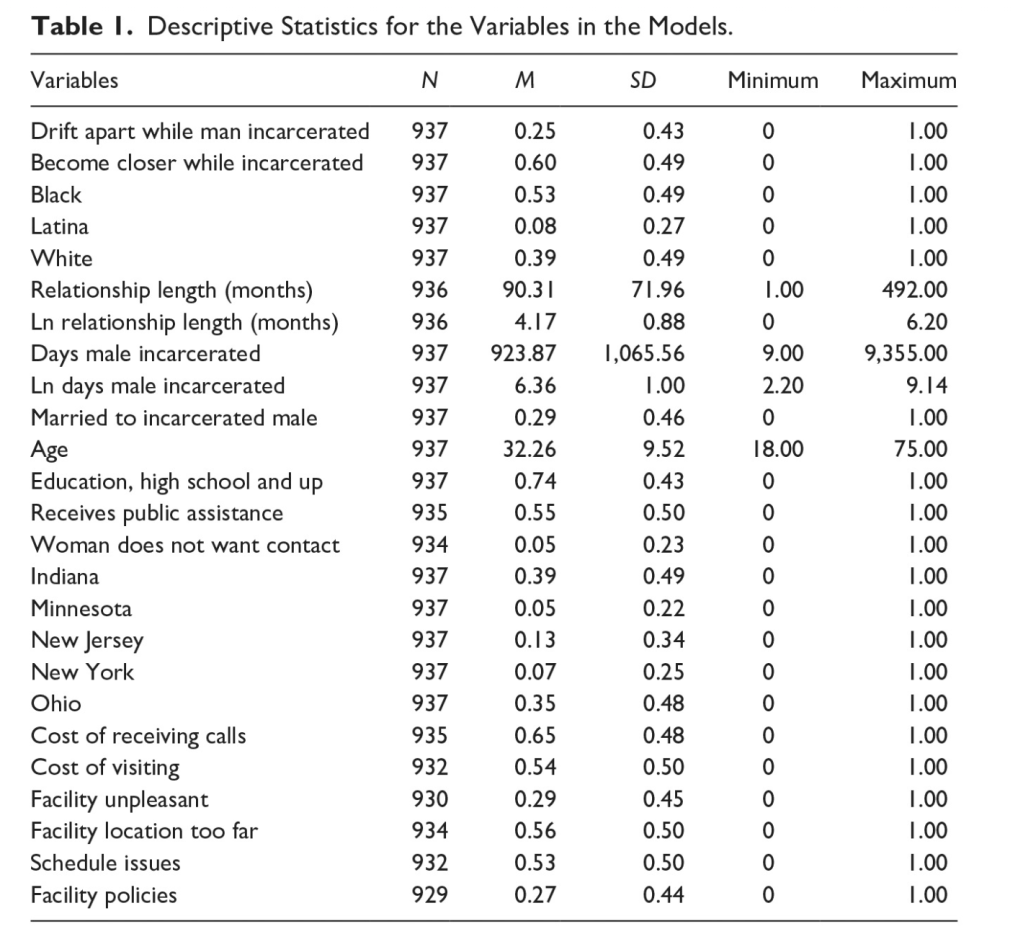
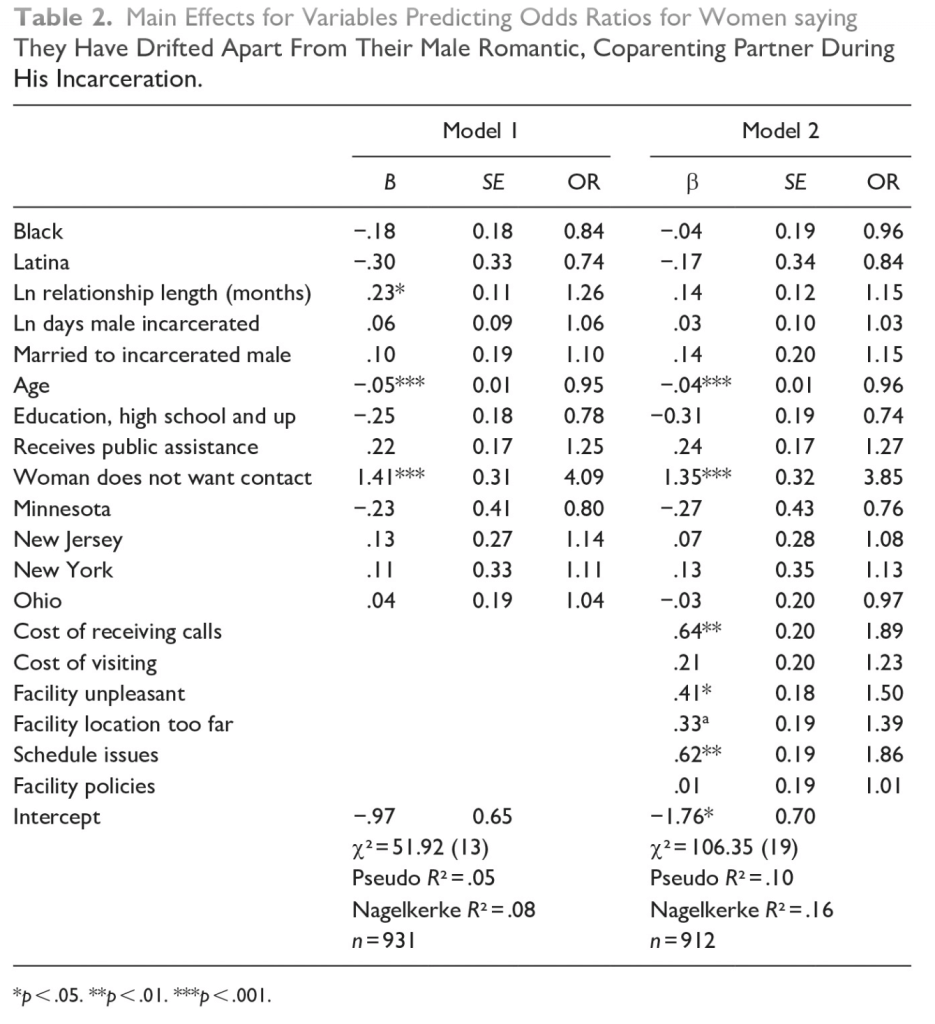
She describes that sometimes you start out with a research question and it doesn’t yield the anticipated results. Initial questions can oftentimes not align with the data that is collected. Dr. Phillips notes that researchers may “reverse engineer it”, by coming up with the results they want and then go on to asking the question. What she and the team did was look at the data set and analyze it in different ways with the hope of uncovering a distinction. Generally, there were certain variables they found not to be significant at all which would result in omitting them or refining the research question in order to understand the data from a different angle.

Phillips Table #1 :Statistical Data

Phillips Table #2

Q: Did you encounter any limitations with your data collection methods? How did you address these limitations in your analysis?

As Dr. Jasmine Phillips mentioned in the interview, one limitation of this study is that the data used was quite old between 2008 and 2014. This made the data less relevant and less applicable to current situations. Dr. Jasmine Phillips also pointed out that this is a quantitative study. There was no way to follow up with participants to clarify or further explore their responses. This made it challenging to understand the reasons behind participant’s answers. In addition, Dr. Jasmine Philips emphasized that the study was a snapshot of one day. It was difficult because it didn’t allow her or her colleagues to track participants from the beginning of their relationships or observe how their views might differ before or after. Dr. Jasmine Phillips concluded her answer by mentioning that this was a longitudinal study and would have been insightful with more varied data.

Q: What specific challenges did the participants identify as most significant in maintaining their relationships with incarcerated partners?

Dr. Jasmine Phillips highlighted that while phone access in prison is often seen as a basic issue, it is a significant problem. Many prisons still restrict phone access; when it is available, the cost is astronomical because two or three companies control it. She continues to say that this burden falls heavily on the families outside, particularly on the primary person with income, such as often being women who are also responsible for taking care of children and planning visits. Dr. Phillips added that she supports free phone calls for prisoners and mentions that maintaining contact through these phone calls can play a crucial role in preserving relationships.

Q: How can the study findings help create better support or programs to help women communicate and maintain their relationships with incarcerated partners?

Dr. Jasmine Phillips pointed out that the high cost of phone calls for prisoners harms both relationships and society. While it benefits corporations, it certainly doesn’t help the individuals or families involved, especially when we live in a period where you can easily talk to someone halfway across the world for free. She emphasized the absurdity of continuing to restrict prisoners’ access to communication, as they are already incarcerated and facing numerous challenges. She continues to mention that several states, including California, have begun to address this issue. She believes this is an important issue to pay attention to. 

To Conclude…

Dr. Jasmine Phillip’s research highlights how prison-related barriers like expensive phone calls hurt relationships between women and their incarcerated partners. These challenges often create emotional detachment between families, resulting in a loss of connection. Dr. Phillips states that making communication affordable or accessible would help these relationships flourish. As states across the country, including California, begin to address this issue, many families have hope that there will be a better support system for prisoners and their families.


Full Interview with Jasmine Phillips

Dr. Kressler “Learning Are Way Through Critical Development For social Justice”

By: Aaron Clayton and Justin Tenorio

My partner and I had the honor of interviewing Dr. Benikia Kressler. Our interview was about an article she published titled “Learning Our Way through” Critical Professional Development for Social Justice in Teacher Education. During our interview, we not only got to see her results from the study she did involving faculty members. But also, how as an educator in one of the largest universities in the country, she noticed we teach in a culturally, experientially, and ideologically diverse context. And like her colleagues nationwide, they bear witness to the tensions and traumas associated with the current U.S. political climate.

Continue reading “Dr. Kressler “Learning Are Way Through Critical Development For social Justice””