By: Olivia Morris, Sheyda Ebrahimi, Cyrus Tavakkoly, & Mhaczyne Chu De Castro
November 5, 2024

Q1: What was your time like in Qatar?
So I lived in Qatar for 4 and a half years, got there on New Years Eve in 2010 and left in the middle of 2015 for 4 and a half years. My son was born there. It was a very interesting place to live, I mean it’s hot and dusty; uber conservative but it has a thriving expat community. The money was way better than I’ll ever make in any other academic appointment. You can travel and all that kind of stuff so it was a very cool place to live.
Q2: What made you come to the conclusion that you wanted to conduct research about how people received their news in Qatar?
The real practical reason was that Qatar University had very good funding for conference attendance, only you had to have a paper accepted. So I was trying to figure out a paper to write to get accepted to these various conferences that would be in Lebanon, Morocco, Jordan, and these places I wanted to go so I started writing papers. In my main area- Advertising research, that’s not really a very big or popular research in the Khaleeji Region in the middle east and so I was trying to figure out something else to do and I found out that there was this really good data set that was available that nobody was using and I thought, well, i’m going to look into that because it was a really rich resource, that people weren’t using and so, I kinda just thought I would troll it for data and see what I can find.
Q3: What type of sampling method did you use to collect the participants?
So this methodology was the research; the surveys were conducted by a professional survey research group. A research foundation that was funded by and housed at Katri university, which is where I work. So there were these people that had worked for top-notch research companies in the US and then, Europe and had this research background, and so, they got grant money from the Katri foundation, which is a very large and wealthy organization that funds a lot of prosocial things in Qatar, and one of the things they wanted to do is fund what they call omnibus survey of life in Qatar. And I don’t know if any of you have ever heard of the general social survey in the US; it is a really big survey that sociologists have been doing, probably since the 1970s, and so they do this survey or modules of it every year. And over time, they’ve developed this incredible database that can show trends data on how values and attitudes and all kinds of things are changing in US society over a period of time because they keep adding to it and also ask a lot of the same questions from year to year so this survey in Qatar was modeled after the US version of the general social survey.
So if you mention that to Dr. Du, I’m sure Dr du will be well aware of the general social survey. And so, anyway, they had all this funding to do this research, and they surveyed, I believe it was over 2,000 people, about 2100 people on this portion of the survey that I was working on the data on, and these were all done in in-person interviews and using a computer-assisted personal interviewing device, so basically, it’s a data collection device on a tablet that administers the survey. Exactly how they sampled it, I’m not entirely clear. It could be that I knew and I don’t remember it could be that I just never knew because in-person sampling, sampling for in-person surveys, often becomes a function of multiple different techniques. One is called snowball sampling, which is where you get some people and then they refer you to others, and refer you to others. That’s not a real statistically strong method of sampling. Could’ve been convenient sampling; I imagine they did hang out at a lot of coffee shops and restaurants, and they did hang out in the malls and things like that and just invited a lot of people, and then there was probably also some invitation through email, text messaging, phone calls, to get people to agree and then let the interviewees come to their home so it was probably, for something that big, a combination of sampling methods.
Q 3.1: Just a follow-up question, in the pre-test assessment, you ruled out migrant laborers from the analysis. Did it affect the overall results?
Probably not because, first off, to understand who the migrant laborers were, and I don’t know if you are that familiar with the population compositions of countries like Qatar and Dubai, things like that. They have, so Qatar for instance, was a population of about 2 million people when I lived there; only about 15% of the population were Qatari nationals. So national citizens from Qatar. The rest were people that were brought in there to work and then they kind of classified the people who were brought into work into two very broad categories. There were the expatriate workers which I was one of those, but these would be mostly people who were working in kind of professional jobs. Management, a lot of stuff in the energy sector. Medicine, education, those are expat workers. Most of the expat workers were from other Arab countries. In the MENA region, North Africa, around the Mediterranean basin, and things like that where you tend to have pretty high levels of education among the Arab-speaking population, but then there were also plenty of European expat workers and things like that. Those were the two groups that were included in the survey. The migrant workers are largely laborers, and they would be, and I don’t know if you’ve followed this, it was kind of a big controversy during the World Cup, but it’s quite controversial how migrant workers are treated in these countries. There’s a lot of promising higher wages than they actually get delivered, there’s a lot of, they get them into the country and then essentially, confiscate their passports so that they can’t leave. There are a lot of human rights issues there, and the people doing this survey wanted and did a lot of interviewing migrant workers to get their perceptions of life in Qatar. However, on the variables that I was looking at as far as media consumption and things like that, there just wasn’t enough. They weren’t even asked those questions because they didn’t have them; they mostly lived in communal housing and did not read newspapers, had very little access, had no general media, and very little general media consumption. Had they had media consumption and been able to be in the survey, may have been a completely different set of results. But they also would’ve been very reluctant to honestly answer questions.
Q4: When conducting this research, how do you determine the sampling error percentage?
So, technically, every question in a survey has its own sampling error, but we usually report the sampling error broadly based on the sample size. I looked it up right before because I couldn’t remember, but the equation… Have you taken any statistics in your research methods class? Okay, so sampling error is calculated using a z-score, which is a standardized score with a midpoint of zero, and each standard deviation is one, or minus one, two, minus two, etc.
The sampling error is calculated as Z, which is based on your confidence interval, and for most surveys, you want a confidence interval of plus or minus 5%. What that means is that within this confidence interval, if people are rating something on a scale of 1 to 10 and the mean is 7, you’re confident that the true mean is within 5% of 7. That’s what a confidence interval represents. So, you take your confidence interval and multiply it by the standard deviation of the population for the variable you’re considering. The standard deviation of the population is divided by the square root of the sample size, and that gives you a percentage.
Q5: Given the nature of the research, did you find it easier to conduct the research using quantitative or qualitative methods?
I’ve always been a quantitative researcher, that’s how I was raised. And with a data set like this it’s intended for quantitative analysis.
Q6: Could you explain the importance of media framing and agenda setting and how that can influence the public’s opinion?
It’s a theory often used in mass communication context and they’re related. The whole agenda setting framework which started I think in the 19780s McCombs and Shaw had a famous article that kind of started this agenda setting model, but there had been for many many years research into people that were thinking that the media in general and news media in particular had these major effects on what people believed, how they voted, how they thought about things, and the research simply wasn’t supporting it. There just was this idea of these major Grand effects, which kind of grew out of the post WWII framework where sociologists and researchers were really concerned about how somebody like Hitler could come along persuade an entire population of country to believe that a set of people were bad and needed to be removed and needed to be exterminated, right. And researchers were like how can somebody be that powerful through their use of the media and they started thinking that media had these profound effects on people but it isn’t necessarily the media that is having these profound effects. And so the agenda setting model kinda started with the idea that maybe the media don’t tell you so much about what to think, but they are pretty good at informing you or informing you in terms of what you think is important. Not so much what to think, but what to think about. If you were to look at political polling right now leading up to the presidential election and I am not sure exactly the order of the top 5, but the top 5 issues across the broad samples of American voters would be the economy, immigration, climate change is actually in the top 5, democracy itself is in the top 5, and I can’t remember the 5th one but that could be an agenda setting effect, depending on what news media you are most paying attention to, which ones they cover the most could influence you in which order is most important So that’s the idea of agenda setting. Framing then gets into how do they characterize the issues and that’s where you get more into liberal media, is it mainstream media, is it conservative media and they may cover the same topics, but they are going to put a vastly different spin on it depending on the political leanings of the people running these news organizations, but also to an extent of the political leaning of the audiences, and trying to feed them information that is consistent with their world view and all media do that so that’s the relationship between agenda setting and framing.
Q7: What language is the news given in in Qatar?
So in Qatar, I guess it depends on which media vehicle you’re talking about. Most of the newspapers were in Arabic only, and then there were two English-language newspapers. Al Jazeera, which is featured pretty prominently in this article, is headquartered in Doha, Qatar, and is quasi-funded by the Qatari government. Al Jazeera essentially has two networks: an English network and an Arabic network. They have different managing editors. The whole top structure is unified, but they are essentially different news divisions under the same name. So, there are different reporters, camera people, producers, and programs between Al Jazeera English and Al Jazeera Arabic. Some of the other TV news networks mentioned would be mostly or completely in Arabic, but they come from other countries like Saudi Arabia.
Q8: I think you talked about this a little bit earlier, but based on the research that you conducted in your results what type of surveys would you recommend we use in order to receive the most effective and accurate data?
Meeds: So tell me a little bit more about what you’re doing
Cyrus: Yeah so we wanted to interview students about like where they consume their media and if it shapes their opinion, or we can find that out when we ask them, but we didn’t know the best way to do that, like we could probably go on campus
Olivia: We were also thinking we could do a google survey and send them because we all have different classes and Discord chats we can send them in there but I feel like we would need to have a some sort of incentive for them to do the survey, but i feel like thats a good way to get more people to do it in a different demographic of people if we were to send it out that way instead of going up to everybody on campus and having them answer questions right then and there, would you think that would be a good idea?
Meeds: It very well might be. Are you talking about doing a survey then?
Olivia: Yes making a survey and having them fill it out.
Meeds: Ok so like a quantitative survey you could set it up in qualtrics. You could also go through survey monkey which is pretty cheap, and you can limit it to college students
Olivia: Ok, so narrow it down so it’s not so broad.
Meeds: Right I would have that conversation with Dr. Du, who is more engaged in survey methodologies than I am, most of my research has been behavioral experiments so this whole thing of doing secondary analysis on survey data was a jump in a different direction for me. I’m not a survey researcher. She knows you won’t have a lot of resources and you’re not going to get a huge random sample of respondents.
Olivia: Right and she told us from the beginning that the survey would probably be the easiest for us since one we don’t have a lot of time and two it’s just the easiest way to quickly receive the data that we need so I think she’ll be happy with the survey.
Q9: Why do you think Qatari nationals trust Al Jazeera more than other news channels?
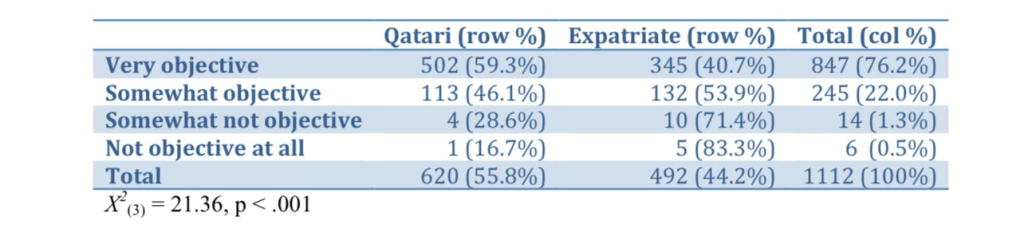
Well, Al Jazeera is kind of the home media. It’s headquartered in Doha. It’s a point of national pride. I mean, Qataris are very proud that Al Jazeera is theirs. And so, they, and I assume they still do, but it is kind of a point of national pride, so it would be natural that they would trust that more so than news sources that were from outside the country. Al Jazeera has been criticized quite a lot for being very pro-Qatar in their editorial stances. As you might expect, but that didn’t necessarily bother the Qataris, so they tended to trust it.
Q10: At the end of the study it was deemed that television was the dominant source for news, looking back from those 10 years how that has changed in both the US and Qatar?
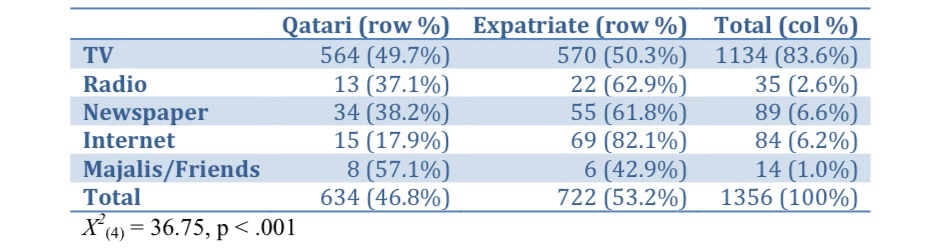
Meeds: the influence of newspapers have a very long and rich heritage in Arab countries even though the models of freedom of the press are quite different than what the US press system was founded on and this was a 2013 paper and I was doing this stuff probably in 2012, which is one of the reasons why I don’t remember it real well, I don’t remember what I had for dinner last night laughs. But even then the influence of newspapers was waning in 2012. The influence of Al Jazeera in particular in television news was very strong but people were starting to consider Facebook as kind of a source of news information, so now Facebook is a bit pase and I’m sure it is in Qatar as well but Twitter was also used quite heavily so I’m sure that if you were to look at it now you would see a lot more reliance on social media for the source of news. I would guess Al Jazeera is still pretty strong in Qatar, but may not be as strong in other Arab countries. One of things about social media that often gets overlooked in it’s role in providing information in developing countries and 3rd world countries is that a lot of people in North Africa, East Africa where there’s a lot of political strife and also a lot of poverty- they may not have access to much traditional media, but they all have phones.
Cyrus: That’s interesting
Meeds: That is a really big link to the outside world and as cheap as phones are, that has made a lot of information available to many many people who maybe didn’t get much information before.
Cyrus: And I did a slight dive into how people- college students specifically, and how they get their news, and most of it has been through social media whether it’s Instagram, or Youtube, a lot of it being third party sources, unlike older generations that use traditional like TV or newspaper and I thought it was pretty interesting how it can shape their perception of world foreign affairs that are going on today
Meeds: Very much so.
Our Interview With Meeds
 The Society for Communications Research