By: Demi Estrada, Kevin Huang, Mason Kao, and Nicole Porter
Religious devotion, video game fandoms, and public relations; one would think that all three subjects are unrelated. Though a study done by Professor Cylor Spaulding says otherwise. Spaulding’s 2016 journal article called “Applying the devotional–promotional model to the video game Faithful” theorizes how public relations can adopt the ideas of religious devotion and video game fandoms. Religious devotion’s foundation is made up of an idea shared amongst a group of people. Fandoms are a result of a community’s devotion, where individuals can express their dedication to a cause. Public relations can take these ideas and build up brands by developing relationships with their audience, creating a sense of trust and involvement. Collectively as a group, we found this topic eye-opening as it teaches us to recognize old yet effective models of the past that can be applicable now. Additionally, showing how subjects with no explicit relation are correspondent with one another.
by Evan Da Silva, Hillary Avelino, and Kristofer Medina
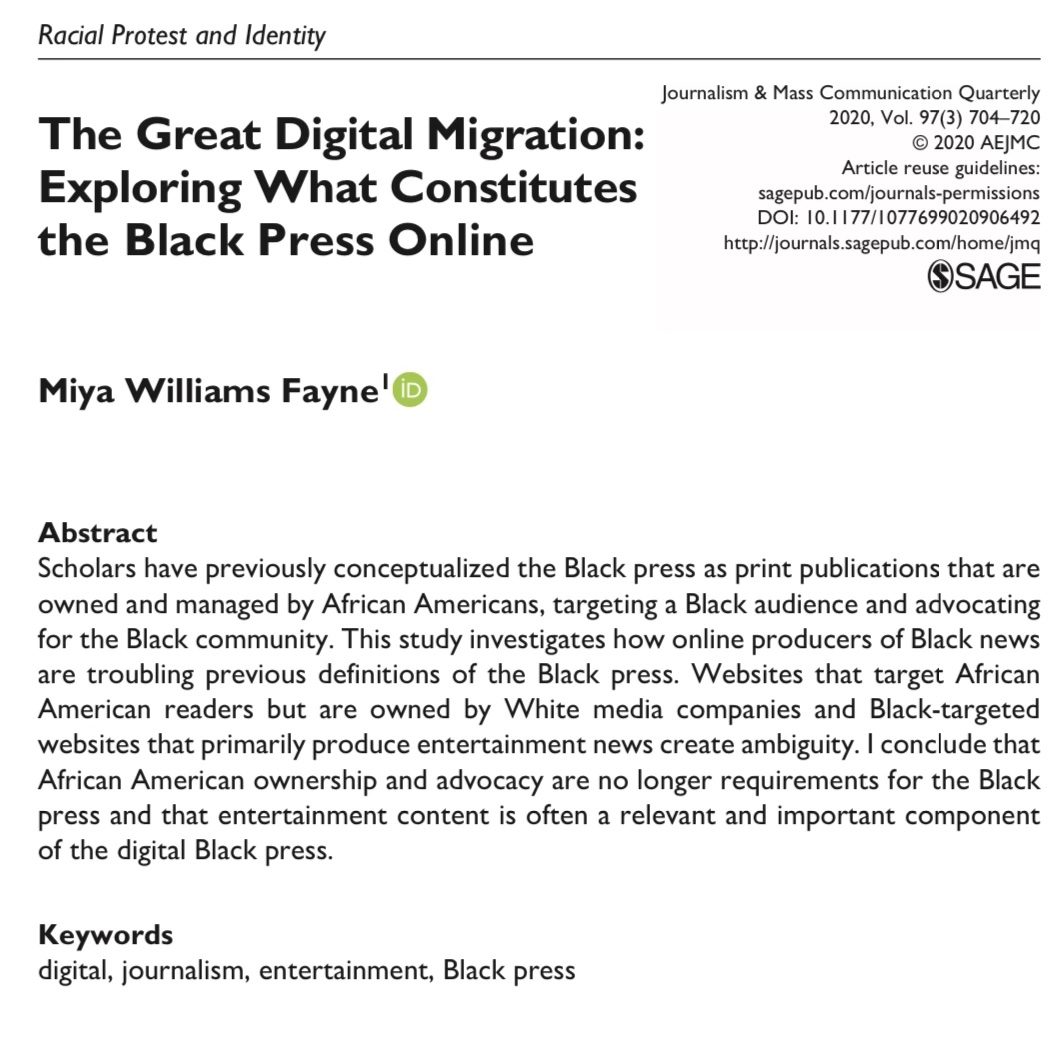
Dr. Miya Williams Fayne is an associate professor at California State University, Fullerton. She is an extremely well-educated individual, having received a Ph.D. from Northwestern University in media, technology and society, an M.A. from Emerson College in publishing and writing, and a B.A from the University of Southern California in print journalism. In her study, The Great Digital Migration: Exploring What Constitutes the Black Press Online, Dr. Williams Fayne acknowledges that the Black Press has historically been defined as print publications that are published by and for African Americans in the United States. The Black Press was officially established as an institution in 1827. But, historically, there is not an outstanding definition of what the Black Press truly is. Being that most media is now consumed digitally, is attempting to reach wider audiences, and is primarily white-owned, Dr. Williams Fayne hypothesized that, in the opinions of modern journalists, black ownership and advocacy would no longer be requirements for publications of any medium to consider themselves a part of the Black Press. With that hypothesis in mind, Dr. Williams Fayne felt that it was important to find out how the Black Press was being defined in today’s journalism field.
By: Valerie Madrid, Mary Sutedja, Isabela Veloro, Kayla Nguyen
On October 18th, 2022, we interviewed California State University Professor Dr. Russell via Zoom in regard to his paper, The New Gatekeepers: An Institutional-level View of Silicon Valley and the Disruption of Journalism.
This interview was conducted to bring a better understanding of our own interpretations of the research process and its somewhat complex nature. In our interview, we asked Dr. Russel six questions related to conceptual ideas of research, as well as questions regarding his own personal research process. Our questions ranged from specific questions about The New Gate Keepers to questions that were more general for Dr. Russell to answer in order to gain a bigger picture of the exploration and interpretation of research data.
Read More: The New Gatekeepers: An Institutional-level View of Silicone Valley and the Disruption of Journalism with Professor Frank Russell
The six questions asked to Dr. Russell were chosen to give the professor a way of answering broadly and openly. Our goals were to have a better understanding of The New Gate Keepers as well as Dr. Russell and his own personal objectives with research.
Question 1: As a seasoned researcher, has qualitative or quantitative data been more helpful in finding data that helps your research question?
Russell starts his answer with stating it depends on your question on whether you will use qualitative or quantitative data. He continues to share that he has used both types of data in his research. The two main forms of research Russell performs is quantitative content analysis and qualitative discourse analysis. Though one is a quantitative analysis, he states it is the most qualitative quantitive analysis. Russell continue to shares that the characteristics of his studies are, “argubably qualitative as they are quantitative.” (Russell 2:11). Additionally, Russell mentions how this specific study that we are looking at is a qualitative discourse analysis of an oral history that has occurred. With that being said, it required him to be cautious of what was already mentioned, and how to conduct an effective study, limitations of interviews and what can be learned from interviews. Russell states based on interviews, you can tell what people view as a priority, and what they believe should have been reported. Through their answers it can display their values. Russell ties in his answer to the original question, by stating it ultimately depends on the question and whether you have a hypothesis or if you have research questions. With a hypothesis you need to test if something if one object will affect another object, which will have to be qualitative research. Now with a research question, if you can measure the concepts you can quantitative study. Russell finishes his answer with stating he cannot state which answer is better than the other and refuses to give a one is better than the other answer.
Question 2: When compiling relevant data for your research, how do you flow the data in between your own words to have a consistent and easy-to-follow narrative?
Russell reveals that he has been writing since he was kid which has allowed him to be able to have strong writing skills. Additionally, Russell expresses that his effectively writing skills have been crafted for over 40 years. He continues to share that he has studied writing and teaches students how to write effectively. Russell continues to if he were a professor who specific taught research methods, he would teach his students how to switch from your own words to quotes. He continues to share that in writing, writing consists of re-writing and re-writing to ensure your message is clear.
Question 3: The sample size and who you are interviewing are highly significant. Your publication interviewed the names of those partial to Silicon Valley. How do you personally stir away from possible sample bias?
Russell begins to share that he was not the one who personally conducted the interviews. He conducted a secondary analysis of the interviews that were conducted. Since this was a qualitative study, he did not have a sample or did not attempt to have a representative sample of all journalists of Silicon Valley. However, Russell expresses why the reason why his study was effective was because the people who conducted the original report were fellows of Harvard University. To add on, these reports were done by top editors and managers, which is arguably an accurate representation of journalism as an institution. Russell shares that he was just as interested in the answers by the interviewers answers as well because they were involved in the Silcon Valley as a social institution as well. Additionally, Russell shares he was attempting to analyze something that would provide him with a deeper understanding of Silicon Valley as a social institution, in relation to journalism as a social institution.
Question 4: Has there been any time when particular research is being conducted, and an entirely new angle has appeared that you may not have considered?
Upon asking Professor Russell this question, his immediate response was that new angles appear all the time, and proceeded to provide an example of the study he is currently working on. In this study, he believed due to his previous research that #breaking was not a popular hashtag to use on Twitter for broadcast stations. However, upon looking at English-only broadcast stations on Twitter, he found that using the hashtags he previously thought were not useful, actually had a positive impact on user engagement. Russell very openly admits he did not know why the originally perceived to be “negative” hashtags had a positive impact. However, he was able to speculate that it may be because people who follow broadcast news on social media enjoy live coverage of news; and that the #breaking tag may replicate the “live” aspect of broadcast news. Russel concludes by explaining that figuring out why the hashtags were getting more engagement is a question for a different person because he does not know but is quite curious to find out.
Question 5: Journalism and its connections to Silicon Valley may not be a connection many makes when thinking about those concepts separately. Do you believe your publication has had the power to bring awareness to a growing issue of news bias? 18:57
We clarified the definition of news bias in the context of our question as, “manipulating news to ones favor,” Professor Russell explained that he believes, “everyone tries to manipulate the news to their favor, however, journalists when they try to do their jobs well, try their best to resist that.” Russell laughed at how simple his answer was but then went on further detail explaining that there has been a lot of research on a theory called, “framing theory.” Framing theory, as explained by Professor Russell, is that for any issue in the news, there are different aspects of that issue that one can look at. He uses the window in Bela’s zoom background as an example of constraints of perspective in media; what Bela sees out of her window is different from what he sees, and what he sees is not the real world. Russel goes on to explain that a typical news story or news article can only fit so much information in a short amount of time and space, so you have to choose different attributes of what you’re writing about. Another influence on the aspects media has to choose when creating news is that the source may want to promote certain aspects as well. Professor Russell expands on the idea of source influence by providing an example of his own experience. Russell explains how Apple throws big “psuedo-events” every time new products are being launched and reveals that these events are created to create news coverage for the event. He poses the questions, “were the journalists covering the event being manipulated, or was the event being covered newsworthy?” Russell explains that he gets suspicious when students talk about media bias because to him, saying that the media is biased in one way or another is incorrect. There are so many different types of bias and it tends to be a topic that is oversimplified.
Question 6: Do you think that if you were to conduct this research again, this year, your findings would be the same, or significantly different?
Professor Russell revealed to us that the original interviews for this study were conducted in 2013 and 2015. The dissertation on the interviews was presented at conferences in 2016 and published online originally in 2017. 2019 was only when the study was published in print. Professor Russell stated that in the original study, he used a theory called, “new institutionalism.” New institutionalism, as defined by Professor Russell, “assumes that the social institutions are relatively stable or fixed structures.” Russell also clarifies the term ‘institutions’ in the context of the definition. Institutions exist when organizations and individuals share similar values and behave similarly within said institutions. To exemplify this, he uses newspapers as an example of institutions in journalism. Russell explains, because there is a set of established journalistic practices, systems, and values in newspapers, it is not hard to switch from one newspaper company to another. He originally believed that Silicon Valley was the same way, however in our interview, Russell explains that now he is not so sure if Silicon Valley can be identified as an ‘institution’ due to the fact that things have changed more rapidly than he expected. Because of this rapid change, Russell has now looked at two other, more flexible, theoretical perspectives describing people’s relationships with organizations. Professor Russell originally was convinced that the structure of Silicon Valley was not going to change, but now believes that you must use at least two of the three theoretical perspectives in order to approach this topic.
Conclusion:
The overall interview with Dr. Russell was very informative and effective in giving us a better understanding of research development and processes. Dr. Russell in regards to The New Gate Keepers as well as his other research conducted shines a light on the long but rewarding process that is conducting research.
By: Holly Johnson, Emma Thomas, Marisol Ceja, Karina Orellana
Technology has progressed rapidly over the past 50 years, with new technological items being introduced to the masses. Music has been one of those technologies that is seen as “new”, in a sense that new genres and ways to listen to them have been invented. CDs were very popular for a decent amount of time, gaining popularity from the 80’s well into the mid 2000’s. The current and most popular music listening platform is streaming. Professor Rashidi conducted his research on transitional experiences from physical music media purchases to streaming service subscriptions. His research titled “What do we do with these CDs? Transitional experiences from physical music media purchases to streaming service subscriptions” was published in 2020.
By Fynn Chester, Juan Pablo Sepulveda, Andrew Gutierrez, Jacob Ishikawa
Dr. Cynthia King
We conducted an interview with Dr. Cynthia King, a very well known professor of Communications at California State University, Fullerton. The Interview was based off of one of her publications called the Effects of Humorous Heroes and Villains in Violent Action Films.
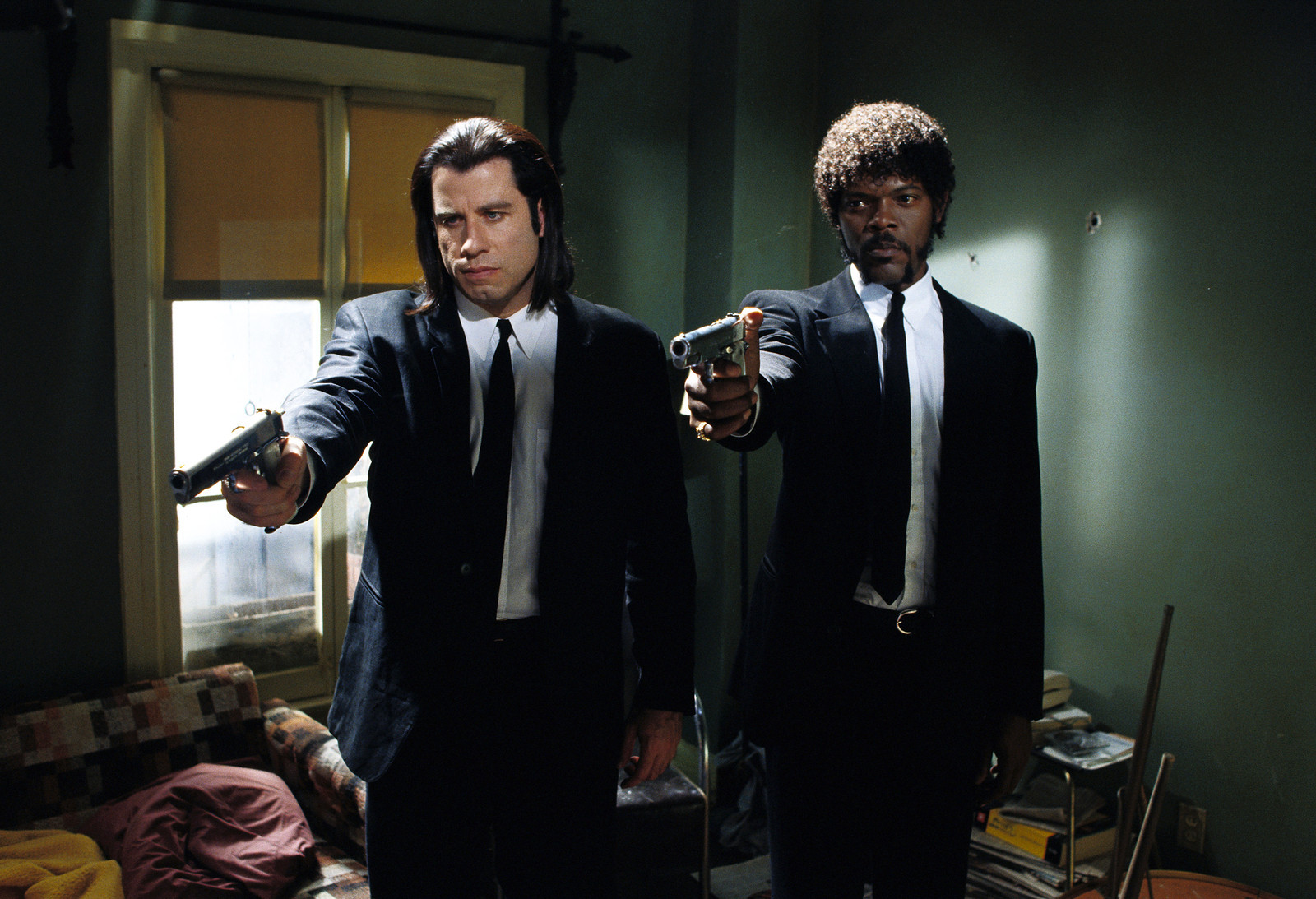
Dr. King worked in a media violence research field prior to conducting this study. While working on media violence, she then took a course to elaborate on humor theory. The similarities between the two intrigued her enough that she combined the two during this study. During this time, however, there were movies coming out such as Pulp Fiction, and one liner Arnold Schwarzenegger movies where violence was at the forefront, but humor was a close second. Dr. King decided to research the effects that humor plays in these violent, and sometimes grotesque, action films. King goes on to describe how her curiosity was what attracted her to the topic and how presenting this to some of her classes gives students an understanding of the commitment, curiosity, and thinking process one must have as a research professional.
Pulp Fiction (1994)
Dr. King describes how the background information is based on what we already know. Reviewing articles, other studies, and using key information to obtain a plethora of knowledge and information as the cornerstone of your research. King describes how you may already find an answer to a question you’re thinking about using as a hypothesis altogether and your understanding of the question at hand may be resolved before starting. By using this information to your advantage, you can refine and redetermine your hypothesis in a more quality manner. King studied how humor and violence wasn’t a new theory and that her previous knowledge on the topics had been short stemmed. Learning to love the process of examining an entire history of feelings and emotions among certain aspects of life. Designing a study that is well rounded is key and the goal of all researchers and publishers. Then having others review your research and study and giving you very helpful feedback, even about information that you may have already seen and adapted into your study. King compares her study to mystery movies and foreshadowing. A good mystery movie will leave you at the end looking back and saying you already had the answers, and you just had to finish the movie to see it. A bad mystery movie will leave you with open ended questions that have no result from the movie itself. The study should come to an answer at the end, whether it is negative or positive, but it shouldn’t end in more questions.
Dr. King states that her study was completely experimental, which allowed her to manipulate whichever part of the process she’d like. A survey, King says, is really only correlational, and cannot create causality. Taking films and editing the movie to have no humor at all allows for the manipulation in her survey, which resulted in varying answers for her study. The main difference between the control groups was that each viewed a different version of the same movie because of the editing. One control group viewed a movie which had been edited to show no humor for the hero, another was edited to show no humor for the villain. These manipulations created vast differences in the outcomes of how the viewer interpreted the film. In the bigger picture, the study aims to show what the effects on society may be, and that maybe violence mixed with humor can desensitize something that is wrong or not seen in everyday life. The true test of the experiment came after the movie when Dr. King had the control groups watch short videos of actual violence. King played two videos, one of the show Cops, where a squad car pulls up to two men in a violent altercation, and another video from Face of Death, a video compilation of people being hurt or hurting themselves.
Terminator 2: Judgement Day 1991
Villain humor made the movie more distressing for all viewers, and hero humor made the movie less distressing only for men. Women still had the distressing factor to the movie based on the perception of the movie. Also, finding a film that not everyone had seen was key to the experiment, because bias did not want to be included if participants had viewed a film before. The implication of using humor in violence actually may have worked better because it can make people view it in a more materialistic view. The idea that humorous cues in violent films indicates that whatever is being watched is “just a movie” and not reality allowed audiences to enjoy and appreciate the films.. The second aspect of the study showcases actual violence, but without any humor at all, because it is real life. Without humorous cues to precede the violence, audience reactions were different than expected. Being able to decipher the media research that happens and the effects it can have on populations was of utmost importance.
At the time the experiment was conducted, technology and programs were still in their infancy, so paper and pencil were the instruments used. While inputting the results and coding the participants to have statistical analysis is difficult, it used to be much harder due to the lack of technology at the time. The brainstorming and designing of the study will take much more time to prepare then actually putting it into action.
In Dr. King’s experience with film editing, it became much harder to actually learn a completely different skill just to be able to conduct a study. Without the technology to “point and click”, it was tedious and difficult and the study took quite some time to complete in full. In total, the experiment took one year from start to finish. Dr. King states she had a great, sometimes frustrating, experience. King found a new love for video editing, considering she had never edited film before. King also had to build her own code to gather the statistics. It was an experience that allowed her to grow as a person, instructor, and doctor.
If one is to take anything from this interview, it should be that perseverance and understanding should be at the forefront of one’s goals during an experiment. There will be times when one cannot fathom moving forward, finishing a task, gathering the right partners, or building an experiment…but if the motivation and determination is there, one can endure. Create, learn, and share. That is the true nature of experimentation.
We had the opportunity to speak with Professor Cynthia King to discuss research methods and her experiences with conducting research. Dr. King is a professor at Cal State Fullerton who wrote a book titled Entertainment & Society: Influences, Impacts, and Innovations. Before earning her Ph.D. in Mass Communications from the University of Alabama, she went to Florida State University to get a Master’s Degree in Political Science. Throughout our hour-long discussion, we gained some insight into what the best methods would be for us to conduct our own research. Our research we will soon be conducting will be on social media advertisements and which mediums prove to be the most effective. Dr. King was able to give us insight based on her seasoned background with entertainment and media psychology. With the rise of popularity in social media and constantly evolving algorithms, it is imperative to apply research to understand the changes patterns. Dr. King was able to give us an understanding of her background, methods and concepts to give us a greater insight for our project.
By Gwynnevere De La Cruz Lauren Nadal Caitlin Dempsey April 14, 2022
Gwynndlc@csu.fullerton.edu
Quinn Corralejo
From lecturing to responding to comments and questions from students, posting content on ASI social media channels, updating the ASI calendar and budget, sending emails, and meeting with her social media and marketing staff, this is a typical workday for ASI Marketing Coordinator Quinn Corralejo. A CSUF Alumni, she received her bachelor’s degree in Business administration in 2017. She received her MBA in 2019 in organizational leadership; and is currently receiving her Ph.D. in business management, where shes focusing on strategy and innovation at Capella University. As ASI Marketing Coordinator, Corralejo has developed a better understanding of how to use social media to target GenZ and guide her ASI staff in improving their communication and marketing abilities.
Do you believe Twitter is a viable way to collect data for communications research? Journalist and CSUF Professor Frank Russell goes in-depth about his past experiences using Twitter and other social media sites for data research.
Professor Russell had worked in the news industry for over 20 years for newspapers such as San Jose Mercury News, The Seattle Times, and The Los Angeles Daily, among other newspapers. Near the end of his time in journalism, he worked in digital journalism.
Humans have been making music for over 35,000 thousand years. The oldest manufactured instrument is the flute, originally made out of mammoth ivory. Today, there are over 1,500 musical instruments used individually or together to make the music we listen to every day. Advancements in technology have also allowed us to make and listen to music more efficiently, making it easier to take music with us wherever we go. After interviewing researcher and Professor Waleed Rashidi regarding music and its related technology, we were able to gain some insight on their important roles in students’ lives today.
By Alan Ramirez, Branden Richards, and Gabriel Gonzalez
We’d like to first give a huge thank you to Dr. Assaf for clearing time in her busy schedule to talk with us and share her expertise with us on our topic. She was a huge help and provided a lot of insight into the topic of our study.
Discussion with Dr. Elise Assaf
Dr. Elise Assaf (Communications)
What Is Your Current Knowledge On The Social Media Platform, Tik Tok?
We began our interview by asking Dr. Assaf about what her prior knowledge on Tik Tok was. Her answer was that although she has heard a lot about Tik Tok and finds herself learning a lot about it in her field of communications she did not have the app herself. She also acknowledged that her previous knowledge on the app was anecdotal. This question was followed by a conversation by Brendan about the addiction of social media itself. Brendan expressed his love/hate relationship with Tik Tok which entails him downloading the app. Then realizing he has been on it way too long and deleting it. Then later out of boredom downloading the app again. Assaf related with us and expressed how sometimes when she opens up Instagram and notices that there isn’t anything new to look at she feels a little sense of frustration as well as wondering where new content is as well as sometimes trying to search herself for new content.






 The Society for Communications Research