By: Zach Juarez, Gerardo Colon & Rene Trujillo Jr.
Professor Robert Meeds, Courtesy of the CSUF Communications Department
We had the pleasure of interviewing Dr. Robert Meeds for our scholar interview.
Meeds is a professor of Communications at California State University, Fullerton, teaching areas are in advertising and integrated marketing communications. His research explores how changes in the ways advertising copywriting affects what consumers notice, learn, think, and feel. His research articles are published in academic journals such as the International Journal of Advertising, Journal of Consumer Psychology, Psychology and Marketing, Journal of Computer-Mediated Communication, Newspaper Research Journal, Journal of Middle East Media, and others. Prior to joining Academia, Meeds worked as a graphic designer and newspaper advertising director.
To gain feedback and insight into research methods, we interviewed him about his research on factors affecting the information processing of internet advertisements. Our blog post summarizes our interview with the professor.
by Jackie Logwood, Stephen Lopez, Dustin Malek & Tony Rodriguez
Amy Schmitz Weiss is a research professor at the School of Journalism and Media Studies, at San Diego State University. Her 2020 paper titled Journalists and Their Perceptions of Location: Making Meaning in the Community is an attempt to better understand the role location plays in journalism. It’s one of many papers and research projects Dr. Schmitz Weiss has conducted over several years.
“The article is one of several that I’ve done that look at the idea and the framework called spatial journalism. That is an area that I’ve been developing for several years now that looks at…how journalists do their work from a lens of location,” says Dr. Schmitz Weiss.
The role of location and journalism is long-standing and, in many ways, obvious. After all, newspapers are often location-based. The New York Times, The Chicago Tribune. The Fayetteville Observer. For centuries newspapers have been serving specific communities, covering local elections, high school sports teams, community events, and the like. Location and journalism are not a new concept but that doesn’t mean there isn’t room for improvement. Nearly every person in the developed world carries a GPS device in their pocket and uses apps like Yelp that can direct you to the best pizza or hamburger in any given city. How the technologies of today improve journalistic practices that have been around for centuries is at the heart of Dr. Schmitz Weiss’s research.
For this study, Dr. Schmitz Weiss interviewed twenty-one journalists from three different media organizations that use software to geotag the location of the stories they report on. The interviews represent a form of qualitative research known as grounded theory. Grounded theory collects data, in this case, answers to interview questions, forms concepts from that data, and groups those concepts into categories. Through these twenty-one interviews, Dr Schmitz Weiss identified recurring themes and insights. Those were grouped into six categories which eventually consolidated into three. This is the final phase of grounded theory research which is where the data is analyzed and interpreted to identify relationships and connections between the categories.
“Basically the grounded theory approach entails diving in and reviewing all the material that you have. In this case, all the transcripts, the 21 reviews going through and at first identifying what the explicit information that’s there, what people say in the actual wording, and doing a first read of that, and then going back through that a few more times, two times, three times, four times to re-review what’s coming up that’s implicit, that could be garnered out of the deeper meaning of what people are saying, and then identifying how they may translate with the specific themes or concepts, and then grouping them accordingly,” says Dr. Schmitz Weiss.
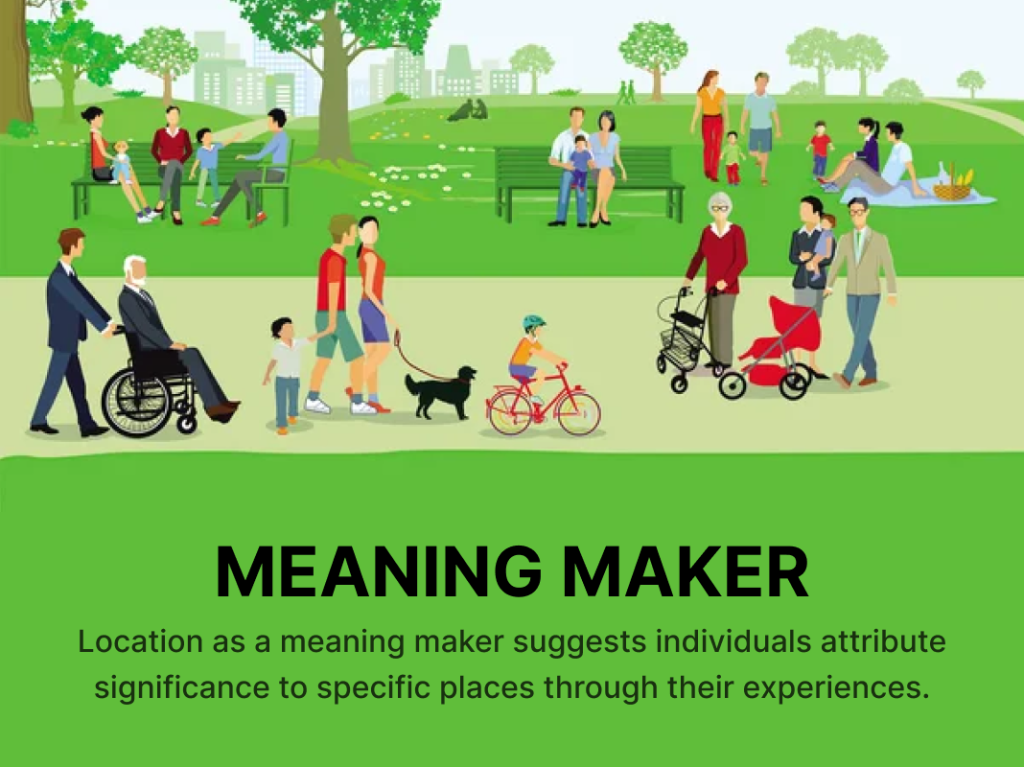
The three categories that the research led to are as follows. Location as a meaning maker, location as an organizer, and location as a communicative challenge. This article offers a cursory overview of each category. It is in no way meant to represent the extensive research Dr. Schmitz Weiss has done on the topic of spatial journalism but rather to display the outcomes the research uncovered using grounded theory research.
Location as a meaning maker is the idea that we as people ascribe meaning to a place. The example Dr. Schmitz Weiss used in our conversation was a person’s favorite coffee shop. To one person it might simply be another coffee shop, to someone else that might be where you wrote your first screenplay or worked your way through college. Readers will engage in a story about a place they care about. Understanding which places people in the community have an outsized connection to provides a helpful context for journalists and can potentially drive readership.
“Spatial ideology takes the idea of what we put in our mind as what’s close and has meaning to us and puts it within the context of space and place is how we associate information and how we make decisions from that information of how important it’s to us or why we would want to know more about it,” says Dr. Schmitz Weiss.
Location as an organizer is helped by the technology that some news organizations use allowing them to geotag the stories they cover. This technology gives newsrooms a visual representation of where news is happening. In the past, a newsroom might have had a sense of where news was happening but they wouldn’t have hard data, now they do. Although this does bring about certain challenges. As one of the publishers, Dr. Schmitz Weiss interviewed explained in the research paper.
“Not everything that you cover should be eligible for this sort of thing. Like, if you’re down at City Hall and you’re writing a story that ultimately takes place at City Hall, people don’t need to see that on a map, because it’s a City Hall story, right? It’s not a geographically linked thing.…. We needed the editor to sort of go through and figure out what was appropriate to tag and what was not,” said the editor.
There’s also the issue of privacy. The Austin Monitor has an interactive map on their website where Austinites can see stories based on location. Usually, they geotag stories based on an address. If a liquor store gets robbed, that’s easy, put in the address and move on. But sometimes a story has multiple locations in those cases they have to make tough decisions. The new technology brings up old ethical issues journalists have always faced. Using an exact address could potentially out a source leaving them open to retribution. Or it could be used to identify a victim of a crime. In cases like that, these organizations have to be broad, opting for cross streets or general areas rather than exact locations. While challenges exist, there are numerous benefits. It allows stories to be categorized in new and unique ways and it lets organizations know which parts of the community are underserved.
The last category Dr. Schmitz Weiss found was location as a communicative challenge. Essentially the challenge is convincing news organizations that spatial journalism is a value add that will help drive readership.
“The research shows that when something has space place with meaning to them, they are more interested, they’ll consume it more,” says Dr. Schmitz Weiss.
While this type of grounded theory qualitative research is thorough and can be eye-opening it does have its drawbacks in comparison to quantitative research.
“If you have a thousand people representative of a population for a quantitative study, you might be able to say because of X, Y happened based on statistics…. with qualitative you’re not going to have a large enough sample to say, because of X, Y happened with twenty people,” says Dr. Schmitz Weiss.
Still, qualitative research has many advantages. Dr. Schmitz Weiss continues.
“…with that said, qualitative research can still show the validity in the layers of nuance and deep meaning that comes out of those 20 people that shows specific patterns, similarities or differences.”
Mark Wu is a presitgous professor at California State University, Fullerton. He has been conducting his own research and teaching at many prestigous universities all over the world for over 20 years now. He also worked for many Fortune 500 companies across the globe. Professor Wu research focuses more on the Advertising side, winning many awards along the way. With all of his accollades and credibility we felt like he was the perfect person for our group to interview.
We had the privilege to interview Professor Mark Wu on October 25, 2023. We discussed about a variety of topics in terms of research. We started off with a basic question on ways to conduct research and asked him about his opinions on certain topics regarding research. All of us being Advertising Majors as well we were interested in his research that involved social media and how it can be used to advertise products to the consumers of today.
What we wanted to focus on was Professor Wu’s research in regards to Social Media. Bringing up some of his older works like “Traits, Predictors, and Consequences of Facebook Self-Presentation”. We wanted to know how that research would apply in todays social media platforms such as TikTok, Instagram & many others. We were also curious on his thought on AI technology and how it can be used in research today as well. These questions helped us learn more about how to do research and also learn about how research may be conducted in the near future.
When answering this question Professor Wu helped us learn how we can minimize as many errors as possible in our future research. He brought up how there are multiple different forms of research errors such as administrative error, instrument error and process error. He mentions the fact of how one administers their survey can be the difference between a good amount of error and a few.
Another, tip that Professor Wu gave was for sampling and non-sampling errors. For sampling error that is a fixable, by increasing the sample size or by using probability sample rather than convenience sample. While for non-sampling error it is not as easy. The way to minimize non-sampling errors is to make sure the survey instrument is created correctly. This is because non-sampling cannot be fixed after the fact.
The final point that Professor Wu made that we thought was interesting was when he said, “You cannot avoid errors, the best you can do is minimize.” This opened our eyes on how we will conduct research and also approach errors that we may face.
Does your research in “Traits, Predictors and Consequences of Facebook Self-Presentation” apply to social media today?
The thing that Professor Wu brings up when discussing this specific research is that even thought this research paper is over 10 years old, the findings from this research still apply to many of the social media platforms today. What the research paper mainly focuses on how Facebook affects the way people interact and present themselves on the platform.
The reason the Professor Wu believes this is the case is due to human nature and the way that people interact with social media hasn’t changed. He brings up a phenomenon that is used in media called Echo Chamber. An echo chamber in social media is when a person only encounters ideas that reflect their own. This reinforces their ideas that they had already believed. This keeps people on social media because they like to see things that they agree with. Professor Wu mentions the platforms that partake in this phenomenon such as TikTok and Youtube.
Another, topic that Professor Wu mentions that reflect this belief is that we as people are more influenced by what others do more than we know. This is part of the reason why a majority of people post on social media. They basically want to get gratification and assurance from the content that they are posting on certain platforms.
The final point that he talks about is how we as researchers for advertising are always looking to study human nature and how people think. By doing this it allows for researchers to get a sense or idea of what society may think as well.
Sun, Tao; Wu, Mark (2012). Traits, Predictorsand Consequences of Facebook Self-Presentation” Sage Publishing.
Ethics of AI technology use in Research
With AI technology such as Chat GPT becoming more significant and many workplace within the Advertising space starting to use it capabilities, we thought it was appropriate to get Professor Wu’s thoughts on this topic. AI technology has become the latest trend in terms of almost everything. This is due to it seemingly unlimited capabilities and its vast amount of information that is pulled from the internet. Many companies hiring nowadays want people who know how to work with such tools, which is why it is important for us to learn more about the topic now.
One of first points that Professor Wu discusses with us for this question is that with AI technology it allows researchers to get a more personal idea of what consumers may want. This is what companies are looking for, so they can directly target consumers with Advertisements that will most likely fit them. The use of AI technology has potential to be used for great things in research.
The view of ethics that Professor Wu had on the use of AI technology in research is, he thought it depends on how the technology is used. He believes that if the tool is in the correct hands than there is nothing wrong with it. But, when organizations start to use AI as a tool to promote propaganda or political agenda then it starts to be used for wrong purpose. Also, if AI is used to exploit people. This is because the ability to gather information about a person or society in general has become much easier than before with AI.
Desiree Arevalo, Jamie Richardson, Emily Bell, Jessica Ryan
In order to further analyze and bring awareness to the published study, The Watchdog Joins the Fray: The Press, Records Audits, and State Access Reform, conducted by Emily Erickson, we have written this blog post to allow our readers to learn more about the scholar, her published study, and her contributions to the field of journalism and government transparency. As the press plays an important role in holding governments accountable, this study sheds light on the effectiveness of public records audits in promoting transparency and accountability in government agencies. Through our blog post, we hope to provide readers with a deeper understanding of the importance of public records audits and the role that journalists and the press play in advocating for government transparency and accountability.
Professor Assaf works in the department of Communications at California State University of Fullerton. We asked her questions regarding her writing process behind her dissertation, Hidden Power: Journalistic Representations of Mental Health Labels.
Professor Assaf explained that a big catalyst that inspired her research was her brother and his schizophrenia diagnosis. While it isn’t a mental health diagnosis like depression or anxiety, schizophrenia still came with similar negative stereotypes. Assaf explains,
“There were a lot of stereotypes that were communicated to me. People would question, ‘Oh is he dangerous?’, ’Is he violent?’ … In my mind, it was like, ‘Where are these [stereotypes] coming from?’ And why do people have these assumptions, because they are very far from the truth.”
Professor Elise Assaf
Assaf was also inspired personally by the increase of mental health becoming a more prevalent problem in the college setting. She recalled a specific article from the Daily Titan about test anxiety and witnessing it herself through her students.
Assaf mentions that she wishes she had included more of this information about what inspired her in the positionality statement of her publication. A positionality statement is a part of qualitative studies where you explain what inspired your research, your perspective, and any other biases you may have related to the research. However, with this particular study, Assaf had an advising team that helped her decide what she should include. During the time of the publication Assaf was working towards tenure and Assaf and her advisors decided that including too much information about her personal mental health diagnoses could potentially harm her chances of getting a tenure (especially based on what the research was studying).
Because of her career in public relations, education in mass communications, and disability studies, as well as personal experiences with mental health stereotypes— she demonstrates the importance of picking a topic that interests you. However, she also warns that a challenging part of choosing a topic you like is ensuring it is not only interesting, but that it also provides an opportunity for advancing the field with your own studies, or, “growing the research that is already out there” as Assaf puts it.
Professor Assaf’s Rules of Thumb
Assaf explained narrowing down her publications proved to be one of the most challenging parts behind her research process. A personal rule of thumb Assaf follows is finding publications that are similar in their consistency, size, and importance to the subject being discussed. One might find difficulty comparing a short publication to a longer one as short ones are more condensed. Assaf found the top ten articles in the U.S. surrounding her subject of research and picked her sources from those based on their relevance, importance, and length. The importance of staying neutral and being aware of any conflicts of interest is crucial as well. Assaf explained that a woman from her dissertation committee had a husband who worked for the L.A. Times, and it prevented her from using them as a source. She recommended that it is important to go into the writing process knowing what your research goal is and having an idea on what topics you will compare, as doing such is the key to writing an in-depth, intellectual piece.
Her Own Work
We asked Professor Assaf about her personal thoughts on her dissertation and whether or not she wished to condense it or hoped to expand upon it. Assaf explained that her dissertation is more of a broad publication that she has been able to submit fragments of to various areas. She recalled being told to write something that she could pull about two to three sources from. The dissertation she wrote had to be a bit longer as she explained that proving her knowledge on the subject itself was the most important part, as there was not a lot of current or past research on the topic. Her goal was to get at least a conference paper or journal article out of the dissertation; after publication, her dissertation was picked for a conference discussion, and a piece of it was submitted for a chapter of a book being written by a professor.
Bridging the Gap
In building the foundations for forming productive conversation on research, Professor Assaf illuminates the importance of providing context for the intended audience, explaining that “it was something I specifically worked on” in regards to her own dissertation on mental health. Pertaining to the research that she conducts, Professor Asssaf mentions that it is targeted towards those that produce content, such as reporters, and therefore it is her responsibility to ensure that the content she writes can be reproduced in an easily digestible form by the general public. Essentially, because reporters are communicating her research on widely discussed topics like mental health in mass media channels, it is necessary to make the information as accessible as possible so that societal changes and perceptions can be positively affected.
Paramount to research as a whole, Professor Assaf further highlights the process of disseminating content and always holding in consideration to whom the information will be received by: at a conference, for publication, to journalists, and above all, “knowing who my target audience is” so that she can present it “in a format that makes sense for the group I’m reaching out to.” For Professor Assaf, she aims to address groups such as advocates for mental health, and focuses upon adjusting the language to make the biggest impact within communities.
Reinventing Research
Because research is a saturated field of varying perspectives and analyses, we brought up our concerns for “double-dipping” or being repetitive in putting together our own research. Responding to these inquiries, Professor Assaf stated that in this industry, you must be “cognizant” of becoming “pigeon-holed…or in your echo chamber of what you expect to find within research.” To do so, researchers should always consider alternate perspectives, and avoid leaning into established biases and expectations for the subject areas that they explore. Assaf advises us to stay current and aware of the information circulating on our topic, so that we can consider all points of discussion.
Moreover, when working with sources, Professor Assaf states it is imperative to, “look at other research as the building blocks to your study.”
Professor Elise Assaf
In doing so, one can find where there is a lack of research, and formulate their studies based on those guidelines instead of regurgitating information; essentially, we are filling in the gaps. Assaf also reassures us that it can take time to uncover where there are unsupported ideas, and to find what research hasn’t been done, while simultaneously being cautious about redundancy. A method of implementing this involves “tak[ing] a study that was done a decade ago, two decades ago, and…apply[ing] it again to see if that is still accurate or if things have changed,” and in that way, “you could potentially be looking at the same thing, but seeing if it’s still a current finding.”
Ultimately, Professor Assaf encourages us as researchers to find topics we’re interested in, invested, and passionate about, and to be realistic about executing our research based on our timeline, the intended target audience, and within the parameters given to us.
By Fynn Chester, Juan Pablo Sepulveda, Andrew Gutierrez, Jacob Ishikawa
Dr. Cynthia King
We conducted an interview with Dr. Cynthia King, a very well known professor of Communications at California State University, Fullerton. The Interview was based off of one of her publications called the Effects of Humorous Heroes and Villains in Violent Action Films.
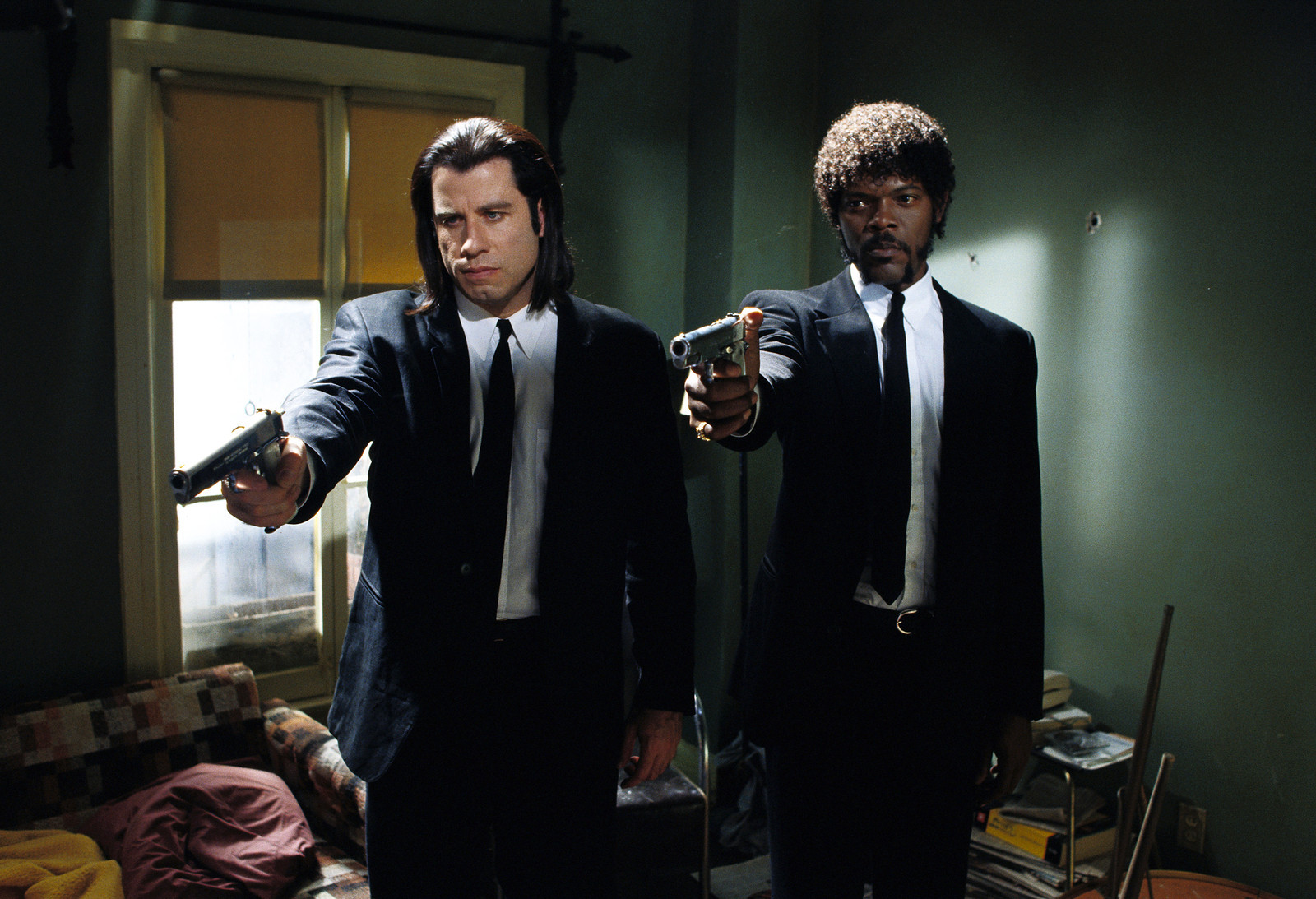
Dr. King worked in a media violence research field prior to conducting this study. While working on media violence, she then took a course to elaborate on humor theory. The similarities between the two intrigued her enough that she combined the two during this study. During this time, however, there were movies coming out such as Pulp Fiction, and one liner Arnold Schwarzenegger movies where violence was at the forefront, but humor was a close second. Dr. King decided to research the effects that humor plays in these violent, and sometimes grotesque, action films. King goes on to describe how her curiosity was what attracted her to the topic and how presenting this to some of her classes gives students an understanding of the commitment, curiosity, and thinking process one must have as a research professional.
Pulp Fiction (1994)
Dr. King describes how the background information is based on what we already know. Reviewing articles, other studies, and using key information to obtain a plethora of knowledge and information as the cornerstone of your research. King describes how you may already find an answer to a question you’re thinking about using as a hypothesis altogether and your understanding of the question at hand may be resolved before starting. By using this information to your advantage, you can refine and redetermine your hypothesis in a more quality manner. King studied how humor and violence wasn’t a new theory and that her previous knowledge on the topics had been short stemmed. Learning to love the process of examining an entire history of feelings and emotions among certain aspects of life. Designing a study that is well rounded is key and the goal of all researchers and publishers. Then having others review your research and study and giving you very helpful feedback, even about information that you may have already seen and adapted into your study. King compares her study to mystery movies and foreshadowing. A good mystery movie will leave you at the end looking back and saying you already had the answers, and you just had to finish the movie to see it. A bad mystery movie will leave you with open ended questions that have no result from the movie itself. The study should come to an answer at the end, whether it is negative or positive, but it shouldn’t end in more questions.
Dr. King states that her study was completely experimental, which allowed her to manipulate whichever part of the process she’d like. A survey, King says, is really only correlational, and cannot create causality. Taking films and editing the movie to have no humor at all allows for the manipulation in her survey, which resulted in varying answers for her study. The main difference between the control groups was that each viewed a different version of the same movie because of the editing. One control group viewed a movie which had been edited to show no humor for the hero, another was edited to show no humor for the villain. These manipulations created vast differences in the outcomes of how the viewer interpreted the film. In the bigger picture, the study aims to show what the effects on society may be, and that maybe violence mixed with humor can desensitize something that is wrong or not seen in everyday life. The true test of the experiment came after the movie when Dr. King had the control groups watch short videos of actual violence. King played two videos, one of the show Cops, where a squad car pulls up to two men in a violent altercation, and another video from Face of Death, a video compilation of people being hurt or hurting themselves.
Terminator 2: Judgement Day 1991
Villain humor made the movie more distressing for all viewers, and hero humor made the movie less distressing only for men. Women still had the distressing factor to the movie based on the perception of the movie. Also, finding a film that not everyone had seen was key to the experiment, because bias did not want to be included if participants had viewed a film before. The implication of using humor in violence actually may have worked better because it can make people view it in a more materialistic view. The idea that humorous cues in violent films indicates that whatever is being watched is “just a movie” and not reality allowed audiences to enjoy and appreciate the films.. The second aspect of the study showcases actual violence, but without any humor at all, because it is real life. Without humorous cues to precede the violence, audience reactions were different than expected. Being able to decipher the media research that happens and the effects it can have on populations was of utmost importance.
At the time the experiment was conducted, technology and programs were still in their infancy, so paper and pencil were the instruments used. While inputting the results and coding the participants to have statistical analysis is difficult, it used to be much harder due to the lack of technology at the time. The brainstorming and designing of the study will take much more time to prepare then actually putting it into action.
In Dr. King’s experience with film editing, it became much harder to actually learn a completely different skill just to be able to conduct a study. Without the technology to “point and click”, it was tedious and difficult and the study took quite some time to complete in full. In total, the experiment took one year from start to finish. Dr. King states she had a great, sometimes frustrating, experience. King found a new love for video editing, considering she had never edited film before. King also had to build her own code to gather the statistics. It was an experience that allowed her to grow as a person, instructor, and doctor.
If one is to take anything from this interview, it should be that perseverance and understanding should be at the forefront of one’s goals during an experiment. There will be times when one cannot fathom moving forward, finishing a task, gathering the right partners, or building an experiment…but if the motivation and determination is there, one can endure. Create, learn, and share. That is the true nature of experimentation.
Dr. Bey-Ling Sha, Dean of the College of Communications at CSUF.
“Public relations is about sharing the right information to the right people at the right places and times–to build a brand reputation into a specific image”.








 The Society for Communications Research